
AI
Amazon, OpenAI, and the $10 Billion AI Power Shift: How a New Wave of Investment Is Rewriting the Future of Tech


A deep dive into Amazon, OpenAI, and the $10B AI investment wave reshaping startups, big tech competition, and the future of artificial intelligence.
The AI Investment Earthquake No One Can Ignore
Every few years, the tech world experiences a moment that permanently shifts the landscape — a moment when capital, innovation, and ambition collide so forcefully that the ripple effects reshape entire industries.
2025 delivered one of those moments. 2026 is where the aftershocks begin.
Between Amazon’s aggressive AI expansion, OpenAI’s escalating influence, and a global surge of $10 billion‑plus investments into next‑gen artificial intelligence, the world is witnessing a new kind of tech arms race. Not the cloud wars. Not the mobile wars. Not even the social media wars.
This is the AI supremacy war — and the stakes are higher than ever.
For startups, founders, investors, and operators, this isn’t just “ai news.” This is the blueprint for the next decade of opportunity.
And if you’re building anything in tech, this story matters more than you think.
The New AI Power Triangle: Amazon, OpenAI, and the Capital Flood
Amazon’s AI Ambition: From Cloud King to Intelligence Empire
Amazon has always played the long game. AWS dominated cloud. Prime dominated logistics. Alexa dominated voice.
But 2026 marks a new chapter: Amazon wants to dominate intelligence itself.
The company’s recent multi‑billion‑dollar AI investments — including infrastructure, model training, and strategic partnerships — signal a clear message:
Amazon doesn’t just want to compete with OpenAI. Amazon wants to become the operating system of AI.
From custom silicon to foundation models to enterprise AI tools, Amazon is building a vertically integrated AI stack that startups will rely on for years.
Why this matters for startups
- Cheaper, faster AI compute
- More accessible model‑training tools
- Enterprise‑grade AI infrastructure
- A growing ecosystem of AI‑native services
If AWS shaped the last decade of startups, Amazon’s AI stack will shape the next one.
OpenAI: The Relentless Pace‑Setter
OpenAI remains the gravitational center of the AI universe. Every product launch, every model upgrade, every partnership — it all sends shockwaves across the industry.
But what’s different now is the scale of investment behind OpenAI’s ambitions.
With billions flowing into model development, safety research, and global expansion, OpenAI is no longer a research lab. It’s a geopolitical force.

OpenAI’s influence in 2026
- Sets the pace for AI innovation
- Shapes global regulation conversations
- Defines the capabilities startups build on
- Drives the evolution of AI‑powered work
Whether you’re building a SaaS tool, a marketplace, a fintech product, or a consumer app, OpenAI’s roadmap affects your roadmap.
The $10 Billion Dollar Question: Why Is AI Attracting Record Investment?
The number isn’t symbolic. It’s strategic.
Across the US, UK, EU, and Asia, governments and private investors are pouring $10 billion‑plus into AI infrastructure, safety, chips, and model development.
The drivers behind the investment wave
- AI is becoming a national security priority
- Big tech is racing to build proprietary models
- Startups are proving AI monetization is real
- Enterprise adoption is accelerating
- AI infrastructure is the new oil
This isn’t hype. This is the industrialization of intelligence.
The Market Impact: A New Era of Tech Investment
1. AI Is Becoming the Default Layer of Every Startup
In 2010, every startup needed a website. In 2015, every startup needed an app. In 2020, every startup needed a cloud strategy.
In 2026?
Every startup needs an AI strategy — or it won’t survive.
AI is no longer a feature. It’s the foundation.
Examples of AI‑first startup models
- AI‑powered legal assistants
- Autonomous customer support
- Predictive analytics for finance
- AI‑generated content engines
- Automated supply chain optimization
- Personalized learning platforms
The startups winning funding today are the ones treating AI as the core engine, not the add‑on.
2. Big Tech Competition Is Fueling Innovation
Amazon, Google, Microsoft, Meta, and OpenAI are locked in a race that benefits one group more than anyone else:
Founders.
Competition drives:
- Lower compute costs
- Faster model improvements
- More developer tools
- More open‑source innovation
- More funding opportunities
When giants fight, startups grow.
3. AI Infrastructure Is the New Gold Rush
Investors aren’t just funding apps. They’re funding the picks and shovels.
High‑growth investment areas
- AI chips
- Data centers
- Model training platforms
- Vector databases
- AI security
- Synthetic data generation
If you’re building anything that helps companies train, deploy, or scale AI — you’re in the hottest market of 2026.
Why This Matters for Startups: The Opportunity Map
1. The Barriers to Entry Are Falling
Thanks to Amazon, OpenAI, and open‑source communities, startups can now:
- Build AI products without massive capital
- Train models without specialized hardware
- Deploy AI features in days, not months
- Access enterprise‑grade tools at startup‑friendly prices
This levels the playing field in a way we haven’t seen since the early cloud era.
2. Investors Are Prioritizing AI‑Native Startups
VCs aren’t just “interested” in AI. They’re restructuring their entire portfolios around it.
What investors want in 2026
- AI‑native business models
- Clear data advantages
- Strong defensibility
- Real‑world use cases
- Scalable infrastructure
If you’re raising capital, aligning your pitch with the AI investment wave is no longer optional.
3. AI Is Creating New Categories of Startups
Entire industries are being rewritten.
Emerging AI‑driven sectors
- Autonomous commerce
- AI‑powered healthcare diagnostics
- AI‑driven logistics
- Intelligent cybersecurity
- AI‑enhanced education
- Synthetic media and entertainment
The next unicorns will come from categories that didn’t exist five years ago.
The Competitive Landscape: Who Wins the AI Race?
Amazon’s Strengths
- Massive cloud dominance
- Custom AI chips
- Global distribution
- Enterprise trust
OpenAI’s Strengths
- Fastest innovation cycles
- Best‑in‑class models
- Strong developer ecosystem
- Cultural influence
Startups’ Strengths
- Speed
- Focus
- Agility
- Ability to innovate without bureaucracy
The real winners? Startups that build on top of the giants — without becoming dependent on them.
Future Predictions: What 2026–2030 Will Look Like
1. AI Will Become a Regulated Industry
Expect global standards, safety protocols, and compliance frameworks.
2. AI‑powered work will replace traditional workflows
Not jobs — workflows. Humans will supervise, not execute.
3. AI infrastructure will become a trillion‑dollar market
Chips, data centers, and training platforms will explode in value.
4. The next wave of unicorns will be AI‑native
Not AI‑enabled — AI‑native.
5. The UK will become a major AI hub
Thanks to government support, talent density, and startup momentum.
FAQ (Optimized for Google’s Answer Engine)
1. Why are companies investing $10 billion in AI?
Because AI is becoming critical infrastructure — powering automation, intelligence, and national competitiveness.
2. How does Amazon’s AI strategy affect startups?
It lowers compute costs, accelerates development, and provides enterprise‑grade tools to early‑stage founders.
3. Is OpenAI still leading the AI race?
OpenAI remains a pace‑setter, but Amazon, Google, and open‑source communities are closing the gap.
4. What AI sectors will grow the fastest by 2030?
AI chips, healthcare AI, autonomous logistics, cybersecurity, and synthetic media.
5. Should startups pivot to AI‑native models?
Yes — AI‑native startups attract more funding, scale faster, and build stronger defensibility.
Conclusion: The Future Belongs to the Builders
The AI revolution isn’t coming. It’s here — funded, accelerated, and industrialized.
Amazon is building the infrastructure. OpenAI is building the intelligence. Investors are pouring billions into the ecosystem.
The only question left is: What will you build on top of it?
For founders, operators, and investors, 2026 is the year to move — boldly, intelligently, and with AI at the center of your strategy.
Because the next decade of innovation belongs to those who understand one truth:
AI isn’t the future of tech. AI is tech.
Discover more from Startups Pro,Inc
Subscribe to get the latest posts sent to your email.


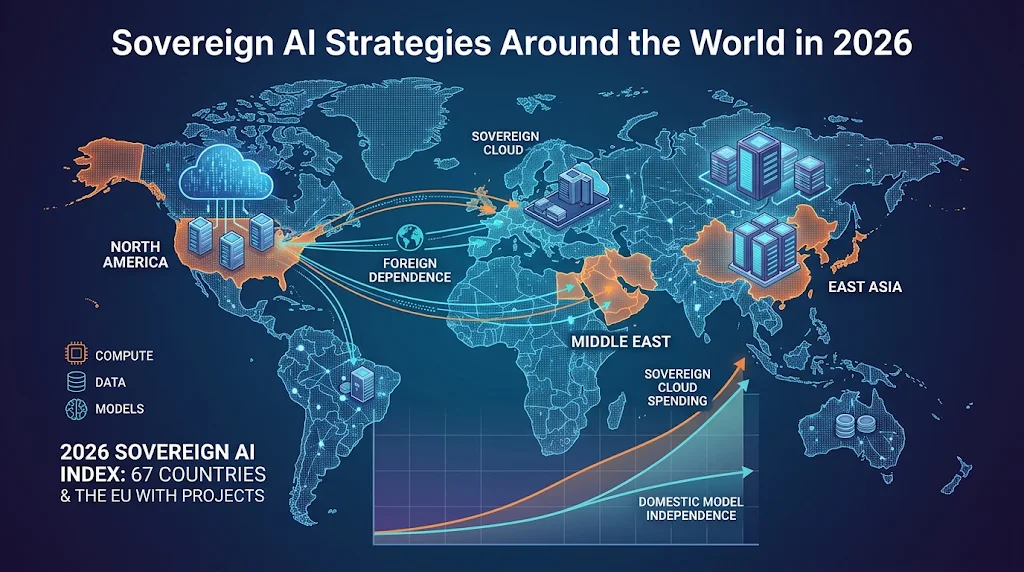
Governments are spending heavily to build domestic AI capacity, from data centers and compute clusters to national language models. The Center for a New American Security’s Sovereign AI Index tracked 67 countries and the European Union with projects by mid-2026, and it found that most of the disclosed investment is concentrated in the Middle East and East Asia. The core tension is that most sovereign projects still rely on American or foreign technology providers.
Key Takeaways
- The CNAS Sovereign AI Index counted 67 countries and the European Union with sovereign AI projects by mid-2026, according to its August 2026 update.
- The Middle East and East Asia account for more than 80% of tracked, publicly disclosed sovereign AI investment, per the CNAS index.
- Infrastructure now dominates new projects: about 80% of projects launched in the first half of 2026 focused on infrastructure, up from 62% in the prior six months.
- Gartner expects China and North America to lead sovereign cloud infrastructure spending in 2026, at roughly $47 billion and $16 billion, respectively, and Europe to surpass North America in 2027.
- Most sovereign projects still depend heavily on foreign providers, often American ones, which limits the autonomy they promise.
What Sovereign AI Means
There is no single definition, which complicates comparisons. The CNAS index treats a sovereign AI project as a government-backed initiative tied to national strategic interests and backed by material public investment in domestic capabilities. Other analysts use the term more broadly to include regulatory control, data localization, and domestic model development.
In practice, governments pursue three layers of capability:
- Compute: data centers, GPUs, and sovereign cloud platforms
- Data: national datasets for training and public-sector use
- Models: domestic foundation models, often tuned to local languages and laws
According to the CNAS index, compute and infrastructure dominate, while data projects remain the smallest category, accounting for about 5% of new projects in the first half of 2026.
Who Is Spending
Spending is highly concentrated. The CNAS index reports that about 40% of tracked countries back only a single project, and that a few large national commitments account for much of the total.
Several examples illustrate scale:
- India: Adani Group announced plans in February 2026 to invest $100 billion in sovereign AI infrastructure by 2035, which it said could contribute to a broader $250 billion ecosystem in the country, per BusinessToday. This is a private commitment, not a government budget figure.
- South Korea: Reports describe a 2026 national AI budget of about 9.9 trillion won, roughly $7.1 billion, across dozens of ministries. This figure comes from a secondary source, so confirm it against official government releases before publication.
- United States: The Stargate project, announced in January 2025 by OpenAI, SoftBank, and Oracle, has a stated commitment of $500 billion over four years. It is largely private rather than public investment.
- Gulf states: Investment in the Middle East is among the largest by disclosed value, per the CNAS index, which accounts for much of the regional concentration.
Stanford’s 2026 AI Index found that national AI strategies are expanding fastest among countries that had no formal AI policy five years ago, and that U.S. public investment in AI remains modest relative to private spending.
The Sovereignty Paradox
Most countries pursuing sovereign AI rely on foreign technology. The CNAS index found that foreign companies, overwhelmingly American, remain embedded in more than 170 national infrastructure and model projects. Many sovereign data centers run on U.S.-designed chips, use American cloud software, or depend on American model architectures.
This creates a paradox. Governments want independence from foreign dependence, yet building independent capability is expensive and slow. Gartner has warned that sovereign AI strategies could lock countries into region-specific platforms: it predicted in January 2026 that 35% of countries would be locked into such platforms by 2027, according to its press release. The paradox is that regional independence can create its own dependencies.
Gartner also projected that nations building a sovereign AI stack would need to spend at least 1% of GDP on AI infrastructure by 2029. For smaller economies, that is a significant commitment.
Sovereign Cloud Is the Fastest-Growing Piece
Sovereign cloud, which keeps data and processing within national borders under local control, is one of the clearest growth areas. Gartner projected 2026 sovereign cloud infrastructure-as-a-service spending of about $47 billion in China and $16 billion in North America, with Europe expected to surpass North America in 2027. The European shift reflects a move away from U.S.-based cloud providers, driven by regulatory and geopolitical concerns.
Why Some Countries Are Building Anyway
The motivations are mixed. Governments cite economic competitiveness, national security, data protection, and the desire to shape local AI use. Some want to retain talent and attract AI companies. Others want to avoid being dependent on a single supplier if export controls or geopolitics disrupt access to chips and cloud services.
Cost is the main limit. As one industry analysis put it, the level of investment required is beyond the reach of most countries, which creates an asymmetry in the global AI landscape. Many countries will rely on partnerships rather than fully independent stacks.
Trade-Offs and Risks
Sovereign strategies carry real trade-offs:
- Capability gap. Domestic models may trail frontier systems, requiring governments to accept lower performance for control.
- Duplication. Multiple countries building similar infrastructure can waste capital if utilization is low.
- Supplier dependence. Chips, networking, and software often come from a small set of firms, limiting independence.
- Energy and land. Like the data center backlash in the U.S., sovereign projects face power and local-approval constraints.
- Fiscal risk. Public money committed to AI infrastructure must compete with healthcare, education, and defense budgets.
What to Watch
- Whether sovereign projects shift from announcements to operating capacity, which CNAS identifies as a key test
- Growth in sub-national sovereign AI projects, which CNAS reports have risen rapidly in 2026
- European sovereign cloud procurement and any move away from U.S. providers
- Export control changes that could affect chip access for national projects
- Gartner and CNAS updates on sovereign spending and lock-in patterns
Frequently Asked Questions
What is sovereign AI? Sovereign AI refers to government-backed efforts to build or control AI infrastructure, data, and models within national borders, often to reduce dependence on foreign providers.
Which countries are leading? By disclosed investment, the Middle East and East Asia lead, according to the CNAS Sovereign AI Index. Specific country rankings depend on how projects are counted.
How much are countries spending on sovereign AI? Estimates vary widely depending on definition. Gartner projects sovereign cloud IaaS spending of about $47 billion in China and $16 billion in North America in 2026, while private commitments such as Adani’s $100 billion plan add to the total.
Do sovereign AI projects use American technology? Often, yes. The CNAS index found that foreign companies, mostly American, remain embedded in more than 170 projects.
Is sovereign AI a good investment for governments? It depends on the country. Costs are high, and returns depend on whether infrastructure is used productively. Governments that tie investment to local skills and research tend to get more value.
What is the risk of sovereign AI? Duplication, supplier dependence, underused capacity, and fiscal strain are the main risks. Some projects may also fall short of their stated independence goals.
Conclusion: Independence Is Expensive
Sovereign AI is becoming a central feature of global technology policy in 2026, but true independence is expensive and hard to achieve. Most countries are building compute with foreign components, and some will end up depending on new regional platforms. Readers should judge sovereign strategies by whether they deliver working capacity, skills, and reduced vulnerability, not just by announced totals.
Discover more from Startups Pro,Inc
Subscribe to get the latest posts sent to your email.
AI
PM Invites US-Based Pakistani Business Community to Invest in Pakistan as Investment Opportunities Expand

NEW YORK, September 24, 2026 — Prime Minister Muhammad Shehbaz Sharif has invited Pakistani business leaders and professionals based in the United States to invest in Pakistan, highlighting government measures aimed at improving the business environment and encouraging investment.
The invitation came during meetings with Pakistani-American business personalities and professionals working across information technology, artificial intelligence, automobiles, energy, construction and other sectors.
According to the Associated Press of Pakistan (APP), the prime minister said the government was working to create a conducive environment for investment and business activity. He also pointed to reforms at the Federal Board of Revenue (FBR) and measures intended to promote innovation in agriculture.
But the latest appeal to the Pakistani-American business community comes against a broader backdrop: Pakistan is seeking to attract more private investment, expand exports and turn improving macroeconomic conditions into sustained economic activity.
Why Pakistani-American Investors Are Being Targeted
The Pakistani diaspora represents an important source of capital, business expertise and international commercial connections.
Pakistan’s remittance flows demonstrate the economic significance of its overseas population. World Bank data show that Pakistan received approximately $40.48 billion in personal remittances in 2025, equivalent to around 9.9% of GDP.
The State Bank of Pakistan also reported workers’ remittances of approximately $3.66 billion in August 2026, with the monthly series showing substantial inflows throughout 2026.
Investment, however, differs from remittances: it involves deploying capital into businesses, projects or financial assets with the expectation of returns. That distinction makes the government’s effort to attract diaspora entrepreneurs particularly relevant.
IT and AI Among the Sectors in Focus
The technology sector is one of the most significant areas highlighted by the government.
The September 24 meeting included Pakistani-American professionals associated with IT and artificial intelligence, alongside representatives from traditional sectors such as automobiles, energy and construction.
Pakistan’s broader investment framework identifies services, including IT and telecommunications, as areas open to foreign investment. The Board of Investment says Pakistan maintains a liberal investment regime and has mechanisms designed to facilitate local and foreign investors.
For Pakistani-American technology entrepreneurs, potential areas include:
- Software and SaaS businesses
- Artificial intelligence
- IT-enabled services
- Fintech
- Digital infrastructure
- Business-process outsourcing
- Export-oriented technology companies
- Technology startups and venture investment
The attraction for diaspora entrepreneurs is not necessarily limited to providing capital. Entrepreneurs with operations in the United States can potentially bring technology, management expertise, international customers, investment networks and access to global markets.
Agriculture Is Another Priority
Agriculture was also specifically mentioned during the prime minister’s meetings.
APP reported that Shehbaz Sharif said the government was taking measures to promote innovation in agriculture.
That creates potential investment themes around:
- Agri-processing
- Agricultural technology
- Cold-chain infrastructure
- Food processing
- Irrigation technology
- Storage and logistics
- Export-oriented agriculture
- Livestock and dairy
- Farm mechanization
For investors, the distinction between producing agricultural commodities and investing in higher-value processing and supply-chain infrastructure can be particularly important because value-added businesses can connect domestic production with international markets.
What Pakistan’s Investment Framework Offers Foreign Investors
Pakistan’s Board of Investment states that the country follows a liberal investment regime and that its mandate includes promoting, encouraging and facilitating both local and foreign investment.
The Board’s investment information also states that foreign investors can have 100% equity ownership in many areas, although restrictions or specific rules apply to certain sectors.
The government’s Investment Policy 2023 also emphasizes investor protection, investment promotion and expanding Pakistan’s investment-promotion presence abroad, including in the United States.
That policy framework provides important context for the prime minister’s latest appeal to Pakistani-American businesses.
Pakistan Has Also Introduced a New Long-Term Residency Route for Investors
Another development relevant to international investors is Pakistan’s Long-Term Residency (LTR) framework.
According to the Board of Investment, the Foreigners (Long Term Residency) Order, 2025 created a residency-by-investment framework offering five-, seven- and ten-year residency options, subject to eligibility and investment requirements. The BOI says the minimum investment requirement is $50,000, to be materialized within one year through authorized banking channels.
The scheme is separate from the government’s broader investment-promotion policies, but it illustrates the effort to create additional mechanisms for attracting international capital and entrepreneurs.
The U.S.-Pakistan Economic Relationship Adds Another Layer
The appeal to Pakistani-American businesses also comes while economic engagement between Pakistan and the United States remains an important part of Pakistan’s external economic strategy.
In July 2026, Reuters reported that Pakistan had requested a proposed $10 billion U.S. exchange stabilization facility, while discussions were also taking place with U.S. financial institutions including the Export-Import Bank and the U.S. International Development Finance Corporation.
More recently, Reuters reported that Pakistan expected a decision from the United States on the proposed facility while continuing discussions with U.S. EXIM Bank and the Development Finance Corporation on potential projects.
These developments concern government-to-government and institutional financing rather than Pakistani-American private investment, but together they illustrate the wider economic relationship in which the latest business-community outreach is taking place.
What the Government Says About Investment Facilitation
Pakistan’s Board of Investment describes itself as the interface between international and domestic investors and the public and private sectors. Its investment regime information highlights measures intended to reduce the cost and procedural burden of doing business and to facilitate investment.
The government has also continued promoting the Special Investment Facilitation Council and other mechanisms intended to streamline investment processes.
For an investor considering Pakistan, however, the existence of an investment framework does not remove the need for sector-specific due diligence, regulatory approvals, taxation analysis, foreign-exchange considerations and commercial risk assessment.
What Pakistani-American Investors Should Examine Before Investing
The prime minister’s invitation is a political and economic call for greater investment, but prospective investors still need to evaluate individual opportunities on their own merits.
Key issues include:
1. Regulatory requirements
Investment rules differ according to the sector. The BOI notes that some industries are subject to specific restrictions or approvals.
2. Ownership structure
Foreign ownership can reach 100% in many sectors, but exceptions exist, making a sector-specific review necessary before establishing a company.
3. Profit and capital repatriation
Pakistan’s investment framework provides mechanisms for foreign investors to repatriate eligible profits, dividends and investment proceeds, subject to applicable foreign-exchange procedures.
4. Taxation
Investors should examine federal and provincial taxes, withholding obligations, customs duties and sector-specific incentives before committing capital.
5. Infrastructure and operating costs
An attractive investment proposition depends not only on headline incentives but also on electricity, logistics, labor, financing, connectivity and supply-chain costs.
6. Exit strategy
Investors should establish how capital can be repatriated, shares transferred and profits distributed before entering the market.
Pakistan’s Investment Push Extends Beyond the United States
The latest initiative is part of a wider effort to attract overseas Pakistani capital.
Earlier in September 2026, Economic Affairs Minister Ahad Cheema directed officials to develop a structured mechanism through which overseas Pakistanis could participate in viable infrastructure projects, including potential opportunities involving railways, highways, power, civic infrastructure and airports.
In July, Planning Minister Ahsan Iqbal also invited Pakistani-American entrepreneurs, technologists and financiers in Chicago to bring capital, expertise and global networks to Pakistan’s economic development.
This indicates that the September 24 appeal is not an isolated announcement but part of a broader government effort to engage overseas Pakistanis and international investors.
The Bigger Question: Can Investment Follow the Outreach?
The government’s challenge is to convert investment invitations into bankable projects and completed investments.
That requires more than announcements. Investors typically assess regulatory predictability, taxation, currency convertibility, infrastructure, security, financing costs, market size, contract enforcement and the ability to repatriate returns.
The U.S. State Department’s investment-climate assessment has previously identified challenges in Pakistan including regulatory complexity, intellectual-property concerns, changing taxation policies and security-related investor concerns. At the same time, it noted that U.S. companies operate profitably in several Pakistani sectors and that there are no restrictions specifically targeting U.S. investors.
That combination—investment opportunity alongside identifiable investment risks—is important context when assessing the latest government outreach.
What Comes Next for Pakistani-American Investment
Prime Minister Shehbaz Sharif’s September 24 appeal places Pakistani-American businesses at the center of Pakistan’s effort to attract additional investment.
The sectors discussed—AI, IT, energy, automobiles, construction and agriculture—cover both emerging technologies and established parts of the economy.
Pakistan’s investment framework, expanding diaspora-focused initiatives and continuing U.S.-Pakistan economic engagement could provide additional channels for investment. However, the eventual impact will depend on whether proposed opportunities develop into commercially viable projects and whether investors find the regulatory and economic environment sufficiently predictable.
For Pakistani-American entrepreneurs, the latest message from Islamabad is therefore straightforward: the government wants greater diaspora participation not only through remittances, but also through entrepreneurship, capital, technology and long-term investment.
Discover more from Startups Pro,Inc
Subscribe to get the latest posts sent to your email.

WASHINGTON — Newly disclosed federal financial records show that investment accounts belonging to President Donald Trump underwent an aggressive portfolio restructuring in July 2026, logging 1,156 individual securities transactions valued between $79 million and $270 million.
While headline attention has focused on multi-million-dollar sales of artificial intelligence and mega-cap tech leaders—including Microsoft, Amazon, and Meta Platforms—a comprehensive examination of the filings reveals a more complex strategy: a transition driven by automated index rebalancing, defensive fixed-income allocation, and concurrent dip-buying.
Executive Overview: July 2026 Disclosure Breakdown
According to analysis of official filings submitted to the U.S. Office of Government Ethics and reported by CNBC, total purchases across the eight managed accounts exceeded total sales.
| Category | Aggregate Value Range | Key Assets / Companies Involved |
| Total July Transactions | $79 Million – $270 Million | 1,156 total trades logged across 8 accounts |
| Total Purchases | $43.6 Million Minimum | Municipal bonds, short-term ETFs, Broadcom, Nvidia |
| Total Sales | $35.6 Million Minimum | Microsoft, Amazon, Oracle, Meta, Northrop Grumman |
| Primary Liquidation Event | July 20, 2026 | Multi-million dollar trims in $MSFT and$AMZN ($5M–$25M bracket each) |
| Quick Re-Entry Trades | July 23, 2026 | Modest buybacks in $MSFT ($100K–$250K) and$AMZN ($1K–$15K) |
Dissecting the Big Tech Trims: Algorithmic Rebalancing vs. Market Sentiment
The largest individual entries in the September filing occurred on July 20, 2026, when investment managers executed broad sell-offs in major cloud and AI infrastructure vendors.
As reported by Quartz, individual sell orders for Microsoft and Amazon each landed in the $5 million to $25 million filing bracket. Simultaneously, managers offloaded between $1 million and $5 million in Oracle stock, alongside position trims in Meta Platforms, Alphabet, and Nvidia.
However, reporting focused exclusively on liquidations misses the broader picture:
- Simultaneous Accumulation: On the very day managers sold Oracle, they added $500,000 to $1 million in Nvidia, while opening $1 million to $5 million positions in enterprise software giants like Salesforce, Intuit, and Marvell Technology.
- Immediate Re-entry: Just three days after the July 20 sell-off, the accounts repurchased positions in Microsoft ($100,001–$250,000 range) and Amazon ($1,001–$15,000 range).
- Fixed-Income Pivot: Significant capital was rotated into defensive yield assets, including the Vanguard Short-Term Bond Index ETF, State Street SPDR Bloomberg International Treasury Bond ETF, and local government bonds such as Miami-Dade County aviation paper.
Financial analysts noted in coverage by Livemint that these multi-directional trades mirror index-tracking models adjusting for market weightings rather than a deliberate directional bet on the tech sector.
White House Clarification: Automated Model Portfolios
Trading volume of this scale by a sitting U.S. president inevitably draws regulatory and public scrutiny. Addressing the disclosures, White House spokesperson Davis Ingle emphasized that the President maintains no personal involvement in daily trade execution.
“The President’s investment portfolio is managed by independent third-party financial institutions through automated model portfolios benchmarked to broad indices like the Schwab 1000,” White House officials stated. “Trading decisions are algorithmically executed without input, direction, or prior knowledge from the President or his family.”
Unlike past presidential administrations that placed assets into blind trusts or single-index mutual funds, the current arrangement relies on third-party wealth managers utilizing direct indexing models.
Regulatory Scrutiny and Geopolitical Overlap
Despite White House assurances, the timing of specific trades has drawn criticism from Capitol Hill.
On July 20, the same day managers sold $250,000 to $500,000 worth of defense contractor Northrop Grumman, President Trump signed an executive order tightening supply chain mandates for defense suppliers and restricting critical material sourcing from foreign nations.
According to government oversight documents cited by Bloomberg, congressional lawmakers—including Senator Elizabeth Warren—have submitted formal inquiries demanding full transparency regarding the identity of the third-party money managers overseeing the accounts to rule out insider conflicts of interest under U.S. Securities and Exchange Commission rules.
Key Takeaways for Market Observers
- Net Buyer Status: Despite headline sales in Big Tech, Trump’s accounts were overall net buyers in July, adding at least $43.6 million in assets.
- Broad Sector Diversification: Capital moved away from concentrated cloud computing mega-caps into short-duration fixed income, municipal bonds, and specialized semiconductor stocks.
- Systemic Model Management: The rapid buy-sell cycles (such as selling and repurchasing Microsoft within 72 hours) strongly align with algorithmic portfolio rebalancing rather than strategic macroeconomic forecasting.
Discover more from Startups Pro,Inc
Subscribe to get the latest posts sent to your email.

Sovereign AI Strategies Around the World in 2026

Nifty 50 Outlook: Why India Is Defying the Asian Tech Sell-Off

Why Is My Social Security Payment Late? What to Check Before Calling SSA

Bitcoin ETF Outflows: Has Institutional Demand Really Turned?

Xbox Nano Controller 2026: $49.99 Price, Features, November Release

PM Invites US-Based Pakistani Business Community to Invest in Pakistan as Investment Opportunities Expand

Trump Accounts Reshuffle Tens of Millions in Big Tech & AI Holdings

NIC Islamabad Launches Exclusive Acceleration Program with Up to PKR 5 Million Equity-Free Grant Support

World School Summit 2026 Malaysia: 41st Edition

Global Digital Trade Expo 2026: Dates, Schedule, Venue, Registration and Everything You Need to Know
Why Is My Social Security Payment Late? What to Check Before Calling SSA
Bitcoin ETF Outflows: Has Institutional Demand Really Turned?
Nifty 50 Outlook: Why India Is Defying the Asian Tech Sell-Off
Sovereign AI Strategies Around the World in 2026
-
Digital6 years ago
Social Media and polarization of society
-
Digital6 years ago
Pakistan Moves Closer to Train One Million Youth with Digital Skills
-
Digital6 years ago
Karachi-based digital bookkeeping startup, CreditBook raises $1.5 million in seed funding
-
Kashmir6 years ago
Pakistan Mission Islamabad Celebrates “KASHMIRI SOLIDARITY DAY “
-
Digital6 years ago
WHATSAPP Privacy Concerns Affecting Public Data -MOIT&T Pakistan
-
News6 years ago
Dr . Arif Alvi visits the National Museum of Pakistan, Karachi
-
China6 years ago
TIKTOK’s global growth and expansion : a bubble or reality ?
-
Business5 years ago
Are You Ready to Start Your Own Business? 7 Tips and Decision-Making Tools