
Blockchain
From Doubting Thomas to Bitcoin Believer: Michael Saylor’s Remarkable Transformation


The ever-shifting landscape of technology has rarely witnessed such a dramatic shift in perspective as the one experienced by Michael Saylor, the CEO of MicroStrategy. Just a decade ago, Saylor harbored significant doubts about Bitcoin, the nascent digital currency, fearing its potential demise due to the uncertain and evolving regulatory environment. He even tweeted in 2013, “Lacking a credible sponsor, #Bitcoin faces the imminent threat of being regulated out of existence.”
Fast forward to 2023, and we encounter an entirely different Saylor. He has transformed into a passionate and vocal champion of Bitcoin, spearheading MicroStrategy’s position as the undisputed global leader in corporate Bitcoin holdings. This remarkable change not only reflects a personal evolution but also serves as a testament to Bitcoin’s resilience and its potential to disrupt the established financial order.
The Seeds of Doubt: Saylor’s Initial Skepticism
Saylor’s initial skepticism towards Bitcoin in 2013 stemmed primarily from its nascent nature. Back then, Bitcoin was still in its infancy, struggling to gain widespread adoption and facing considerable regulatory hurdles. Concerns regarding its security, volatility, and lack of inherent value were widespread, particularly among traditional financial institutions.
However, even amidst this pervasive skepticism, Saylor’s entrepreneurial spirit allowed him to discern the potential inherent in Bitcoin’s decentralized and transparent nature. He envisioned it as a revolutionary technology with the power to completely transform the way we store and transfer value. As he delved deeper into its intricacies and the underlying blockchain infrastructure, his initial skepticism slowly faded, replaced by a burgeoning belief in its potential.
From Skepticism to Bold Action: Saylor’s Transformation
This burgeoning belief manifested in a series of audacious and decisive actions. In 2020, MicroStrategy made history by becoming the first publicly traded company to invest in Bitcoin. This groundbreaking decision acted as a catalyst, prompting other institutional investors to reconsider their stance towards cryptocurrency. Saylor’s unwavering support and MicroStrategy’s massive Bitcoin holdings served as a powerful endorsement, legitimizing Bitcoin and propelling it further into the mainstream financial sphere.
Beyond Finance: Saylor’s Vision for Bitcoin’s Impact
Saylor’s advocacy for Bitcoin extends far beyond the realm of finance. He envisions it as a powerful instrument for financial inclusion, empowering individuals in underserved communities to gain access to essential financial services and participate in the global economy. He further highlights Bitcoin’s potential to promote transparency and accountability within financial systems, challenging the status quo and paving the way for a more equitable and efficient financial ecosystem.
A Journey of Inspiration: Saylor’s Legacy in the Cryptosphere
Saylor’s remarkable journey from a doubter to a passionate advocate serves as a potent reminder of the transformative power of technology. It underscores the importance of open-mindedness and the willingness to challenge established norms in pursuit of innovative solutions. His unwavering faith in Bitcoin, despite initial doubts, has not only benefited his company but has also significantly contributed to the growth and recognition of a revolutionary technology with the potential to change the world.
While the future of Bitcoin remains uncertain, Michael Saylor’s remarkable transformation serves as a testament to its immense potential. His story offers valuable insights and inspiration for individuals and organizations alike, urging them to embrace change, challenge assumptions, and remain open to the transformative power of technology.
Discover more from Startups Pro,Inc
Subscribe to get the latest posts sent to your email.


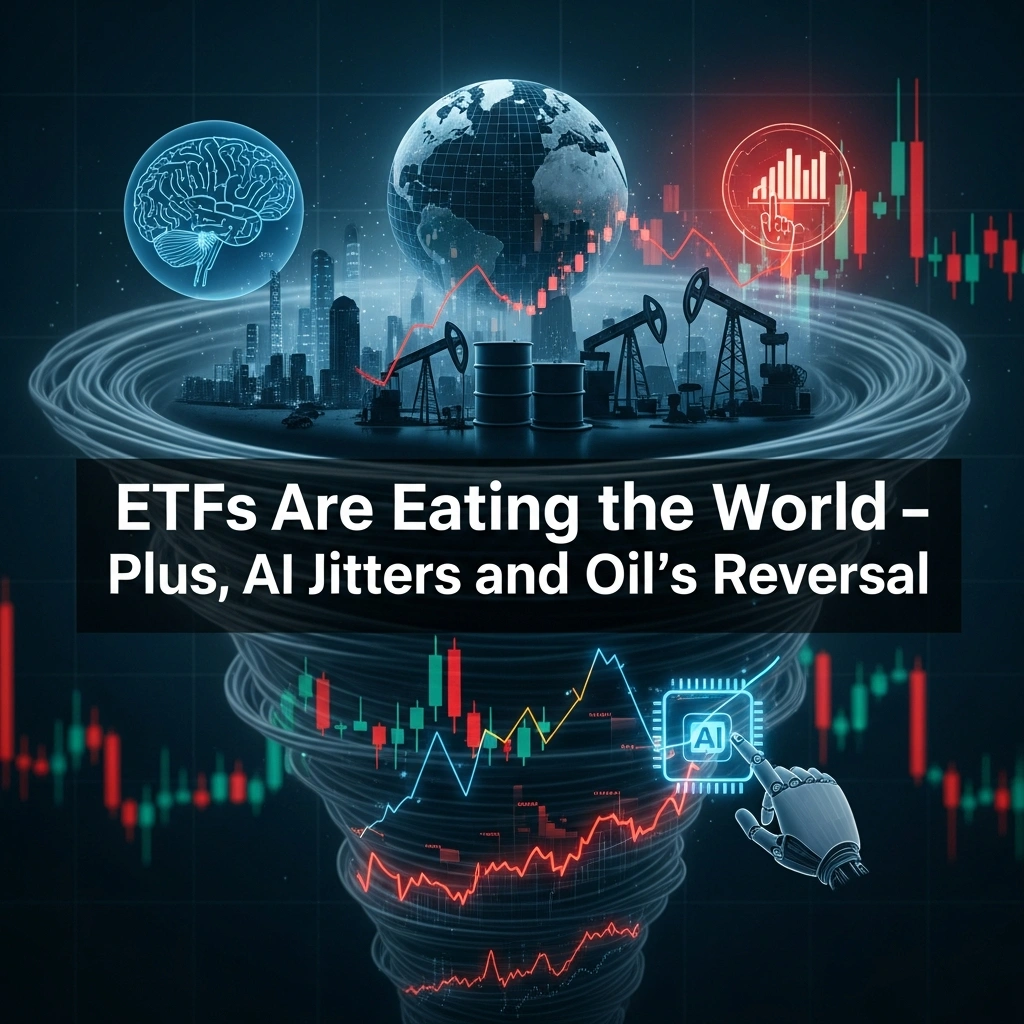
ETFs are reshaping markets as AI hype drives volatility and oil reversals hit energy. A political‑economy view of risk, power, and flows.
ETFs are “eating the world” because low‑cost indexing has pulled vast amounts of capital into a small set of benchmarks, concentrating ownership and flows. AI‑fueled swings intensify crowding in tech, while oil’s reversal exposes how passive portfolios can lag real‑economy shifts and geopolitics.
Key Takeaways
- ETFs made investing cheaper and easier—but they also concentrate flows, power, and price discovery in a handful of indexes and providers.
- AI‑driven enthusiasm creates crowding risk inside passive vehicles, amplifying both rallies and selloffs.
- Oil’s reversal shows the blind spot of broad indexing: real‑economy shocks can move faster than passive portfolios.
- Regulators see the plumbing risks, but policy still lags the market reality.
- Investors need to understand the political economy of indexing, not just its fees.
The Hook: A Market Built for Speed, Not Reflection
Picture a day when the market opens with a jolt: an AI‑themed mega‑cap sells off on a single earnings comment, energy stocks surge on an OPEC headline, and most retail portfolios barely blink—because the flows are pre‑programmed. That’s the new normal. ETFs have turned markets into a high‑speed logistics network where money moves with incredible efficiency, but not always with great wisdom.
This is the core paradox: ETFs are eating the world, yet the world they’re eating is becoming more concentrated, more narrative‑driven, and more sensitive to macro shocks. The political economy angle matters here—because when capital becomes more passive, power becomes more centralized.
1) ETFs Are Eating the World—And It’s Not Just About Fees
ETFs won because they made investing easy: low costs, intraday liquidity, diversification in one click. The U.S. SEC’s ETF rulemaking in 2019 standardized and accelerated ETF growth by making it easier to launch and operate funds, effectively industrializing the format’s expansion (SEC Rule 6c‑11). Add zero‑commission trading and mobile brokerages, and the ETF wrapper became the market’s default delivery system.
But the bigger story is market structure. When indexing dominates, the market stops being a collection of independent price judgments and starts behaving like an ecosystem of shared pipes. The evidence is in decades of data on active manager underperformance: the persistence of indexing’s edge has been documented by S&P Dow Jones Indices’ SPIVA reports, which track active‑vs‑index outcomes across asset classes and regions (SPIVA Scorecards). As more capital goes passive, the marginal price setter becomes thinner.

The Power Shift You Don’t See in Your Brokerage App
Every ETF is a wrapper around an index. That means index providers and mega‑asset managers now sit at the center of capital allocation. Methodology choices—what gets included, what gets excluded, how often rebalanced—are no longer small technical details; they are de facto policy decisions. Index providers publish their methodologies and governance processes, but their influence has outgrown their public visibility (S&P Dow Jones Indices Methodology, MSCI Index Methodology Hub).
The political economy question is straightforward: who governs the gatekeepers? When a handful of index decisions can redirect billions overnight, “neutral” becomes a powerful political claim—one that deserves scrutiny.
2) Market Plumbing: When the Wrapper Becomes the Market
ETF liquidity is often secondary‑market liquidity—trading of ETF shares between investors. But the primary market (where new shares are created or redeemed via authorized participants) is what keeps the ETF aligned with its underlying holdings. This is sophisticated plumbing that works beautifully—until it doesn’t.
Regulators have flagged the risks of liquidity mismatch and stress dynamics in market‑based finance. The IMF’s Global Financial Stability Reports have repeatedly examined how investment funds can amplify shocks through redemptions and market depth constraints (IMF Global Financial Stability Report). The BIS Quarterly Review has also analyzed how ETFs can transmit stress across markets when liquidity in underlying assets dries up (BIS Quarterly Review).
This doesn’t mean ETFs are fragile by default. It means ETF stability is conditional—on underlying liquidity, dealer balance sheets, and the health of market‑making infrastructure. That’s a systemic issue, not an investor‑education footnote.
3) AI Jitters: Narrative Crowding Meets Passive Plumbing
AI is a genuine technological shift—but the market’s response has a familiar shape: concentration, hype cycles, and correlation spikes.
As AI narratives accelerate, money tends to flow into the same handful of mega‑cap names and thematic ETFs. That can create a feedback loop: flows drive prices, prices validate the narrative, and the narrative attracts more flows. Research institutions and regulators have emphasized how valuation sensitivity and concentrated exposures can heighten market vulnerability, especially when expectations outrun fundamentals (Federal Reserve Financial Stability Report).
The irony? Passive investing is supposed to diversify risk. But when the market’s capitalization itself is concentrated, indexing becomes a lever that amplifies concentration. Index providers track and publish concentration metrics, but the shift is structural: if the index is top‑heavy, the index fund is top‑heavy.
Morningstar’s fund flow research highlights how investor demand often clusters in the same categories at the same time—precisely the behavior that can exacerbate crowding in narrative‑driven sectors (Morningstar Fund Flows Research). In an AI‑fueled cycle, this means the same ETF wrapper that democratized access can also democratize risk.
4) Oil’s Reversal: The Old Economy Bites Back
While AI dominates headlines, oil reminds us that real‑world supply and geopolitics still run the table. When oil reverses—whether due to OPEC decisions, demand surprises, or geopolitical shocks—sector weights and macro assumptions change faster than broad passive portfolios can adapt.
The most credible real‑time oil data comes from institutions that track physical balances and policy developments. The International Energy Agency’s Oil Market Report, the U.S. EIA’s Short‑Term Energy Outlook, and OPEC’s Monthly Oil Market Report provide the market’s core macro narrative (IEA Oil Market Report, EIA Short‑Term Energy Outlook, OPEC MOMR).
Now connect that to ETFs: broad‑market indexes rebalance slowly, while sector ETFs can swing on a dime. If oil’s reversal signals a structural shift—say, prolonged supply constraints or a geopolitical premium—passive portfolios are late to the party by design. In the meantime, ESG‑tilted portfolios may under‑ or over‑expose investors to energy at precisely the wrong time, a tension widely discussed in responsible‑investment circles (UN‑supported PRI).
Oil’s reversal isn’t just a commodity story. It’s a governance and allocation story—about how passive capital interacts with geopolitics, energy policy, and the physical economy.
5) The Political Economy of Passive Power
ETFs feel apolitical because they’re built on formulas. But formulas are choices, and choices accumulate power. When a few providers and index committees control the rules, the market’s “neutrality” becomes a governance issue.
Concentration of Ownership and Voting
Large asset managers now represent substantial voting power across public companies—a fact regulators and policy analysts have debated extensively. The SEC’s resources on proxy voting and fund stewardship underscore the governance significance of fund voting policies (SEC Proxy Voting Spotlight). The OECD’s corporate governance work also highlights how ownership structures influence accountability and long‑term capital allocation (OECD Corporate Governance).
The result is a paradox: indexing reduces fees, but concentrates influence. That influence is often exercised behind closed doors via stewardship teams, policy statements, and index inclusion decisions.
Regulatory Lag
Central banks and financial authorities increasingly focus on market‑based finance and nonbank intermediation. Yet ETF‑specific regulation still looks incremental compared with the speed of market evolution. The IMF and BIS acknowledge these dynamics, but the policy response remains cautious—partly because ETFs have also delivered undeniable investor benefits (IMF GFSR, BIS Annual Economic Report).
In short: we have system‑level dependence on a structure whose governance remains diffuse.
6) What This Means for Investors, Policymakers, and Markets
For long‑term investors
- Know what you own: broad ETFs are only as diversified as the underlying index. If the index is top‑heavy, your portfolio is too.
- Understand liquidity layers: ETF trading liquidity can mask underlying asset illiquidity during stress.
- Treat thematic ETFs as tactical: AI‑focused ETFs can be useful, but they behave like crowded trades, not balanced portfolios.
For policymakers
- Index governance deserves visibility: transparency in methodology changes, inclusion criteria, and stewardship votes matters.
- Stress‑test the plumbing: market‑making capacity and authorized participant resilience should be policy priorities.
- Don’t confuse access with resilience: ETFs democratize investing, but democratization can also democratize systemic risk.
For institutions
- Scenario‑test the narrative: what if AI expectations compress sharply? What if oil flips the inflation story?
- Use active risk where it matters: passive core can coexist with active hedges or sector rotations.
- Engage stewardship intentionally: if you own the market, you own its outcomes.
7) Three Scenarios to Watch
- Crowding unwind: AI‑exposed indexes and ETFs face synchronized selling, revealing liquidity gaps.
- Oil regime shift: a sustained energy price reversal reshapes inflation expectations and sector leadership, forcing passive reweighting.
- Regulatory recalibration: a policy move on ETF transparency or index governance changes the economics of passive flows.
None of these scenarios are destiny—but all are plausible.
Conclusion: Convenience Won. Power Concentrated.
ETFs didn’t just win on price—they won on architecture. They are the pipes through which modern capital flows. But when the pipes grow large enough, they shape the city.
AI jitters and oil’s reversal are not separate stories. They are stress tests for a market that now relies on passive plumbing to allocate active realities. The promise of ETFs was democratization; the risk is centralization without accountability.
The real question isn’t whether ETFs are “good” or “bad.” It’s whether we’re willing to govern the system they’ve become. Because in a world where ETFs are eating the world, the rules of the dinner table matter more than the menu.
Discover more from Startups Pro,Inc
Subscribe to get the latest posts sent to your email.
Discover the 10 payment solutions driving startup success in 2025. Expert analysis backed by market data on Stripe, embedded finance, stablecoins, and strategic infrastructure choices.
The payment stack has quietly become the most critical competitive advantage for startups—and most founders are getting it catastrophically wrong.
When Stripe processed its trillionth dollar in transactions last year, something fundamental shifted in the startup ecosystem. Payment infrastructure stopped being back-office plumbing and became the strategic moat separating winners from also-rans. Today, 45% of U.S. e-commerce businesses now use Stripe as their primary processor, yet this represents just the tip of a far more profound transformation reshaping how startups handle money.
The numbers tell a compelling story: the embedded finance market exploded to $146.17 billion in 2025, racing toward $690 billion by 2030 at a staggering 36.4% compound annual growth rate.
Cross-border payment flows are projected to hit $222.1 billion by year-end. Meanwhile, payment fraud losses surpassed $40 billion globally, making security not just a feature but a survival imperative.
After spending fifteen years covering fintech evolution—from the pre-mobile payment Stone Age through today’s AI-powered settlement networks—I’ve watched countless startups either soar or stall based entirely on their payment infrastructure choices. The difference between a $10 million Series A and a failed fundraise often comes down to one question: Can you collect money efficiently, globally, and profitably?
Here’s my definitive analysis of the ten payment solutions actually moving the needle for startups in 2025, backed by data, real-world performance metrics, and hard-earned strategic insights.
Why Payment Infrastructure Became Your Most Important Hire
Three seismic shifts have elevated payment systems from commodity to competitive weapon:
The Embedded Finance Explosion: Financial services are no longer separate from product experiences. Shopify evolved from e-commerce platform to comprehensive business operating system by embedding payments, loans, and banking. The result? Over 50% of North American independent software vendors now offer embedded payments directly in their platforms, driving both revenue and retention through the roof.
The Compliance Cost Crisis: Payment fraud detection alone costs businesses billions annually, with 71% of companies reporting payment fraud attacks in 2023. Regulatory complexity—from PSD2 in Europe to evolving AML directives globally—means 98% of financial institutions report rising compliance costs. Getting this wrong doesn’t just cost money; it kills companies.
The AI Revolution in Risk Assessment: Machine learning now processes over 500 million daily API requests for platforms like Stripe, enabling real-time fraud detection and personalized financial products. AI-driven credit scoring is opening markets previously deemed too risky, particularly in underserved segments like gig workers and emerging market SMEs.
The startups winning today aren’t just accepting payments—they’re using payment data to drive product decisions, using settlement speed as a retention tool, and turning transaction flows into predictive analytics that inform every business decision.
Top 10 Payment Solutions Defining the 2025 Landscape
1. Stripe Treasury – The Full-Stack Financial Operating System
What It Solves: Startups need more than payment processing—they need embedded banking that turns cash flow into strategic advantage.
Stripe’s market position speaks volumes: 17.15% global market share, processing $1.4 trillion in 2024 (up 40% year-over-year), with a valuation now recovered to $91.5 billion. But the real story is Stripe Treasury, which embeds banking-grade financial services directly into applications.
Key Capabilities:
- Bank accounts with FDIC insurance through partner banks
- Real-time payment tracking and automated reconciliation
- Built-in spend management and multi-currency support
- Developer-friendly APIs that reduce integration time from months to days
By The Numbers: Stripe now serves 1.35 million live websites globally, with 80% of America’s largest software companies using the platform. Processing volume increased 133% during the pandemic year alone, proving its scalability during crisis moments.
Strategic Application: A SaaS startup using Stripe Treasury cut their payment reconciliation time by 87% while adding same-day settlement for customers—turning a back-office function into a sales differentiator. The platform’s 99.999% uptime means financial operations literally never stop.
When To Choose This: You’re building a global-first product, need developer flexibility, and plan to embed financial services into your core offering. The 2.9% + 30¢ transaction fee becomes trivial when weighed against operational efficiency gains.
2. Adyen – Enterprise-Grade Unified Commerce Platform
What It Solves: Multi-channel commerce complexity and cross-border payment optimization at scale.
While Stripe dominates startups, Adyen owns enterprise adoption with a different philosophy: unified commerce across every channel and geography. Their single platform handles in-store, online, and mobile payments with consistent experience and consolidated data.
Key Features:
- 250+ payment methods across 150+ transaction currencies
- Real-time fraud prevention using machine learning across billions of transactions
- Network tokenization reducing payment failures by 2-5 percentage points
- Dynamic routing optimizing acceptance rates per transaction
Real-World Impact: Adyen’s AI-powered fraud prevention analyzes patterns across its entire network, meaning each merchant benefits from threat intelligence gathered from global transaction flows. This network effect becomes more valuable as the platform scales.
Strategic Consideration: Best for startups planning rapid international expansion or those in high-risk verticals needing sophisticated fraud tools. The platform supports 45 countries with local acquiring, essential for optimizing payment acceptance rates in diverse markets.
Market Position: Adyen’s focus on enterprise clients means higher barriers to entry but also more robust infrastructure for startups planning to scale quickly. Their embedded finance capabilities rival Stripe’s while offering stronger omnichannel support.
3. PayPal Complete Payments – The Trust Advantage
What It Solves: Consumer trust barriers and immediate credibility for new brands.
PayPal still commands 45% of the online payment processing market—more than double Stripe’s 17%. This isn’t just legacy; it’s strategic asset. Consumer trust remains the invisible conversion killer, and PayPal’s brand recognition removes that friction instantaneously.
The Data Story: PayPal’s acquisition of Honey (cashback rewards) and expansion of Venmo (peer-to-peer payments) creates an ecosystem play that goes far beyond transaction processing. They’re building embedded commerce experiences where payments, rewards, and social proof intertwine.
Key Advantages:
- Instant brand trust with consumers globally
- Buyer protection programs reducing purchase anxiety
- BNPL (Buy Now, Pay Later) capabilities through PayPal Pay Later
- Cryptocurrency transaction support for future-forward positioning
Use Case Reality: E-commerce startups consistently report 20-30% higher conversion rates when offering PayPal as a checkout option alongside card payments. The brand simply removes mental friction at the critical moment.
When It Makes Sense: Consumer-facing products where trust is paramount, or businesses targeting demographics with high PayPal adoption. The higher per-transaction fees (typically 3.49% + fixed fee) are offset by conversion lift and reduced cart abandonment.
4. Wise Business – Cross-Border Payment Specialist
What It Solves: The 5-10% cross-border payment tax killing global startup margins.
Traditional international payments are highway robbery—5-10% fees, 3-5 day settlement times, opaque exchange rates. Wise (formerly TransferWise) built a different model using multi-currency accounts and peer-to-peer matching that cuts costs by 80%.
The Wise Advantage:
- Real mid-market exchange rates without markup
- Multi-currency accounts with local bank details in 50+ countries
- API integration for automated international payroll and supplier payments
- Transparent, upfront fees typically 0.35-1% vs. 5-8% for traditional banks
Market Context: With cross-border payments projected to reach $222.1 billion in 2025, efficient international settlement becomes existential for globally distributed teams. Wise processes billions monthly while saving customers millions in hidden fees.
Real Application: A remote-first startup with contractors in 23 countries switched from traditional banks to Wise, cutting international payment costs by 73% while reducing settlement time from 5 days to 24 hours. The speed improvement alone reduced contractor churn by creating reliable payment schedules.
Strategic Fit: Essential for startups with international contractors, suppliers, or customers. The cost savings at scale often exceed what you’d save through aggressive vendor negotiation elsewhere in the stack.
5. Checkout.com – The Flexible Infrastructure Play
What It Solves: Payment orchestration for businesses needing ultimate flexibility and control.
Checkout.com’s approach differs fundamentally: rather than locking you into their ecosystem, they provide payment orchestration letting you route transactions across multiple processors while maintaining unified reporting and reconciliation.
Technical Sophistication:
- Dynamic routing across 12+ payment processors
- Local acquiring in 150+ currencies
- Advanced retry logic and cascading when primary processors fail
- Unified API abstracting processor complexity
Why This Matters: Payment processor outages cost e-commerce businesses $5,600 per minute on average. Checkout.com’s redundancy architecture means you’re never dependent on single processor uptime. More importantly, you can optimize for cost vs. acceptance rate on a transaction-by-transaction basis.
Performance Data: Businesses using intelligent routing see acceptance rate improvements of 3-7 percentage points—directly impacting revenue without changing anything about the product or marketing.
Ideal For: High-volume businesses where payment optimization becomes a meaningful profit center, or companies operating in emerging markets where payment landscape fragmentation demands flexibility.
6. Razorpay – The India-First Full-Stack Solution
What It Solves: India’s unique payment complexity and SME banking desert.
India’s digital payment explosion—UPI transactions grew from 920 million in 2017-18 to 83.75 billion in 2022-23 (147% CAGR)—created unique infrastructure needs. Razorpay became India’s only full-stack financial solutions company by understanding local market dynamics better than global players.
India-Specific Capabilities:
- Complete UPI integration and Bharat QR support
- Automated GST reconciliation (critical pain point)
- Localized payment methods (wallets, net banking, cards)
- First completely digital onboarding for startups
Market Position: Razorpay serves over 5,000 Indian establishments and has expanded internationally with Curlec by Razorpay in Malaysia, proving the model’s regional portability. They’re addressing India’s $45 billion embedded finance opportunity projected to grow at 45% CAGR.
Strategic Value: For startups targeting Indian consumers or operating in South Asian markets, local payment method support isn’t optional—it’s existential. Razorpay’s deeper integration with Indian banking rails provides acceptance rates global players simply cannot match.
When To Use: India market focus, need for local payment methods, or building for price-sensitive segments where transaction fees matter materially.
7. Stablecoin Payment Rails (BVNK, Rain, Noah) – The Future of B2B Settlements
What It Solves: The 2-5 day settlement lag and currency conversion costs crushing B2B cash flow.
The most profound shift in 2025 isn’t another payment API—it’s institutional embrace of stablecoin settlement infrastructure. Companies like BVNK, Rain, and Noah are building payment rails enabling instant, near-zero-cost cross-border transactions using USDC and other regulated stablecoins.
The Paradigm Shift: Traditional B2B payments take days and cost hundreds in fees. Stablecoin rails settle in seconds for dollars. This isn’t cryptocurrency speculation—it’s infrastructure replacement for an antiquated correspondent banking system.
Key Advantages:
- Near-instant settlement (seconds vs. days)
- Minimal transaction costs (pennies vs. percentages)
- 24/7/365 operation (no banking hours or holidays)
- Transparent, auditable settlement trails
Market Momentum: With regulatory tailwinds accelerating—Hong Kong’s stablecoin sandbox, Singapore’s dual-licensing framework—institutional adoption is exploding. Major banks now offer tokenized asset services, while platforms like RedotPay integrate crypto payments via Visa and Mastercard networks.
Real-World Case: A software company with global enterprise clients switched international invoicing to stablecoin rails, reducing payment processing time from 7-10 days to under 10 minutes while cutting forex fees by 95%. The cash flow acceleration alone improved their working capital position dramatically.
Consider This If: You handle significant B2B cross-border transactions, need instant settlement for operational reasons, or serve markets with banking infrastructure challenges. The regulatory landscape is maturing rapidly, making 2025 the inflection point for mainstream adoption.
8. Klarna – BNPL as Acquisition Channel
What It Solves: High-ticket purchase hesitation and conversion optimization for premium products.
Buy Now, Pay Later isn’t just about deferred payment—it’s a customer acquisition channel hiding in plain sight. Klarna’s 150 million global users actively seek out merchants offering their preferred payment method, creating organic discovery benefits beyond the transaction itself.
Strategic Value Proposition:
- 30-40% increase in average order value for participating merchants
- Access to Klarna’s active shopper marketplace
- Zero credit risk (Klarna assumes default risk)
- Younger demographic acquisition (75% of users under 40)
The Business Model: Klarna makes money from merchant fees (typically 2.49-3.29% + $0.30) while offering consumers interest-free installments. They’re betting on volume and merchant marketing value exceeding credit losses—a bet that’s working with their unicorn valuation.
Performance Metrics: E-commerce businesses report BNPL options increasing conversion rates by 20-30% and average cart value by 35-45%. The psychology is simple: breaking a $400 purchase into four $100 payments removes the pain of payment while maintaining product appeal.
Strategic Fit: Consumer products priced $100-$2,000 where purchase consideration is primary friction. Fashion, electronics, furniture, and experiences see highest impact. B2B startups have less application unless selling to SMEs with cash flow constraints.
Caution: BNPL creates customer expectations for flexibility across all purchases. Once offered, removing it often causes conversion rate drops. Treat it as permanent infrastructure, not temporary promotion.
9. Stripe Atlas + Mercury – The Complete Formation Stack
What It Solves: The international founder’s American incorporation and banking nightmare.
Building a U.S. company from abroad historically meant $5,000+ in legal fees, weeks of bureaucratic maze navigation, and banking relationships requiring physical presence. Stripe Atlas combined with Mercury banking collapses this to 48 hours and $500.
The Complete Package:
- Delaware C-Corp formation with IRS tax ID (EIN)
- U.S. bank account through Mercury (no physical presence required)
- Stripe payment processing pre-configured
- Stock certificate issuance and 83(b) election guidance
- $10,000 in partner discounts (AWS, Google Cloud, etc.)
Why This Matters: Over 140 countries now access this service, democratizing U.S. market entry for global founders. Mercury adds FDIC-insured banking, corporate cards, and automated bookkeeping—the complete financial operations stack for remote teams.
The Network Effect: More than 50,000 Atlas companies have been created, forming a global founder network. This community value often exceeds the direct service value, providing peer learning and partnership opportunities.
Real Impact: An Indian AI startup used Atlas + Mercury to incorporate and access U.S. payment rails within 72 hours, enabling them to charge enterprise customers immediately rather than waiting months for traditional incorporation. First customer revenue arrived within a week.
Perfect For: Non-U.S. founders targeting American customers, SaaS businesses needing U.S. entity structure for enterprise sales, or anyone wanting modern digital-first banking infrastructure. The combination costs roughly $500 setup + monthly fees but eliminates traditional formation complexity entirely.
10. Usage-Based Billing Platforms (Stripe Billing, Chargebee) – The SaaS Revenue Optimization Layer
What It Solves: Complex subscription management, failed payment recovery, and revenue leakage.
Every SaaS company loses 5-10% of revenue to failed payments, billing complexity, and churn. Specialized billing platforms don’t just process subscriptions—they’re revenue optimization engines preventing millions in leakage.
The Forrester Recognition: Stripe Billing was named Leader in both The Forrester Wave: Recurring Billing Solutions (Q1 2025) and by Gartner. This institutional validation matters because billing complexity scales exponentially with business model sophistication.
Core Capabilities:
- Dunning management (automated retry logic for failed payments)
- Usage-based billing and metering for consumption models
- Revenue recognition and accounting automation
- Multi-currency and tax compliance automation
- Subscription lifecycle management (upgrades, downgrades, pausing)
Financial Impact: Companies implementing sophisticated dunning recover 60-70% of failed payments that would otherwise be lost. For a $10M ARR SaaS company losing $500K annually to failed payments, that’s $300-350K recovered revenue.
The Stripe Billing Story: Stripe reports their billing suite is on track for $500 million annual run rate, up from essentially zero five years ago. This explosive growth reflects the massive pain point around subscription complexity, particularly for usage-based and hybrid models.
Strategic Application: A vertical SaaS company switched from homegrown billing to Stripe Billing, immediately recovering $180K in failed payments annually while reducing engineering time spent on billing logic by 80%. The freed engineering capacity went directly to product development.
When Essential: Any subscription or usage-based business model, particularly those with:
- Multiple pricing tiers and add-ons
- Usage-based components (API calls, storage, transactions)
- International customers requiring multi-currency
- Complex revenue recognition requirements
Trying to build this internally is classic founder trap—it always takes 10x longer and distracts from core product development.
The Strategic Framework: Choosing Your Payment Stack
Payment infrastructure selection isn’t one-size-fits-all. Here’s how to think about it by startup stage and profile:
Pre-Seed to Seed ($0-$2M Raised)
- Primary Goal: Speed to market and operational simplicity
- Recommended Stack: Stripe for payments + Mercury for banking + Wise for international
- Why: You need to prove product-market fit, not optimize payment operations. Stripe’s developer experience gets you live in days. Mercury handles banking basics. Wise solves international contractors.
- Cost Reality: You’ll pay higher percentage fees but save thousands in engineering time.
Series A ($2M-$10M Raised)
- Expansion Needs: International growth, specialized payment methods, beginning optimization
- Recommended Stack: Stripe or Adyen (depending on B2B vs. B2C) + specialized billing (Chargebee or Stripe Billing) + regional specialists as needed
- Strategic Additions: Consider Klarna for e-commerce, stablecoin rails for B2B international, Razorpay if India-focused
- Why: You’ve proven product-market fit and need infrastructure supporting scale. Payment optimization now materially impacts unit economics.
Series B+ ($10M+ Raised)
- Optimization Phase: Payment orchestration, multi-processor redundancy, data-driven routing
- Recommended Stack: Payment orchestration layer (Checkout.com) + multiple processors + specialized billing + AI-powered fraud prevention
- Focus Areas: Acceptance rate optimization (every percentage point matters at scale), fraud prevention ROI, settlement speed as competitive advantage
- Why: At high transaction volumes, payment infrastructure becomes profit center, not cost center.
Geography-Specific Considerations:
- India/South Asia: Razorpay is non-negotiable for local payment methods and regulatory compliance
- Global B2B: Stablecoin rails should be in pilot testing immediately—competitive advantage within 12 months
- Consumer E-commerce: PayPal + Klarna combination typically delivers best conversion rates
- Mobile-First: Ensure payment stack supports 62% of transactions now happening mobile (per 2025 data)
The Emerging Trends Reshaping 2025-2027
AI-Powered Underwriting at Point of Sale
Machine learning models now assess creditworthiness using real-time transaction data rather than static credit scores. This enables instant lending decisions embedded directly in checkout flows. Expect AI underwriting to unlock $15-20 billion in previously unqualified consumer lending by 2027.
Real-Time Payment Rails Go Mainstream
The Federal Reserve’s FedNow service joined instant payment networks globally. By late 2025, real-time settlement becomes baseline expectation rather than premium feature. This fundamentally changes working capital management for businesses.
Open Banking Transforms Data Access
PSD2 in Europe demonstrated how standardized APIs unlock innovation. Similar frameworks spreading globally mean payment platforms increasingly access banking data for better fraud detection, credit decisions, and personalized offers. The data advantage becomes the moat.
Regulatory Consolidation Around Stablecoins
Hong Kong’s sandbox, Singapore’s licensing framework, and U.S. regulatory clarity emerging in 2025 all point toward institutional-grade stablecoin infrastructure. This transforms cross-border payments from days/dollars to seconds/pennies. Companies building on this now win disproportionately.
Embedded Finance Becomes Universal
The $146 billion embedded finance market racing to $690 billion by 2030 isn’t hype—it’s infrastructure shift. Every SaaS platform will offer financial services within 5 years. Early movers in vertical-specific financial embedding are building unassailable competitive positions.
Payment Data as Product Input
Forward-thinking startups use payment data as product development intelligence. Transaction patterns reveal feature usage, churn signals, expansion opportunities, and market trends invisible in traditional analytics. Payment infrastructure becomes business intelligence layer.
The Hard Truth About Payment Infrastructure
After analyzing hundreds of startups over fifteen years, I’ve seen this pattern repeatedly: companies that treat payments as commodity typically plateau at $10-20M ARR. Companies that view payment infrastructure as strategic asset routinely scale past $100M.
The difference isn’t the technology—it’s the mindset. Payment infrastructure touches every customer interaction, reveals business health in real-time, and increasingly determines whether you can serve customers profitably across geographies.
Three questions reveal whether you’re thinking strategically about payments:
- Can your payment stack tell you which customer segments are most profitable BEFORE you do cohort analysis? If not, you’re missing real-time intelligence that should inform pricing and acquisition strategy.
- Does payment acceptance rate factor into your geographic expansion decisions? It should—entering a market where you can’t accept 85%+ of preferred payment methods is burning capital.
- Have you modeled how settlement speed impacts your cash conversion cycle? Two-day faster settlement can meaningfully improve working capital, especially for inventory businesses.
The startups winning in 2025 aren’t just choosing payment processors—they’re architecting financial infrastructure as core competitive advantage. They’re embedding banking services into products, using AI-powered fraud detection to enter riskier (but higher-margin) markets, and leveraging payment data for business intelligence.
The Bottom Line
Payment infrastructure stopped being back-office plumbing the moment Stripe processed its first trillion dollars. Today it’s the strategic moat separating market leaders from everyone else.
The ten solutions profiled here represent fundamentally different approaches to the same challenge: how do you collect money efficiently, globally, and profitably while creating customer experiences so seamless they become forgettable?
For pre-seed startups, the answer is speed to market—get live fast with Stripe and Mercury. For Series A companies, it’s strategic expansion—add specialized tools for your specific use case. For later-stage companies, it’s optimization—build payment orchestration that compounds competitive advantages.
But here’s what matters most: the payment landscape is consolidating around winners while simultaneously fragmenting around specialized solutions. You need both the simplified developer experience of platforms like Stripe AND the specialized capabilities of providers like Wise for international, Klarna for BNPL, or stablecoin rails for B2B.
The companies that will dominate the next decade are being built right now on payment infrastructure that didn’t exist five years ago. Embedded finance, AI underwriting, real-time settlement, and cryptocurrency rails are moving from experimental to essential. The question isn’t whether to adopt these technologies—it’s how quickly you can integrate them before competitors do.
The payment revolution is here. The only question left: Are you building on infrastructure that compounds your advantages or holds you back?
Discover more from Startups Pro,Inc
Subscribe to get the latest posts sent to your email.

Cryptocurrency Bitcoin faces sharp declines, with BTC-USD sliding amid fears of a crypto crash and investor sentiment turning cautious.
The cryptocurrency market is once again in turmoil, with Bitcoin (BTC) leading a sharp downturn that has rattled investors worldwide. As headlines ask “why is crypto crashing?” the Fear and Greed Index has plunged to levels not seen since the pandemic-era meltdown, underscoring the depth of anxiety across the sector. With BTC price USD slipping below key support levels, traders are questioning whether this marks a temporary correction or the start of a deeper bear cycle.
Fear and Greed Index Analysis
The Fear and Greed Index, a widely followed sentiment gauge, has dropped to 10 — extreme fear. This collapse reflects widespread panic selling, fueled by macroeconomic uncertainty, hawkish Federal Reserve signals, and rising Treasury yields. Historically, such extreme readings have coincided with heightened volatility and, in some cases, buying opportunities for long-term holders. Yet, for many retail investors, the index’s plunge is a stark reminder of crypto’s inherent risks.
Bitcoin Price Movements (BTC USD)
In recent sessions, BTC USD has fallen sharply, dipping below $86,000 before attempting to stabilize near $91,000–$96,000. The sell-off wiped out nearly $0.19 trillion in market value within 24 hours, with altcoins like Ethereum and Solana also suffering steep losses. Liquidations across leveraged positions exceeded $1 billion, amplifying the downward spiral.
Why Is Crypto Crashing?
Several factors explain why crypto is crashing:
- Macroeconomic pressures: Rising bond yields and Fed tightening have reduced appetite for risk assets.
- Regulatory uncertainty: Ongoing debates around crypto oversight in major markets have unsettled investors.
- Market structure: Heavy leverage and speculative trading magnify downturns, leading to cascading liquidations.
- Broader sentiment: With the stock market today also under pressure, correlations between equities and crypto have intensified, dragging digital assets lower.
Expert and Market Commentary
Analysts note that while short-term sentiment is bleak, long-term accumulation continues. Institutional players are quietly buying dips, betting on Bitcoin’s resilience as a store of value. However, retail investors remain cautious, with bitcoin news dominated by headlines about collapsing portfolios and vanishing trillions in market capitalisation.
Broader Market Context
The crypto crash has unfolded alongside turbulence in global equities. The stock market today reflects similar risk-off behaviour, with investors shifting toward safe-haven assets. This correlation highlights how the cryptocurrency bitcoin is increasingly tied to broader financial conditions, challenging the narrative of Bitcoin as a purely independent hedge.
Outlook: Bitcoin’s Path Ahead
Despite the current downturn, history suggests that extreme fear often precedes recovery. If BTC price USD can stabilise above key support levels, confidence may return. Yet, persistent macro headwinds mean volatility will remain elevated. For now, the Fear and Greed Index serves as both a warning and a potential contrarian signal: while many ask “why is bitcoin dropping?”, seasoned investors see opportunity in crisis.
Discover more from Startups Pro,Inc
Subscribe to get the latest posts sent to your email.

Top 10 Media Startup Ideas for Massive Success in 2026

Billionaire Enrique Razon Accelerates Energy Push With Colombia, Philippine Deals

Bangladesh Rations Fuel as Mideast War Deepens Energy Crisis

Virgin Atlantic’s Strategic Swoop: On Track to Lure Tens of Thousands from British Airways’ Frequent Flyer Fold

The Great Launch Rush: How China’s Rocket IPO Surge Is Reshaping the Global Space Race

The Top 10 Business and Tech Institutes in the USA for Aspiring Business Leaders in 2026

ETFs Are Eating the World: AI Jitters and Oil’s Reversal

The Future is Now: Top 10 UK Startups Defining 2026

Entrepreneurship Funding: From Venture Capital to Bootstrapping

FITUR 2026: US, Mexico, India, China, and Spain Lead Global Tourism
Bangladesh Rations Fuel as Mideast War Deepens Energy Crisis
Billionaire Enrique Razon Accelerates Energy Push With Colombia, Philippine Deals
Top 10 Media Startup Ideas for Massive Success in 2026
-
Digital5 years ago
Social Media and polarization of society
-
Digital5 years ago
Pakistan Moves Closer to Train One Million Youth with Digital Skills
-
Digital5 years ago
Karachi-based digital bookkeeping startup, CreditBook raises $1.5 million in seed funding
-
News5 years ago
Dr . Arif Alvi visits the National Museum of Pakistan, Karachi
-
Digital5 years ago
WHATSAPP Privacy Concerns Affecting Public Data -MOIT&T Pakistan
-
Kashmir5 years ago
Pakistan Mission Islamabad Celebrates “KASHMIRI SOLIDARITY DAY “
-
Business4 years ago
Are You Ready to Start Your Own Business? 7 Tips and Decision-Making Tools
-
China5 years ago
TIKTOK’s global growth and expansion : a bubble or reality ?