
China
Unveiling China’s Diplomatic Strategy: How Funding Fuels Influence in the Global South


Introduction
In the realm of international relations, China’s approach to diplomacy has been a subject of intrigue and analysis. With a keen focus on the Global South, Beijing’s strategic manoeuvring in merging funding with diplomacy has reshaped traditional power dynamics. This article delves into how China leverages financial resources to bolster its influence in regions like Latin America and Africa, shedding light on the implications of this approach.
1: The Evolution of China’s Diplomatic Strategy
China’s diplomatic strategy has undergone a significant evolution over the years, transitioning from a policy of non-interference to proactive engagement with developing nations. By intertwining funding initiatives with diplomatic efforts, Beijing has effectively positioned itself as a key player in shaping global discourse.
1.1: The Belt and Road Initiative (BRI)
At the forefront of China’s diplomatic endeavors is the Belt and Road Initiative (BRI), a massive infrastructure development project spanning multiple continents. Through the BRI, China extends financial support to countries in need of infrastructure development, fostering closer ties and enhancing its geopolitical influence.
1.2: South-South Cooperation
China’s engagement with the Global South is characterized by a commitment to South-South cooperation, emphasizing mutual benefit and shared development goals. By offering funding assistance without imposing political conditions, Beijing has cultivated strong partnerships with countries in Latin America and Africa.
2: Beijing’s Engagement with Latin America
Latin America has emerged as a key battleground for China’s diplomatic ambitions, with Beijing actively seeking to deepen economic and political ties with countries in the region. Through strategic investments and funding initiatives, China aims to solidify its position as a leading partner for Latin American nations.
2.1: Economic Investments
China’s economic investments in Latin America have surged in recent years, encompassing sectors such as infrastructure, energy, and technology. By providing funding for critical projects, Beijing not only stimulates economic growth in the region but also strengthens its influence over key decision-making processes.
2.2: Political Alliances
In addition to economic investments, China has forged strategic political alliances with countries in Latin America, leveraging its financial resources to garner support on international issues. By aligning interests and offering funding assistance, Beijing cements its position as a trusted partner for regional governments.
3: China’s Engagement with Africa
Africa represents another focal point of China’s diplomatic outreach, with Beijing actively engaging with African nations through a combination of funding initiatives and strategic partnerships. By investing in key sectors and promoting cooperation, China seeks to enhance its presence on the African continent.
3.1: Infrastructure Development
China’s investments in infrastructure development across Africa have been instrumental in driving economic growth and connectivity within the region. Through initiatives like the Forum on China-Africa Cooperation (FOCAC), Beijing channels funding towards critical projects that benefit both Chinese interests and African development goals.
3.2: Resource Diplomacy
Resource diplomacy plays a crucial role in China’s engagement with Africa, as Beijing seeks to secure access to vital resources through strategic partnerships with African nations. By offering funding for resource extraction projects and infrastructure development, China strengthens its foothold in key sectors like mining and energy.
Conclusion:
China’s fusion of funding and diplomacy represents a nuanced approach to global engagement, one that prioritizes economic cooperation and mutual benefit. By strategically leveraging financial resources to build relationships with countries in the Global South, Beijing is positioning itself as a formidable player on the world stage. As we witness the unfolding dynamics of international relations, it becomes evident that China’s push to lead the Global South is not merely about funding projects but about shaping a new era of diplomatic influence.
Discover more from Startups Pro,Inc
Subscribe to get the latest posts sent to your email.


On its first day of trading on Shanghai’s STAR Market, ChangXin Memory Technologies — known globally as CXMT — did something few companies of any nationality have ever managed: it became more valuable than one of its country’s largest state-owned banks within hours of going public. Shares surged approximately 466% above their IPO price, closing the day with a market capitalization of roughly RMB 3.3 trillion — enough to overtake Industrial and Commercial Bank of China as the most valuable China-listed company, with more than RMB 140 billion of shares changing hands during the session alone.
The Numbers Behind the Debut
CXMT’s offering was not a marginal listing padded by speculative retail enthusiasm — it was Asia’s largest IPO of 2026 by a wide margin, and mainland China’s second-largest ever, trailing only Agricultural Bank of China’s $22.1 billion 2010 offering. The Hefei-based chipmaker raised 57.92 billion yuan, roughly $8.6 billion, pricing shares at 8.66 yuan before they closed the debut session at 49 yuan. Based on 2025 sales figures cited in its own IPO prospectus, CXMT held a 7.67% share of the global DRAM memory-chip market — positioning it as a genuine, if still distant, challenger to the three companies that have long dominated the sector: Samsung Electronics, SK Hynix, and Micron Technology.
The company’s underlying financials help explain investor enthusiasm. CXMT’s revenue reached 50.8 billion yuan, approximately $7.5 billion, in the first quarter of 2026 alone — a year-on-year increase of more than 700%, driven by surging AI-related demand for the DRAM chips used across AI servers, personal computers, smartphones, and automotive electronics.
Why This Listing Is a Geopolitical Story, Not Just a Financial One
Brookings Institution fellow Kyle Chan, an expert in China’s technology policy, framed CXMT’s significance in explicitly strategic terms, describing the company as playing a critical role in China’s AI push, particularly in the face of US export controls. That framing matters because of what US restrictions specifically target: Washington’s export-control regime has barred China from importing high-bandwidth memory (HBM) chips — a high-performance category of DRAM that is critical for training and running advanced AI models. CXMT’s expansion is, in effect, China’s most concrete industrial answer to that restriction: building domestic capacity in the exact chip category the US has tried hardest to keep out of Chinese hands.
The timing also matters. CXMT’s Shanghai debut followed closely behind South Korea’s SK Hynix completing a $26.5 billion Nasdaq IPO, meaning global capital markets absorbed two of the memory-chip industry’s largest-ever public offerings within weeks of each other — a signal of just how central memory chips have become to the broader AI infrastructure investment cycle reshaping capital markets globally in 2026.
The Cash-Drain Concern
Not every signal ahead of the listing was unambiguously bullish. In the days before the debut, CXMT’s looming IPO stoked fears of a broader cash drain from Chinese equities, as investors pulled capital from other Chinese tech holdings to fund participation in what was widely expected to be an oversubscribed offering — a dynamic that contributed to a pullback in Chinese technology shares in the sessions immediately preceding the listing.
Analysts have also flagged sustainability questions about the memory sector’s current earnings profile more broadly. One market strategist cautioned that the industry may be nearing a short-term peak in memory-cycle sentiment, warning that the exceptional margins and profitability currently visible across the DRAM sector are unlikely to persist through a full cycle and will eventually normalize — a caution that applies to CXMT’s own trajectory as much as to its global peers, even as the company’s near-term revenue growth remains extraordinary.
What Comes Next for China’s Chip Ambitions
CXMT has stated its IPO proceeds will be deployed primarily toward mass production of memory wafers and expanded R&D — a direct, capital-intensive bet on scaling output rather than diversifying into adjacent businesses. For China’s broader semiconductor self-sufficiency strategy, CXMT’s success (or eventual stumble) will serve as a bellwether for whether domestic Chinese chipmakers can translate state-backed capital access and captive domestic demand into genuine competitiveness against entrenched South Korean and American incumbents — the same question underlying Beijing’s parallel investments across the semiconductor supply chain, from lithography equipment to rare-earth-dependent chip materials.
The Bottom Line
CXMT’s 466% debut is simultaneously a financial-markets story, an AI-infrastructure story, and a geopolitics story — and the three are now inseparable. For investors and policymakers tracking the broader US-China technology competition, CXMT’s post-IPO performance over the coming quarters will offer one of the clearest available signals of how effectively Chinese state-directed capital can compensate for continued exclusion from the most advanced Western and allied semiconductor technology.
Discover more from Startups Pro,Inc
Subscribe to get the latest posts sent to your email.
The launchpad is no longer just a stretch of concrete in Florida or Kazakhstan. It has expanded to include the trading floors of Shanghai and Shenzhen. In a coordinated financial maneuver as precise as an orbital insertion burn, China is propelling its top private rocket start-ups into the public markets. This month, the IPO plans for four major firms—LandSpace, i-Space, CAS Space, and Space Pioneer—have advanced with bureaucratic swiftness. It’s a move that signals a profound shift: the 21st-century space race will be won not just by engineers, but by capital markets. As Beijing systematically builds its commercial space arsenal to counter Elon Musk’s SpaceX, we are witnessing the financialization of the final frontier.
The IPO Quartet: A Strategic Unfolding in Real Time
This is not a trickle of investment but a flood. The Shanghai Stock Exchange’s recent interrogation of LandSpace Technology’s application is the linchpin, advancing a plan to raise 7.5 billion yuan (US$1 billion). They are not alone. i-Space has issued a counselling update, CAS Space passed a key review, and Space Pioneer published its first guidance report—all within a critical seven-day window in January 2025.
| Company | Planned Raise (Est.) | Flagship Vehicle / Tech | Current IPO Stage (Jan 2025) | Strategic Angle |
|---|---|---|---|---|
| LandSpace | ¥7.5 Bn (~$1Bn) | *Zhuque-3* (Reusable Methalox) | SSE Star Market Review | China’s direct answer to SpaceX’s Falcon 9 reuse. |
| i-Space | To be confirmed | Hyperbola series | Counselling Phase | Early private pioneer, focusing on small-lift reliability. |
| CAS Space | To be confirmed | *Lijian-1* (Solid) | Review Passed | Spin-off from Chinese Academy of Sciences, blending state R&D with private agility. |
| Space Pioneer | To be confirmed | *Tianlong-3* (Kerosene) | Guidance Published | Aims to be first private firm to reach orbit with a liquid rocket. |
The message is clear. As noted in a Financial Times analysis of state-guided industry, China is executing a “cluster” strategy, fostering internal competition within a protected ecosystem to produce a national champion. These IPOs provide the war chest not just for R&D, but for scaling manufacturing—a key lesson learned from watching SpaceX.
State Capitalism Meets the Final Frontier
To view this solely through a lens of Western-style venture capitalism is to misunderstand the engine of China’s space ambition. This IPO wave is a masterclass in the synergy between state direction and private market discipline. Beijing’s “China Aerospace 2030” goals and the mega-constellation project Guowang (a direct competitor to Starlink) create a guaranteed, sovereign demand pull. The government, as the primary customer, de-risks the initial market for these companies, allowing them to scale at a pace unimaginable in a purely commercial environment.
As a Center for Strategic and International Studies (CSIS) report on space competition astutely observes, China’s model “leverages the full toolkit of national power—industrial policy, military-civil fusion, and strategic finance—to create a self-sustaining space ecosystem.” The IPOs on the tech-focused Star Market are a critical piece, moving the funding burden from state balance sheets to public investors, while retaining strategic oversight. This contrasts sharply with the U.S. model, where SpaceX and its rivals have been fueled primarily by private VC, corporate debt, and, in Musk’s case, the cash flow of a billionaire’s other ventures.
The Valuation Galaxy: Appetite, Hype, and Calculated Risk
Investor appetite appears voracious, driven by the siren song of the trillion-dollar space economy projected by firms like Morgan Stanley. The narrative is compelling: China has over 100 commercial space firms, a booming satellite manufacturing sector, and a national imperative to dominate low-Earth orbit. The IPO funds will be channeled into the holy grail of reuse—LandSpace’s goal to land and refly its Zhuque-3—and scaling launch rates to dozens per year.
Yet, risks orbit this sector like space debris. Overcapacity is a real threat, as four major firms and dozens of smaller ones vie for domestic launch contracts. Technical reliability remains unproven at SpaceX’s scale; a high-profile public failure post-IPO could shatter confidence. Furthermore, geopolitical tensions threaten supply chains and access to foreign components, pushing an already insulated market further into redundancy. As Reuters reported on China’s tech sector challenges, self-sufficiency is both a shield and a potential constraint on innovation.
The Long Game: Catching SpaceX or Carving a Niche?
The central question for analysts and investors alike: Is the goal to create a true, global SpaceX competitor, or a dominant national champion that secures the Chinese sphere of influence? The evidence points to the latter, at least for this decade.
While reusable rocket technology is the stated aim—with LandSpace targeting a first reuse by 2026—the immediate market is sovereign. The launch of the 13,000-satellite Guowang constellation will require hundreds of dedicated launches, a contract pool likely reserved for domestic providers. This creates a parallel “space silk road,” where Chinese rockets launch Chinese satellites for Chinese and partner-nation clients, largely decoupled from the Western market.
However, to dismiss this as merely a protected play is to underestimate Beijing’s long vision. By achieving cost parity through reuse and massive scale, China’s leading firm could, by the 2030s, emerge as a formidable low-cost competitor on the commercial international market, much as it did in solar panels and telecommunications infrastructure.
The Bottom Line: An Inflection Point, Not a Finish Line
This month’s IPO rush is not the culmination of China’s commercial space story, but the end of its first chapter. It marks the transition from venture-backed experimentation to publicly accountable scale-up. The capital influx will test whether these firms can evolve from innovative start-ups into industrially disciplined aerospace giants.
The global implications are stark. The United States and Europe now face a competitor whose space ambitions are underwritten not by the fleeting whims of market sentiment, but by the deep, strategic alignment of state policy, national security, and now, liquid public capital. The race for space dominance has entered a new, more financialized, and intensely more competitive phase. The countdown to a bipolar space order has well and truly begun.
Discover more from Startups Pro,Inc
Subscribe to get the latest posts sent to your email.
Introduction
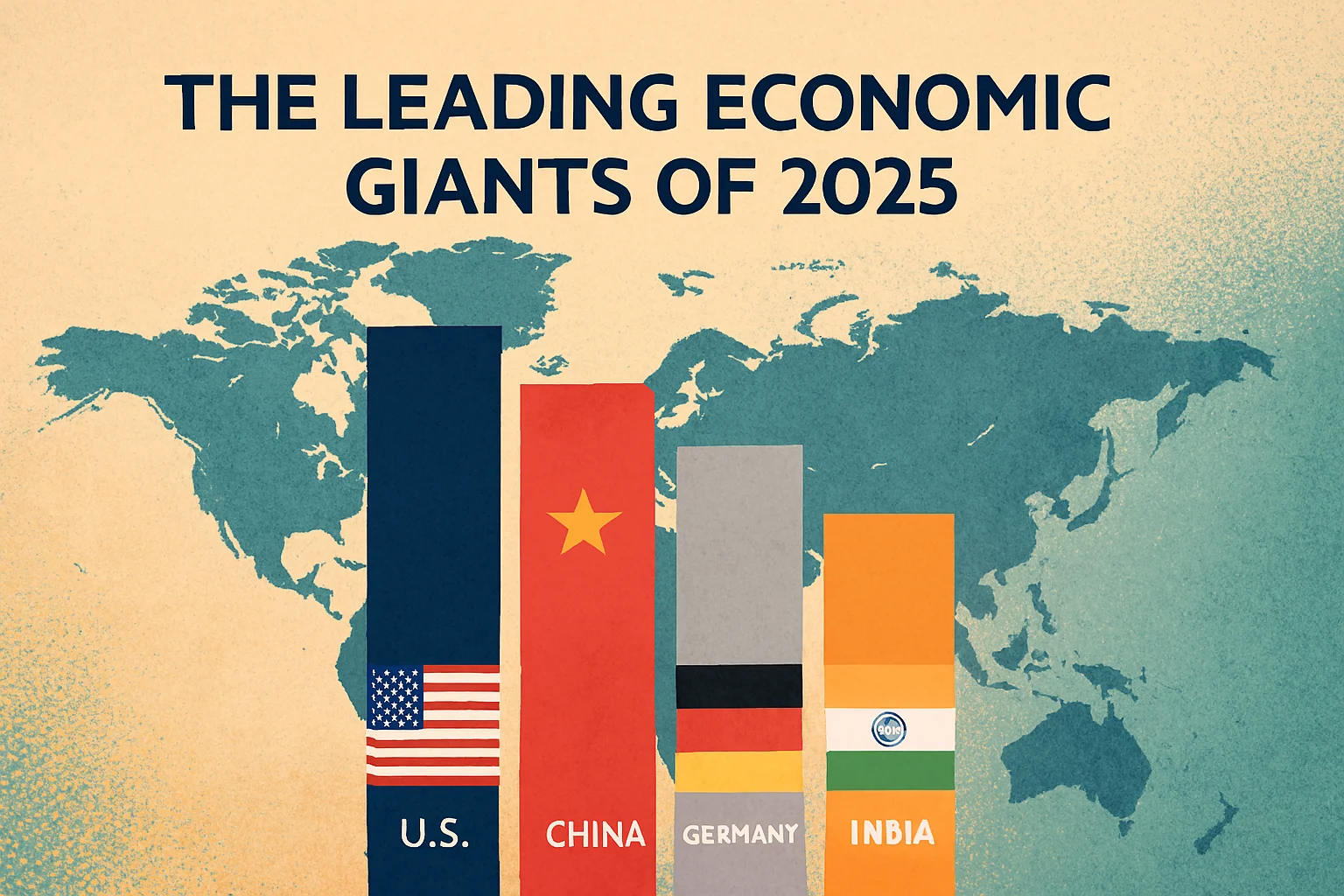
As December 2025 draws to a close, the global economy stands at a fascinating crossroads. The fourth quarter has revealed both continuity and disruption: familiar giants, such as the United States and China, continue to dominate, while rising powers, including India and Germany, reshape the hierarchy. The chessboard of global GDP leaders is shifting, and the implications for trade, investment, and geopolitics are profound.
This article provides a data-driven analysis of the leading economic giants of 2025, comparing nominal GDP, purchasing power parity (PPP), and growth trajectories. It integrates authentic statistics from the IMF, OECD, and Fitch Ratings, while embedding SEO-rich
United States – Still the Nominal Leader
The United States remains the world’s largest economy in nominal terms, with GDP estimated at $29 trillion in 2025. Growth has moderated to around 2%, reflecting a mature cycle but supported by robust consumer spending and AI-driven productivity gains.
- Inflation: ~2.75%, easing from earlier highs.
- Monetary Policy: The Federal Reserve has begun rate cuts, balancing inflation control with growth support.
- Sectoral Strength: Technology, healthcare, and financial services continue to anchor resilience.
Despite China’s PPP dominance, the U.S. retains unmatched influence in global capital markets, innovation ecosystems, and reserve currency status.
China – Closing the Gap
China’s economy has expanded to nearly $26 trillion nominal GDP, with growth around 4.8% in 2025. On a PPP basis, China leads the world, outpacing the U.S. by an estimated Int. $10.4 trillion.
- Exports: Strong performance in EVs, semiconductors, and renewable energy.
- Domestic Demand: Rising middle-class consumption continues to drive growth.
- Challenges: Property sector fragility and demographic headwinds remain.
China’s ability to sustain growth above advanced economies underscores its role as a global GDP leader 2025, though questions linger about structural reforms.
India – The Rising Star
India has emerged as the fastest-growing major economy, with GDP growth near 6% in 2025. Its nominal GDP is projected at $4.8 trillion, positioning it to surpass Japan by 2026 and claim the fourth-largest spot globally.
- Drivers: Digital economy expansion, infrastructure investment, and strong domestic demand.
- Demographics: A youthful workforce contrasts sharply with aging populations in advanced economies.
- Global Role: Increasing influence in supply chains, fintech, and renewable energy.
India’s trajectory exemplifies the emerging markets rise 2025, making it a focal point for investors and policymakers alike.
Germany – Europe’s Anchor
Germany solidified its position as the third-largest economy, overtaking Japan in 2023 and maintaining momentum in 2025. With GDP around $5.5 trillion, Germany anchors the Eurozone, which grew at 1.4% in 2025.
- Industrial Strength: Automotive, engineering, and green technologies.
- Policy Focus: Energy transition and fiscal discipline.
- Resilience: Despite global headwinds, Germany’s export machine remains robust.
Germany’s role as Europe’s anchor highlights the Eurozone Q4 outlook, balancing stability with innovation.
Japan & Emerging Markets
Japan, once the world’s second-largest economy, has slipped to fifth place with GDP around $4.7 trillion. Growth remains sluggish (~1%), constrained by demographics and deflationary pressures.
Meanwhile, emerging markets such as Brazil, Indonesia, and Nigeria are showing resilience. Their collective growth underscores the global growth forecasts 2025, with commodity exports, digital adoption, and regional trade blocs driving momentum.
Comparative Data Table
| Country | Nominal GDP (2025 est.) | Growth Rate | PPP Position |
|---|---|---|---|
| US | $29T | 2% | #2 |
| China | $26T | 4.8% | #1 |
| Germany | $5.5T | 1.4% | #4 |
| India | $4.8T | 6% | #3 |
| Japan | $4.7T | 1% | #5 |
Conclusion – Looking Ahead to 2026
As 2025 ends, the economic giants Q4 2025 analysis reveals a reshaped hierarchy. The U.S. remains the nominal leader, China dominates PPP, India rises rapidly, and Germany anchors Europe. Emerging markets add dynamism to the global outlook.
Looking ahead to 2026:
- AI-driven productivity will offset demographic challenges.
- Green energy transition will redefine industrial competitiveness.
- Geopolitical risks (trade tensions, regional conflicts) will test resilience.
The economic outlook 2026 suggests a world where power is more distributed, innovation is more global, and competition is more intense.
Discover more from Startups Pro,Inc
Subscribe to get the latest posts sent to your email.

PM Invites US-Based Pakistani Business Community to Invest in Pakistan as Investment Opportunities Expand

Trump Accounts Reshuffle Tens of Millions in Big Tech & AI Holdings

NIC Islamabad Launches Exclusive Acceleration Program with Up to PKR 5 Million Equity-Free Grant Support

World School Summit 2026 Malaysia: 41st Edition

Global Digital Trade Expo 2026: Dates, Schedule, Venue, Registration and Everything You Need to Know

How to Claim Your Sony PlayStation Store Credit Settlement (Up to $33.66)

CES 2027 Las Vegas: Registration Details, Dates and Venue [Ultimate Guide]

IPhone 18 Pro Specifications, Pricing, and Thermal Architecture Leaks Analyzed

Pre-IPO Investing Strategies: How Institutional Money is Approaching Anthropic

Smash Bros Ultimate 13.0.5 Patch Notes: What Actually Changed
CES 2027 Las Vegas: Registration Details, Dates and Venue [Ultimate Guide]
Global Digital Trade Expo 2026: Dates, Schedule, Venue, Registration and Everything You Need to Know
How to Claim Your Sony PlayStation Store Credit Settlement (Up to $33.66)
IPhone 18 Pro Specifications, Pricing, and Thermal Architecture Leaks Analyzed
NIC Islamabad Launches Exclusive Acceleration Program with Up to PKR 5 Million Equity-Free Grant Support
World School Summit 2026 Malaysia: 41st Edition
Trump Accounts Reshuffle Tens of Millions in Big Tech & AI Holdings
PM Invites US-Based Pakistani Business Community to Invest in Pakistan as Investment Opportunities Expand
-
Digital5 years ago
Social Media and polarization of society
-
Digital6 years ago
Pakistan Moves Closer to Train One Million Youth with Digital Skills
-
Digital5 years ago
Karachi-based digital bookkeeping startup, CreditBook raises $1.5 million in seed funding
-
Kashmir6 years ago
Pakistan Mission Islamabad Celebrates “KASHMIRI SOLIDARITY DAY “
-
Digital6 years ago
WHATSAPP Privacy Concerns Affecting Public Data -MOIT&T Pakistan
-
News6 years ago
Dr . Arif Alvi visits the National Museum of Pakistan, Karachi
-
China5 years ago
TIKTOK’s global growth and expansion : a bubble or reality ?
-
Business5 years ago
Are You Ready to Start Your Own Business? 7 Tips and Decision-Making Tools