
Analysis
Digital Nomad Visas in Asia: Your Complete 2026 Guide to Working Remotely Across the Continent

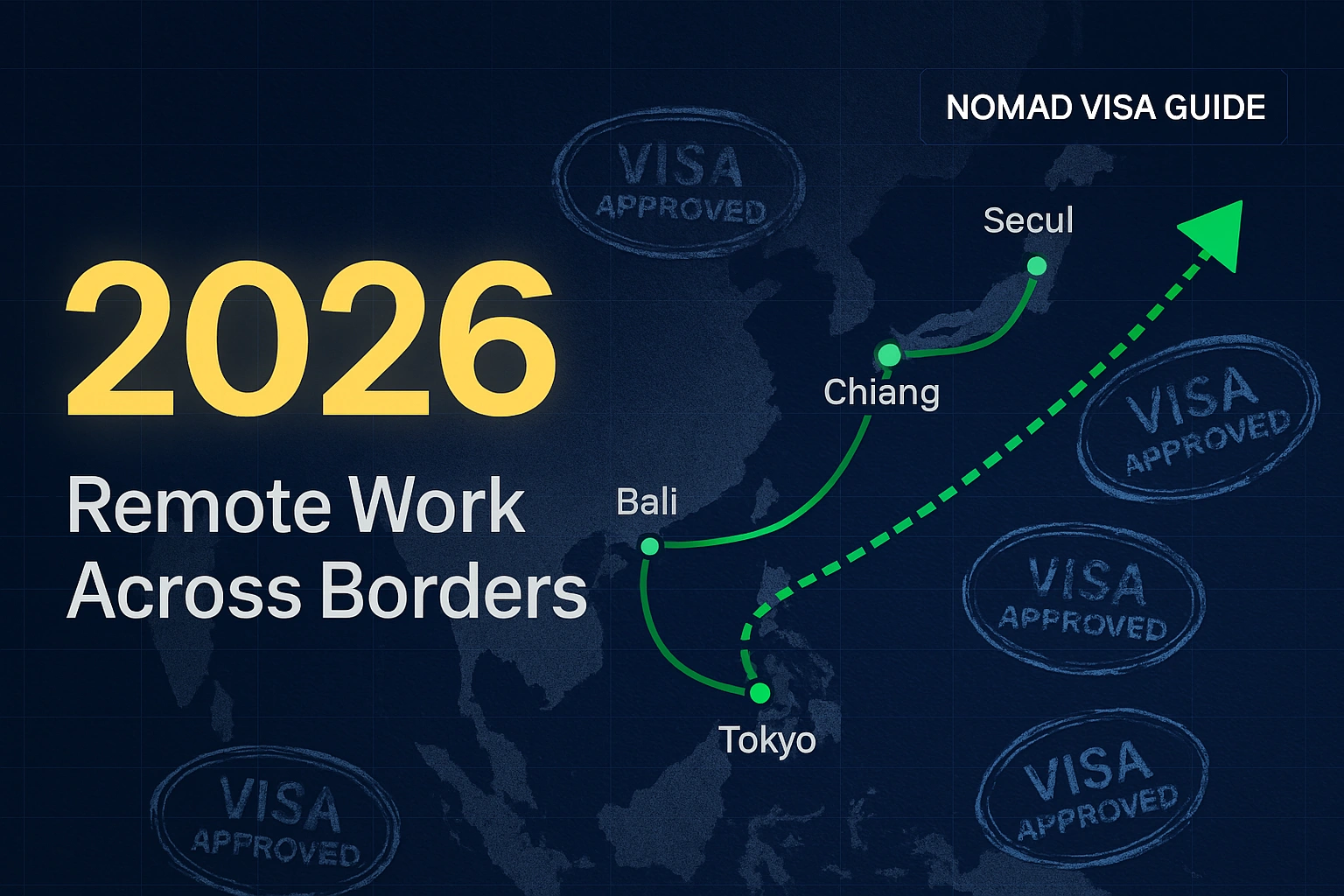
Imagine ! You’re sipping coconut water at a beachside café in Bali, laptop open, ocean breeze cooling your workspace. Your morning meeting wraps up just as the sun hits that perfect golden angle. This isn’t a vacation—it’s your everyday life as a digital nomad in Asia.
The numbers tell a remarkable story. The global digital nomad economy has exploded to $787 billion, with over 40 million remote workers now calling themselves location-independent. And here’s the kicker: Asia isn’t just participating in this revolution—it’s leading it. From Thailand’s revamped Long-Term Resident Visa to Japan’s surprising entry into the digital nomad space, Asian countries are rolling out the welcome mat for remote workers in ways that would’ve seemed impossible five years ago.
Why the sudden enthusiasm? Governments across Asia have done the math. Digital nomads spend an average of $2,000–$4,000 monthly in their host countries without taking local jobs. They fill coworking spaces, rent apartments, eat at restaurants, and boost local economies while requiring minimal public services. It’s economic development gold.
But navigating the visa landscape can feel overwhelming. Requirements vary wildly between countries. Application processes range from surprisingly simple to bureaucratically Byzantine. And finding reliable, up-to-date information? That’s its own challenge.
This guide cuts through the confusion. You’ll discover which Asian countries offer digital nomad visas in 2026, exactly what each program requires, realistic costs of living, and insider tips that only come from people who’ve actually done this. Whether you’re dreaming of temples in Thailand, tech hubs in South Korea, or tropical islands in Indonesia, you’ll walk away knowing exactly which visa suits your situation—and how to get it.
The Asian Digital Nomad Visa Landscape: What’s Changed in 2026
Asia’s approach to remote work visas has matured dramatically. What started as experimental programs in 2020–2022 has evolved into competitive, well-structured visa options designed to attract the growing pool of location-independent professionals.
Currently, nine Asian countries offer dedicated digital nomad or remote work visas, with another four providing long-term tourist visas that effectively serve the same purpose. The competition is fierce. Thailand extended its visa duration. Malaysia slashed income requirements. Japan—previously resistant to long-term tourism—launched its own program. Even the UAE, technically in Western Asia, has entered the game with aggressive marketing.
The key differences? Duration is the big one. Some visas last just six months, while others offer up to five years. Income requirements range from $1,000 to $5,000 monthly. Application complexity varies from “upload three documents online” to “visit an embassy with notarized paperwork.” And costs run anywhere from $50 to $1,000 in visa fees alone.
Understanding these distinctions matters because the “best” digital nomad visa in Asia doesn’t exist. The best visa for you depends on your income level, desired length of stay, comfort with bureaucracy, and the lifestyle you’re chasing. A freelance writer earning $2,500 monthly will have different options than a software engineer pulling $8,000. Someone planning a six-month test run needs different visa terms than someone ready to commit to two years.
The good news? There’s genuinely something for everyone in 2026. Asia’s remote work visa guide has expanded to accommodate budget travelers, mid-range professionals, and high-earning executives. Let’s break down exactly what each country offers.
Country-by-Country Breakdown: Asia’s Digital Nomad Visas for 2026
Thailand: The Long-Term Resident (LTR) Visa
Thailand has long been a digital nomad favorite, and the LTR visa—introduced in 2022 and refined through 2025—makes it official. This is arguably the most generous digital nomad visa Asia offers right now.
Visa Type & Duration: The LTR visa lasts up to 10 years with five-year renewals. Yes, you read that right. Ten years.
Application Process: Apply online through Thailand’s Board of Investment portal. Upload your passport, proof of income ($80,000 annually or $40,000 with qualifying employment), health insurance covering $100,000, and background check. Processing takes 30–60 days. No need to visit an embassy initially—though you’ll need to activate the visa in Thailand.
Income Requirements: $80,000 annually ($6,667/month) or $40,000 annually if you work for a well-established foreign company or own shares in publicly traded companies.
Cost of Living: Bangkok averages $1,500–$2,500 monthly depending on lifestyle. Chiang Mai runs $1,200–$1,800. Beach towns like Hua Hin fall somewhere between. You’re looking at $400–800 for a comfortable apartment, $300–500 for food, $100–200 for transportation, and $200–300 for entertainment and coworking.
Internet Speed & Coworking: Thailand’s internet infrastructure is excellent. Bangkok averages 200+ Mbps in most areas. Coworking spaces like The Hive, HUBBA, and AIS D.C. offer professional environments for $150–250 monthly. Coffee shops with solid WiFi are everywhere.
Cultural Adaptation Tips: Learn basic Thai phrases—it goes a long way. Respect the monarchy (seriously, this is law). Remove shoes when entering homes and temples. Thai culture values “sanuk” (fun) and “sabai sabai” (relaxed)—embrace it. The bureaucracy can be slow, so patience isn’t optional.
The Reality Check: The high income requirement excludes many nomads. Tax implications are complex—Thailand is moving toward taxing foreign income for tax residents. And while Bangkok is cosmopolitan, smaller cities require more cultural flexibility.
Indonesia: The B211A Visit Visa (Second Home Visa)
Indonesia launched its “Second Home Visa” in late 2023, targeting digital nomads and retirees. Bali has been a digital nomad hub for years; now there’s finally a proper visa for it.
Visa Type & Duration: The B211A allows stays up to two years (initial six months plus four possible extensions).
Application Process: Apply online or through an Indonesian embassy. You’ll need passport copies, proof of $2,000 monthly income or $130,000 in an Indonesian bank account, health insurance, and a sponsor letter (many visa agencies provide this service for $100–200). Processing typically takes 7–14 days.
Income Requirements: $2,000 monthly income or substantial savings deposited in an Indonesian bank.
Cost of Living: Bali’s Canggu and Ubud run $1,000–$2,000 monthly for a comfortable lifestyle. Jakarta is slightly higher at $1,500–$2,500. You’ll pay $300–600 for housing, $200–400 for food (eating local cuts this significantly), $50–100 for transportation, and $150–250 for coworking and activities.
Internet Speed & Coworking: Bali’s internet has improved dramatically. Canggu and Ubud average 50–100 Mbps, adequate for most remote work. Starlink is becoming more common. Coworking spaces like Dojo Bali, Outpost, and Tropical Nomad are legendary in nomad circles—expect to pay $100–200 monthly.
Cultural Adaptation Tips: Bali is predominantly Hindu (unlike Muslim-majority Indonesia). Dress modestly when visiting temples. Traffic is chaotic—rent a scooter but get insurance. Balinese people are warm but value indirect communication. Learn about “hari raya” ceremony days when much of the island shuts down.
The Reality Check: Visa extensions require leaving and re-entering Indonesia every six months, which adds cost and complexity. Internet reliability varies significantly by location. And Bali’s nomad scene, while vibrant, can feel like a bubble disconnected from authentic Indonesian culture.
Malaysia: The DE Rantau Nomad Pass
Malaysia’s digital nomad visa launched in October 2022 and has been quietly gaining traction. It’s one of the most straightforward visa requirements for remote workers in Asia.
Visa Type & Duration: The DE Rantau Pass allows 12 months with possible renewal for another 12 months.
Application Process: Entirely online through the Malaysia Digital Economy Corporation (MDEC) website. Upload passport, proof of $24,000 annual income, employment contract or client letters, and bank statements. Approval typically takes 7–14 days. The visa fee is approximately $200.
Income Requirements: $24,000 annually ($2,000/month)—one of the lowest thresholds among digital nomad visas in Asia.
Cost of Living: Kuala Lumpur runs $1,200–$2,000 monthly. Penang is slightly cheaper at $1,000–$1,600. Expect $400–700 for a modern apartment, $300–500 for food, $100–150 for transportation (the metro is excellent and cheap), and $100–200 for coworking.
Internet Speed & Coworking: Malaysia boasts some of Asia’s fastest internet—Kuala Lumpur averages 100–300 Mbps. Coworking spaces like Common Ground, WORQ, and The Co. offer professional environments for $120–200 monthly.
Cultural Adaptation Tips: Malaysia is multicultural—Malay, Chinese, and Indian communities coexist. English is widely spoken in cities. “Bahasa Malaysia” is the official language, but learning a few words helps. Respect Islamic customs during Ramadan. Food is phenomenal and incredibly cheap.
The Reality Check: Malaysia’s visa is straightforward, but the country sometimes falls off nomads’ radars compared to Thailand or Bali. The weather is hot and humid year-round. And while Kuala Lumpur is modern, it lacks the beach appeal of other Asian countries digital nomads favor.
Japan: The Digital Nomad Visa (New for 2025)
This is the surprise entry. Japan, long resistant to anything resembling long-term tourism, launched a six-month digital nomad visa in March 2025. It’s causing buzz in nomad communities worldwide.
Visa Type & Duration: Six months, non-renewable (though you can apply for different visa types afterward).
Application Process: Apply through a Japanese embassy with passport, proof of $60,000 annual income, employment verification, travel insurance covering your stay, and a detailed itinerary. Processing takes 14–30 days. The visa fee is around $30—surprisingly cheap.
Income Requirements: $60,000 annually ($5,000/month)—reflecting Japan’s higher cost of living.
Cost of Living: Tokyo runs $2,500–$4,000 monthly. Osaka and Kyoto are slightly lower at $2,000–$3,000. Smaller cities like Fukuoka or Sapporo drop to $1,500–$2,500. Budget $800–1,500 for housing, $600–900 for food, $150–250 for transportation, and $200–300 for activities.
Internet Speed & Coworking: Japan’s internet is world-class—200+ Mbps is standard even in rural areas. Tokyo’s coworking scene includes WeWork, Fabbit, and Impact Hub, running $200–400 monthly. Coffee shops typically offer free WiFi, though cultural norms discourage staying all day without ordering multiple items.
Cultural Adaptation Tips: Learn basic Japanese—English proficiency outside major cities is limited. Respect is paramount: bow when greeting, remove shoes indoors, be quiet on trains. Punctuality isn’t valued, it’s expected. The cultural learning curve is steeper than Southeast Asia, but the experience is incomparable.
The Reality Check: Six months isn’t long for settling in. Japan’s cost of living digital nomad Asia travelers face is among the highest on the continent. Bureaucracy is real—opening a bank account or renting an apartment requires multiple visits and substantial paperwork. But for those who can swing it, living in Japan is a bucket-list experience.
South Korea: The F-1 Visit and Sojourn Visa
South Korea doesn’t have a dedicated digital nomad visa, but its F-1 visa effectively serves this purpose for many remote workers.
Visa Type & Duration: The F-1 allows stays up to two years depending on your nationality and circumstances.
Application Process: Apply at a Korean embassy with passport, bank statements showing $3,000+ balance, employment letter or freelance contract, and accommodation proof. Processing takes 7–14 days. The fee is approximately $80.
Income Requirements: No official minimum, but demonstrating financial stability ($3,000+ in savings) is necessary.
Cost of Living: Seoul runs $1,800–$3,000 monthly. Busan is cheaper at $1,400–$2,200. Expect $600–1,200 for housing, $400–600 for food, $100–150 for transportation (the metro is excellent), and $200–300 for entertainment.
Internet Speed & Coworking: South Korea has the world’s fastest internet—300+ Mbps is common. Seoul’s coworking scene includes Sparkplus, FastFive, and Maru180, running $200–350 monthly.
Cultural Adaptation Tips: Learn Hangul (the alphabet)—it’s surprisingly easy and dramatically improves daily life. Korean work culture is intense, but you’ll find the expat-friendly Asian cities culture in neighborhoods like Itaewon and Hongdae. Respect hierarchies and age in social situations. The food scene is incredible—embrace it.
The Reality Check: South Korea’s immigration policies can be unpredictable. The F-1 visa doesn’t explicitly allow remote work for foreign companies, creating legal gray areas. Winter is brutally cold. And while Seoul is cosmopolitan, smaller cities have limited English support.
United Arab Emirates: The Virtual Working Program
Technically in Western Asia, the UAE’s program attracts many Asian-bound nomads due to Dubai’s position as a global hub.
Visa Type & Duration: One year, renewable.
Application Process: Apply online through the Dubai government portal. Upload passport copies, proof of $5,000 monthly income, employment contract, one-month bank statement, and health insurance. Processing takes 2–5 days (impressively fast). The fee is around $600—steep, but includes health insurance.
Income Requirements: $5,000 monthly ($60,000 annually).
Cost of Living: Dubai runs $2,500–$4,500 monthly. Expect $1,200–2,000 for housing, $600–900 for food, $200–300 for transportation, and $300–500 for entertainment.
Internet Speed & Coworking: Dubai’s infrastructure is world-class—300+ Mbps is standard. Coworking options like The Bureau, Nook, and Astrolabs run $300–500 monthly.
Cultural Adaptation Tips: Respect Islamic customs—dress modestly, no public displays of affection, no alcohol outside licensed venues. Arabic is official, but English is widely spoken. Dubai is transient—most residents are expats, creating an international but sometimes impersonal atmosphere.
The Reality Check: The high cost barrier excludes many nomads. Dubai’s summer heat (120°F+) is oppressive. And while it’s technically open-minded, conservative laws occasionally create unexpected situations for Western visitors.
Taiwan: The Gold Card (Employment Gold Card)
Taiwan’s Gold Card isn’t specifically a digital nomad visa, but many remote workers qualify under its “specialized professional” category.
Visa Type & Duration: One to three years with work authorization and permanent residence pathway.
Application Process: Apply online demonstrating specialized skills in tech, finance, education, or other fields. Requirements vary by category but generally include portfolio evidence, income history, and professional certifications. Processing takes 30–60 days. The fee runs $100–300 depending on duration.
Income Requirements: Varies by specialization—generally $50,000+ annually.
Cost of Living: Taipei runs $1,500–$2,500 monthly. Kaohsiung and Taichung drop to $1,200–$1,800. Expect $500–900 for housing, $400–600 for food, $50–100 for transportation, and $150–250 for activities.
Internet Speed & Coworking: Taiwan’s internet averages 150–250 Mbps. Taipei’s coworking scene includes CIT, Kafnu, and The Hive, running $150–300 monthly.
Cultural Adaptation Tips: Mandarin is essential outside Taipei—English proficiency is limited. Taiwanese people are incredibly friendly and helpful. The scooter culture is intense—be cautious. Food is fantastic and cheap. Taiwan has a distinct identity from mainland China—be mindful of politics.
The Reality Check: The application process is subjective—qualifying as a “specialized professional” isn’t always clear. Processing times vary wildly. And Taiwan’s international status creates occasional complications (some countries don’t recognize Taiwanese visas for transit).
Philippines: The Special Resident Retiree’s Visa (SRRV)
While marketed toward retirees, the Philippines’ SRRV works excellently for younger digital nomads willing to make a refundable deposit.
Visa Type & Duration: Indefinite, essentially permanent residency.
Application Process: Apply through the Philippine Retirement Authority office in Manila. Deposit $10,000 in a Philippine bank (refundable when leaving), provide health clearance, police records, and passport. Processing takes 2–4 weeks. The total cost runs around $1,500 including fees and deposit interest loss.
Income Requirements: None beyond the $10,000 deposit.
Cost of Living: Manila runs $1,000–$2,000 monthly. Cebu, Dumaguete, and other cities drop to $800–$1,500. Expect $300–600 for housing, $250–400 for food, $100–150 for transportation, and $100–200 for entertainment.
Internet Speed & Coworking: Philippines’ internet has improved but remains inconsistent—50–100 Mbps in good areas, much slower elsewhere. Manila’s coworking scene includes KMC Solutions, The Grovery, and Acceler8, running $100–200 monthly.
Cultural Adaptation Tips: English is widely spoken—the Philippines is the third-largest English-speaking country globally. Filipino culture is warm and welcoming. Traffic in Manila is among Asia’s worst—plan accordingly. Island-hopping is a way of life—embrace it.
The Reality Check: The $10,000 deposit is a barrier, though it’s refundable. Internet reliability frustrates remote workers—have backup plans. Typhoon season (June–November) brings disruptions. And while English is common, cultural differences run deeper than language.
Comparing Asia’s Digital Nomad Visas: The Decision Matrix
Here’s how the best countries for digital nomads in Asia stack up:
| Country | Duration | Cost | Min. Income | Internet | Expat Scene | Processing |
|---|---|---|---|---|---|---|
| Thailand | 10 years | $1,000+ | $80K/year | Excellent | Massive | 30–60 days |
| Indonesia | 2 years | $200–400 | $24K/year | Good | Large | 7–14 days |
| Malaysia | 2 years | $200 | $24K/year | Excellent | Moderate | 7–14 days |
| Japan | 6 months | $30 | $60K/year | World-class | Growing | 14–30 days |
| South Korea | 2 years | $80 | Flexible | World-class | Large | 7–14 days |
| UAE | 1 year | $600 | $60K/year | World-class | Massive | 2–5 days |
| Taiwan | 1–3 years | $100–300 | $50K/year | Excellent | Moderate | 30–60 days |
| Philippines | Indefinite | $1,500 | $10K deposit | Variable | Large | 14–30 days |
The cheapest countries with digital nomad visas in Asia are clearly Malaysia and the Philippines, with Indonesia close behind. Thailand offers the longest duration but requires significant income. Japan provides a bucket-list experience but limits you to six months.
Emerging Trends: What’s Coming in Asia’s Remote Work Revolution
The competition for digital nomads is intensifying. Vietnam is reportedly developing a digital nomad visa for launch in late 2026. Cambodia is considering similar programs. Even India—traditionally challenging for long-term stays—is exploring options for remote workers in tech hubs like Bangalore and Hyderabad.
Tax policies are evolving too. Thailand’s announcement that it may tax foreign income for tax residents sent shockwaves through the nomad community in late 2024. Other countries are watching closely. The affordable Asian countries digital nomads love may become less affordable if tax treaties don’t keep pace with visa programs.
Regional cooperation is another trend. ASEAN countries are discussing reciprocal digital nomad agreements, potentially allowing one visa to work across multiple Southeast Asian nations. Think Schengen for remote workers. It’s early stages, but momentum is building.
Looking ahead to 2027–2028, expect income requirements to drop as countries compete more aggressively. Application processes will streamline—fully digital applications will become standard. And we’ll likely see differentiated programs targeting specific demographics: family-friendly visas, startup founder visas, and student-nomad hybrid options.
The visa-free countries for remote workers concept is also gaining traction. Several nations allow 30–90 day stays without visas for many nationalities. While not officially sanctioned for remote work, enforcement is minimal for those working online. Countries like Georgia, Armenia, and Sri Lanka (not technically Asia but close) have built large nomad communities this way.
Your Practical Planning Guide: Making It Happen
Choosing the right visa starts with honest self-assessment. Ask yourself:
- How long do I want to stay? Six months exploring or two years settling in?
- What’s my realistic monthly income? Minimum requirements are non-negotiable.
- How much bureaucracy can I handle? Some visas are straightforward; others require patience.
- What lifestyle am I seeking? Beach towns, megacities, or cultural immersion?
- Do I have dependents? Many visas allow family members; others don’t.
Once you’ve narrowed your options, gather documents early. The standard checklist includes:
- Passport with 6+ months validity
- Proof of income (bank statements, employment contracts, client letters)
- Health insurance covering your destination
- Police background check (some countries)
- Passport photos (specific sizes—check requirements)
- Accommodation proof (sometimes)
- Return flight booking (sometimes)
Insurance deserves special attention. Many countries require minimum coverage amounts. SafetyWing and World Nomads are popular among remote workers, running $50–80 monthly. Ensure your policy explicitly covers Asia and doesn’t exclude activities you plan to do (scooter riding is often excluded—get additional coverage).
Banking before arrival saves headaches. Wise (formerly TransferWise) offers multi-currency accounts accepted widely in Asia. Charles Schwab reimburses ATM fees globally. Revolut provides good rates and virtual cards. Having 2–3 banking options prevents disasters if one card gets blocked.
The step-by-step visa process for remote workers generally follows this pattern:
- Research requirements (you’re doing this now—good job)
- Gather documents (2–4 weeks depending on background checks)
- Submit application (online or embassy, 1–3 days)
- Wait for processing (7–60 days depending on country)
- Receive approval (digital or stamped passport)
- Enter country (activate visa at immigration)
- Complete in-country registration (some countries require this within 7–30 days)
Pro tips from experienced nomads:
- Apply early. Processing times are estimates, not guarantees.
- Over-document. Immigration prefers too much proof over too little.
- Use visa agencies for complex applications (costs $100–500 but reduces stress).
- Join online communities. Facebook groups and Reddit’s r/digitalnomad offer real-time advice.
- Have Plan B. Not all applications succeed—know your backup option.
The Future Is Already Here
Asia is shaping the future of remote work, and that future looks remarkably welcoming. What started as pandemic-era experiments has evolved into comprehensive programs designed to attract, retain, and benefit from the world’s growing population of location-independent professionals.
The digital nomad visas Asia offers in 2026 represent genuine opportunities. Whether you’re earning $2,000 monthly and eyeing Malaysia or making $8,000 and dreaming of Tokyo, there’s a visa designed for you. The bureaucracy is manageable. The costs are reasonable. And the experiences—cultural immersion, professional growth, personal transformation—are priceless.
Yes, challenges exist. Language barriers are real. Cultural adaptation takes time. Internet reliability varies. Tax situations can be complex. But millions of digital nomads are proving these challenges are surmountable. The coworking spaces Asia 2026 offers buzz with remote workers from every corner of the globe. The expat communities provide support and friendship. The local populations welcome the economic and cultural exchange.
The question isn’t whether you can become a digital nomad in Asia. The question is which country you’ll choose first, how long you’ll stay, and what adventures you’ll have along the way. The visas are ready. The infrastructure is built. The communities are waiting.
Your laptop, passport, and sense of adventure are all you need. The rest is paperwork—and we’ve just shown you exactly how to handle it.
Frequently Asked Questions
Can I work for local companies on a digital nomad visa?
No. Digital nomad visas Asia countries offer explicitly prohibit local employment. You can work remotely for foreign employers or clients but cannot take jobs that would otherwise go to local residents. Violating this risks visa cancellation and deportation.
Do I need to pay taxes in my host country?
It depends on the country and duration. Most digital nomad visas don’t create tax residency if you stay under 183 days annually. But Thailand’s new rules and other evolving policies complicate this. Consult a tax professional familiar with international remote work—seriously, don’t guess on this.
Can my family come with me?
Many visas allow dependent visas for spouses and children, though requirements and costs vary. Thailand, Malaysia, and the UAE offer family-friendly options. Japan and South Korea are more restrictive. Always check specific country requirements for dependents.
What happens if I overstay my visa?
Don’t. Overstaying results in fines, deportation, and future visa bans. If you need to extend your stay, apply for extensions well before expiration or leave and apply for a new visa. Immigration violations have serious consequences.
How do I prove income as a freelancer?
Bank statements showing consistent deposits work for most countries. Some accept client letters on company letterhead. Tax returns help but aren’t always accepted. Having 3–6 months of bank statements showing income above the minimum threshold is your safest bet.
Do I need to show a return ticket when entering?
Many countries require proof of onward travel—either a return ticket or travel to another destination. Some accept fully refundable bookings made just for visa purposes (you can cancel after entering). Check your specific country’s requirements.
Can I renew digital nomad visas indefinitely?
It depends. Thailand’s 10-year LTR is essentially renewable indefinitely. Malaysia and Indonesia limit renewals. Japan doesn’t allow renewals at all. Check each country’s specific policies—some nomads “visa hop” between countries when renewals aren’t available.
What’s the best country for beginners?
Malaysia or Thailand. Both offer clear processes, strong infrastructure, large expat communities, affordable living, and English-speaking support. They’re genuinely the best countries for digital nomads in Asia who are new to remote work abroad.
Is health insurance really necessary?
Yes, both legally and practically. Many visas require proof of coverage. More importantly, medical emergencies happen. A hospital stay in Bangkok or Kuala Lumpur without insurance can cost thousands. $50–80 monthly for coverage is cheap insurance against financial disaster.
Can I travel to other countries while holding a digital nomad visa?
Usually yes, though re-entry rules vary. Some visas are multiple-entry, allowing unlimited exits and returns. Others are single-entry, requiring a new visa if you leave. Always clarify re-entry provisions before booking regional travel—getting stuck outside your host country is expensive and stressful.
The world of remote work is still young, and Asia is writing the playbook. These visas, requirements, and processes will continue evolving. But the fundamental opportunity—to live, work, and explore this incredible continent—is real, achievable, and waiting for you to take the first step.
Discover more from Startups Pro,Inc
Subscribe to get the latest posts sent to your email.


Analysis
The HR Pros Turning Workplace Horror Stories Into Startup Success: How the Hosts of ‘HR Besties’ Weaponized Candor, Outmaneuvered SHRM, and Built a Media Empire

They mocked bad leadership on air, survived a gag-order attempt from the century-old HR establishment, and turned podcast banter into books, training platforms, speaking gigs, and seven-figure personal brands. The lesson for every would-be creator is brutally simple—and profitable.
Picture the scene: three women who have never met in person before squeeze into a pop-up church inside a strip mall in Atlanta, Georgia, over Memorial Day weekend 2023. They are all seasoned HR veterans—an employment attorney turned corporate culture critic, a meme-lord chief officer of workforce absurdity, and a General Counsel who once coached executives at McKinsey not to be, as she memorably puts it, “assholes.” They record eight podcast episodes back to back. Eight weeks later, HR Besties debuts at number six on Apple Podcasts’ business chart. The century-old Society for Human Resource Management, keeper of the sacred scrolls of corporate best practices, eventually tries to keep the hosts from discussing one of the biggest HR stories of the year in open court. The effort fails spectacularly. The podcast, meanwhile, keeps climbing.
This is a story about what happens when the people who are supposed to protect a broken system decide, instead, to describe it out loud—and monetize the reaction.
The Problem With “Best Practices” (And Why a Podcast Fixed It)
There is a peculiar irony at the heart of the HR profession. No industry produces more earnest guidance on psychological safety, inclusive leadership, and anti-retaliation policy than Human Resources. And no industry has historically been more reluctant to practice what it preaches in public.
This is the gap that HR Besties identified and exploited with a precision that any McKinsey consultant would quietly admire. Leigh Elena Henderson (@hrmanifesto), Jamie Jackson (@humorous_resources), and Ashley Herd (@managermethod) are not outsiders lobbing critiques from a safe distance. They are former insiders—a trio with combined CVs spanning BigLaw, McKinsey & Company, Yum! Brands, General Counsel offices, and executive HR leadership. What they bring to the podcast microphone that their white-paper-writing peers cannot is a willingness to say, on the record, what the rest of the profession only says on Signal chats and in airport lounges after the conference keynote.
The show is structured like a recurring staff meeting—because the joke works, and because it is also a genuine act of service for the millions of workers who have sat through exactly this meeting and found it soul-destroying. There is an agenda. There are “Qs and Cs” (questions and comments). There is a hard stop. What fills the time in between is a rotating menu of workplace horror stories, dissections of cringey corporate-speak, hot HR news, and enough dry wit to classify the episode as a controlled substance in several jurisdictions.
The combined social following of the three hosts exceeds 3.5 million across platforms, and Ashley Herd’s personal community alone has crossed 500,000 professionals. As Leigh Henderson herself observed early in the show’s run: “As an HR exec, here I am coaching executives one-by-one not to be assholes. Imagine the impact now of 100+ million of reach monthly across my accounts.” That is not a vanity metric. That is a distribution advantage that no SHRM conference could ever replicate.
Why the SHRM Gag-Order Drama Was the Best Marketing Money Can’t Buy
In December 2025, a Colorado jury delivered a verdict that landed in the HR world like a live grenade at a compliance training session. SHRM—the Society for Human Resource Management, the world’s largest HR organization with 340,000 members—was ordered to pay $11.5 million in damages to Rehab Mohamed, a former instructional designer who alleged that SHRM fired her shortly after she filed a racial discrimination complaint. The jury awarded $1.5 million in compensatory damages and a staggering $10 million in punitive damages—a quantum typically reserved for conduct the jury found especially egregious.
The irony was almost too rich to consume without choking. The organization that trains and certifies HR professionals on anti-discrimination and investigation best practices had violated Section 1981 of the Civil Rights Act of 1866—a statute so old it predates the telephone. The investigator SHRM assigned to Mohamed’s discrimination complaint, trial testimony revealed, had never investigated a discrimination claim before. SHRM CEO Johnny C. Taylor Jr., who testified that he played no role in Mohamed’s termination, later described the $11.5 million verdict to reporters as “a blip in the history of SHRM.”
Eleven and a half million dollars. A federal civil rights finding. And the CEO called it a blip.
But here is where the story turns into a masterclass in how institutional defensiveness generates earned media that money cannot buy. Before the trial began, SHRM’s legal team asked the court to bar Mohamed from introducing evidence about SHRM’s status as an HR authority—essentially arguing that the fact that SHRM positions itself as the nation’s foremost HR expert should be inadmissible and kept away from the jury’s ears. U.S. District Judge Gordon P. Gallagher denied the motion, ruling that SHRM’s expertise in human resources was “integral to the circumstances of this case and cannot reasonably be excluded.”
The HR Besties hosts discussed the trial with the same granular attentiveness they bring to every episode. They walked listeners through what the filings meant, what the verdict signaled, and—without softening their conclusions—what they thought of SHRM’s response. Ashley Herd posted on LinkedIn that all HR leaders should be paying attention, calling the case “a reminder of why processes and conversations matter—and how easy it can be for ‘best practices’ to not actually be followed in real life.” In a subsequent episode, she framed SHRM as “a wonderful case study on the impact and importance of leadership.” The word wonderful did considerable heavy lifting there.
The episode did what all great journalism does: it helped an audience make sense of something important, and it did so without protective euphemism. The listener numbers, predictably, rose.
This is the contrarian insight at the core of the HR Besties phenomenon: in a profession built on the management of other people’s reputations, being openly, specifically honest about institutional failure is the rarest and most valuable thing you can offer. The audience that pours into your feed is not looking for validation of the party line. They are looking for someone who will finally say what they already know.
How Three Side Hustles Built a Media Empire—Without Quitting Their Day Jobs
The architecture of what Leigh, Jamie, and Ashley have constructed is more strategically sophisticated than the “just start a podcast” narrative suggests, and it is worth disaggregating carefully for any entrepreneur who wants to replicate it.
Each host was already running a separate, revenue-generating business before HR Besties launched. This is not incidental. This is the entire thesis. The podcast, as Jamie Jackson has said with characteristic bluntness, generates six-figure revenue split three ways, primarily through sponsored conference sessions and select brand partnerships—not traditional CPM advertising. As Jackson puts it: “Podcast ad revenue on its own is an expensive hobby. It’s like pennies on the dollar.” The pod is not the product. The podcast is the audience magnet.
Consider the individual orbits:
Leigh Henderson (HRManifesto) launched her TikTok account after being fired from an executive HR role—a fact that gave her content an authenticity that no brand consultancy could engineer. Her HR Manifesto platform has become a destination for workers seeking frank counsel on navigating corporate culture.
Jamie Jackson (Humorous Resources / Millennial Misery / Horrendous HR) is, by her own description, a “self-proclaimed Chief Meme Officer.” Her interconnected social accounts, which aggregate the absurdities of corporate life into formats that travel with viral velocity, function as a top-of-funnel operation of remarkable efficiency. Memes cost nothing to produce and are shared by everyone who has ever sat through a mandatory fun event.
Ashley Herd (Manager Method) has built what is arguably the most scalable revenue operation of the three. A former employment attorney, General Counsel, and Head of HR with experience at McKinsey and Yum! Brands, Herd has trained over 300,000 managers through LinkedIn Learning and corporate contracts. In early 2026, The Manager Method was published by Penguin Random House—a full-length book that translates her social content into a B2B training asset deployed at the enterprise level. Her Manager 101 course serves organizations ranging from boutique firms to Fortune 500 companies. HR Besties itself is consistently cited as a Top 10 Business Podcast on both Apple Podcasts and Spotify—a positioning that functions as a permanent credential on every speaking deck and proposal deck Herd submits.
The structure here is not accidental. It is precisely what the most durable creator businesses look like: a free, high-reach media property that builds trust and audience at scale, feeding into a portfolio of higher-margin products—courses, books, keynote fees, corporate training contracts, sponsored conference appearances. The podcast is marketing. The businesses are the revenue.
Edison Research’s Infinite Dial reports consistently show that podcast listeners are among the most educated, highest-income, and most brand-loyal audiences in media. The HR professional demographic that HR Besties captures skews toward exactly the kind of buyer that corporate training vendors, HR tech platforms, and conference organizers will pay handsomely to reach—not in thirty-second pre-roll ads, but in integrated, trusted-voice sponsorships where the endorsement carries real weight.
The Besties Playbook: 5 Rules for Turning Truth-Telling Into Revenue
The HR Besties story, stripped to its structural logic, yields a replicable framework. Not for podcasters specifically—but for any knowledge worker sitting inside a broken system who suspects that describing the breakage clearly and publicly might actually pay.
Rule 1: Start where the stakes are genuinely low. Every Bestie began on social media, in newsletters, or in micro-experiments where failure is private and success compounds publicly. Leigh launched a TikTok after being let go. Jamie built meme pages. Ashley began teaching on LinkedIn Learning. None of them started with a podcast studio, a publisher, or a venture investor. The algorithm is forgiving of early content; institutional gatekeepers are not.
Rule 2: The podcast is not the business. The podcast is the proof. In an era of content saturation, a podcast functions as a weekly demonstration of expertise, chemistry, and trustworthiness. What it rarely does, on its own, is generate meaningful revenue. The Besties understood this faster than most. The real economics live in the corporate training contract, the speaking fee, the book advance, the course subscription, the sponsored panel at a major HR conference where 5,000 decision-makers are in the room.
Rule 3: Radical candor is a competitive moat. Gallup’s 2024 State of the Global Workplace report found that only 23% of employees globally are engaged at work. The other 77% are quietly desperate for someone in a position of authority to acknowledge what they already experience every day. HR Besties monetizes that desperation—not cynically, but productively. The audience does not pay directly; they pay with attention, loyalty, and word-of-mouth distribution that no advertising budget can replicate.
Rule 4: Never quit the day job until the side hustle pays more. This is the rule that most aspiring creators violate, and it is the reason most aspiring creators fail. The financial security of existing revenue removes the desperation that makes content worse—the willingness to take any sponsor, soften any opinion, or avoid any story that might irritate a paying customer. The Besties had thriving individual businesses before the podcast launched. That independence is encoded in every frank observation they make on air.
Rule 5: Treat institutional controversy as a growth event. When SHRM’s pre-trial motion to exclude evidence of its own HR expertise was denied, and when the $11.5M verdict landed, the Besties did not hedge. They analyzed. The institutional controversy became content. The content became listens. The listens became evidence of authority that compounds in Google rankings, speaking proposals, and media coverage. The lesson: the moment a powerful institution notices you enough to push back, you have arrived. Respond with facts, not fury. Let the audience draw the obvious conclusion.
The Global Lens: Why This Model Travels (and Where It Gets Complicated)
The workplace candor economy is not a purely American phenomenon, though America has been its most fertile initial habitat. In the United Kingdom, a similar appetite for honest workplace commentary has produced a cluster of employment law podcasters and LinkedIn voices who critique what HR professionals there diplomatically call “people risk.” In Australia, the Fair Work Act’s complexity has generated entire media micro-businesses built on explaining what the legislation actually does versus what employers tell workers it does.
The European market is trickier. Works councils, co-determination rights, and powerful unions mean that the “HR horror story” genre often implicates legal frameworks that require more careful navigation than an American podcast’s disclaimer provides. That said, the underlying human experience—the bad manager, the sham investigation, the performance improvement plan deployed as a managed exit—is not culturally specific. It is a universal feature of hierarchical organizations, from Munich to Mumbai.
In Asia, particularly in markets where professional culture emphasizes deference to institutional authority, the HR Besties model is more disruptive still. A Seoul or Singapore equivalent would require more structural anonymity and would likely emerge first in newsletter format before migrating to audio. But the demand is there: Microsoft’s 2024 Work Trend Index found that 68% of workers globally say they don’t have enough uninterrupted focus time, and distrust in management communication is a consistent finding across every geography surveyed.
The insight travels. The execution requires local calibration.
Why Corporate Podcasts Keep Failing (And Why HR Besties Doesn’t)
It is worth dwelling on the specific failure mode that the Besties have avoided, because it claims nearly every podcast that a corporation, trade association, or brand has ever launched. Call it the authenticity tax.
According to Spotify’s 2024 Culture Next report, younger listeners in particular have a finely calibrated detector for managed messaging. When a podcast sounds like its hosts are working from approved talking points—which is to say, when it sounds like a press release delivered in a conversational register—audiences simply do not return after episode three. The corporate podcast fails not because the production is poor or the topics are wrong, but because the hosts are not allowed to be honest. The audience can tell.
HR Besties succeeds for precisely the inverse reason. The hosts are not employees. They have no communications department reviewing their scripts. When Ashley Herd says that the SHRM case is a reminder of how easily best practices fail to be followed in real life, she is saying it as someone who has personally seen dozens of similar failures from the inside, who has no institutional motive to protect SHRM’s reputation, and who has a professional reputation built on the quality of her analysis rather than the safety of her conclusions.
This is what brands mean when they describe “authentic content”—and why they almost never succeed in producing it. Authenticity is not a style. It is a consequence of incentive structures. You cannot hire your way to it.
The AI and Quiet-Quitting Coda: Why Candid Workplace Media Is Just Getting Started
The environment into which HR Besties has launched and grown is, by any historical measure, an unusual one. The quiet-quitting discourse of 2022 has matured into something more structural: a durable, widespread renegotiation of the psychological contract between employers and employees. McKinsey’s 2024 American Opportunity Survey found that more than a third of workers report having left a job due to lack of flexibility, with workplace culture cited as a primary driver of turnover at a rate that has not declined meaningfully since the post-pandemic spike.
Into this environment, AI is arriving as both a tool and a threat. For HR Besties, the AI story is complicated in genuinely interesting ways. On one hand, automation is generating a new wave of workplace anxiety—layoffs justified by “efficiency,” roles redefined or eliminated, performance management increasingly driven by algorithmic outputs that workers cannot interrogate. This is excellent podcast material, and the Besties have covered it accordingly. On the other hand, AI-generated content is flooding every search engine and social platform with text that is technically accurate, structurally competent, and completely devoid of the specific, opinionated, lived-experience texture that makes the Besties’ content valuable.
The competitive moat, in other words, is widening—not because AI content is bad, but because human credibility, earned through years of real institutional experience, is becoming rarer relative to the volume of content being produced. Ashley Herd’s ability to walk an audience through exactly why SHRM’s performance management process in the Mohamed case represented a failure of basic HR practice is not replicable by a language model. It requires having been, personally, the person in that room. Jamie Jackson’s instinct for which absurdity will go viral requires years of immersion in the specific cultural substrate of corporate American workplace life. Leigh Henderson’s authority on what HR executives are actually feeling is inseparable from her career history.
In a media environment that is becoming increasingly automated, the thing that the Besties are selling—honest, specific, credentialed, risk-tolerant human voice—may be the scarcest resource of all.
The Brutally Simple Lesson
Here is what the HR Besties story actually teaches, stripped of sentiment: a willingness to be radically honest—no matter the professional risk—is what they are ultimately selling. Not HR expertise. Not humor. Not the parasocial warmth of a group chat you’ve always wanted to be part of. All of those things are real, and all of them matter. But the underlying product is candor, offered consistently and with credentials.
The business model that grows from that candor is not mysterious. Start with free, high-reach, low-stakes content. Build an audience that trusts your judgment. Convert that trust, gradually and selectively, into products and services that the audience would pay for anyway—training, books, consulting, speaking, events. Never let any single revenue stream become so large that losing it would require you to soften your opinions. Stay independent enough to remain honest.
The Edison Research Infinite Dial 2024 report estimates that monthly podcast listeners in the United States alone have now crossed 135 million—a number that has more than doubled in a decade. The market for candid, expert-led workplace commentary is enormous and still underserved. SHRM’s rocky 2025—the $11.5 million verdict, the removal of “equity” from its DEI framework, the invitation of anti-DEI activist Robby Starbuck to speak at its diversity conference—has, if anything, accelerated the appetite for voices that will say clearly what the institution will not.
Three women in an Atlanta strip-mall church figured this out in May 2023. The rest of the professional media world is still catching up.
The Manager Method, Ashley Herd’s book on practical leadership frameworks, was published by Penguin Random House in 2026 and is available here. The HR Besties podcast publishes new episodes every Wednesday and Friday at hrbesties.com.
Discover more from Startups Pro,Inc
Subscribe to get the latest posts sent to your email.

There is a particular kind of policy that arrives dressed as housekeeping but lands like a structural shock. The UK Government’s Earned Settlement consultation, which closed in February 2026 and is now moving toward implementation, is precisely that kind of measure. On its surface, it looks like an orderly recalibration of how migrants earn the right to remain—an administrative tightening after years of critics decrying what they called an “automatic” route to settlement. In practice, it may well constitute the most consequential immigration reform for small and medium-sized enterprises since the Points-Based System replaced free movement in 2021.
Understanding how the UK’s Earned Settlement model will impact hiring plans for SMEs requires more than a quick skim of the policy’s headline numbers. It demands grappling with the cascading economics of talent retention, the geography of UK business, and the uncomfortable truth that the labour migration system has quietly become load-bearing infrastructure for a significant portion of British enterprise.
The Architecture of Earned Settlement: What Has Actually Changed
The old framework was straightforward, if imperfect: five years of lawful residence, largely free of conditions beyond basic compliance, and you qualified for Indefinite Leave to Remain. The new model is something altogether more elaborate—a points-style scoring system layered onto the settlement pathway itself, long after a worker has already navigated visa applications, sponsor licensing, and the cost of entry.
Under Earned Settlement, the baseline ILR qualifying period rises from five to ten years. That doubling is the headline. But the real complexity lies in how the period can be compressed or extended based on a matrix of factors:
- Earnings above £50,270 (roughly the 80th percentile of UK wages): qualifying period reduced by up to five years
- Earnings above £125,140 (the additional-rate tax threshold): reduced by up to seven years, potentially restoring something close to the old timeline
- English proficiency at B2 or C1 (Cambridge/IELTS equivalents): further positive weighting
- National Insurance contributions of £12,570+ per annum for three or more years: additional credit toward earlier settlement
- Use of public funds: penalties of +5 to +10 years added to the baseline
- Occupation classification: workers in medium-skilled roles (RQF Level 3–5—think technicians, associate professionals, skilled tradespeople) face a maximum qualifying period of fifteen years
- Dependants: assessed separately, with their own earnings and contribution matrix
The Home Affairs Committee’s March 2026 report flagged significant concerns about the retroactive dimension: existing visa holders who structured their lives around a five-year pathway to settlement may now find the rules rewritten around them mid-journey. The legal and ethical complexity here is substantial. But it is the economic complexity—particularly for the 1.4 million SMEs that collectively employ around 16 million people in the UK—that has been most conspicuously underexamined.
The SME Cost Equation: Sponsorship Is Now a Much Longer Bet
To understand the Earned Settlement impact on SME hiring, you have to start with what sponsorship already costs before the new model arrived.
A Skilled Worker visa sponsorship licence runs between £536 and £1,476 to obtain. The Certificate of Sponsorship is another £239. The visa application itself, for a worker outside the UK, costs between £610 and £1,235 depending on length and fast-track options. The Immigration Skills Charge—levied annually on the sponsor, not the applicant—runs £364 per year for small businesses or £1,000 per year for medium and large ones. Over a five-year sponsorship, a medium-sized enterprise was therefore paying between £5,000 and £6,500 per sponsored worker in direct costs alone, before accounting for legal advice, HR time, and the compliance infrastructure that a sponsor licence demands.
Now model what happens under Earned Settlement.
For an RQF Level 3–5 worker—a dental technician, a data analyst in a regional firm, an engineering technician at a manufacturing SME—the pathway to ILR extends to fifteen years. The worker remains on Skilled Worker visa extensions, each requiring renewal fees, for potentially a decade and a half. The total direct cost to a medium business for that sponsorship journey rises to somewhere between £15,000 and £22,000 per worker, based on current fee structures and the assumption of three to four visa cycles before settlement eligibility.
That is not a rounding error. For a 50-person SME with five sponsored employees in mid-skilled roles, the aggregate compliance and fee burden over a decade could exceed £100,000—a figure that, for most small businesses, competes directly with equipment investment, workforce development, or export market expansion.
The Migration Observatory at Oxford University has long warned that immigration policy carries disproportionate costs for smaller firms, which lack the in-house legal departments and HR bandwidth of FTSE-listed employers. The Earned Settlement framework, whatever its merits as an integration policy, compounds this structural disadvantage substantially.
The Talent Flight Risk: Why the Best People May Simply Leave
Here is a dynamic that has received almost no serious coverage in the policy debate so far: Earned Settlement does not prevent emigration. It only makes UK settlement more conditional and more distant. And in a world where Australia, Canada, Germany, and the Netherlands are actively competing for the same mid-skilled and specialist workers that UK SMEs rely on, extending the settlement pathway by a decade creates a powerful incentive for exactly the workers SMEs most want to keep.
Consider the mathematics from a worker’s perspective. A Filipino nurse who arrived in the UK in 2022 to take up an RQF Level 5 role in a private care home had a reasonable expectation of ILR by 2027, followed by British citizenship eligibility by 2029. Under retroactive Earned Settlement application—which the consultation strongly implies but has not definitively confirmed—her pathway might now stretch to 2037. Canada’s Express Entry system, by contrast, can offer permanent residency within six to twelve months for applicants with her qualifications and work history.
This is not a hypothetical. The Financial Times has reported extensively on the UK’s intensifying competition with Canada and Australia for international health and care workers. Germany’s new Chancenkarte (Opportunity Card) system is explicitly designed to attract exactly the mid-skilled international workers that the UK’s new policy treats most harshly. The UK, in tightening its settlement route, is simultaneously loosening the golden handcuffs that made long-term commitment here attractive.
For SMEs in social care, hospitality, construction, and technology—sectors where international recruitment is not a supplement to domestic hiring but a structural necessity—this creates a dual retention crisis: attracting workers becomes harder because the settlement offer is less competitive, and retaining workers beyond year three or four becomes harder as alternative permanent residency offers materialise elsewhere.
Sector-Specific Pressures: A Regional Story Nobody Is Telling
The UK ILR changes in 2026 will not be felt evenly across the economy. London firms—particularly in professional services, finance, and tech—sponsor primarily at RQF Level 6 and above, and their workers’ earnings frequently breach the £50,270 threshold that compresses the qualifying period back toward five years. In other words, high-earning workers in high-cost cities are largely insulated from the reform’s sharpest edges.
The pain lands hardest in regional SMEs. A precision engineering firm in Wolverhampton, a food processing operation in Lincolnshire, a care home group in Tyneside—these businesses sponsor at RQF Levels 3–5, pay wages that rarely breach £35,000 to £40,000, and operate in labour markets where domestic recruitment has been functionally exhausted. For them, the fifteen-year qualifying period is not a marginal inconvenience. It is a structural barrier that will, over time, price international talent entirely out of reach.
This has macroeconomic consequences that the policy’s architects appear to have underweighted. The UK’s regional productivity gap—already a defining structural weakness of the British economy—is significantly exacerbated when the SMEs that anchor regional economies face hiring constraints that their London counterparts do not. If mid-skilled Skilled Worker visa settlement changes for SMEs in 2026 push regional businesses toward workforce contraction rather than expansion, the downstream effects on local tax bases, supply chains, and community economic activity could be substantial.
The Office for Budget Responsibility has, in successive forecasts, noted that labour supply is among the primary constraints on UK growth. A policy that systematically reduces the attractiveness of the UK as a long-term destination for mid-skilled workers tightens exactly that constraint, at exactly the moment the economy can least afford it.
The Strategic Pivot: What Smart SMEs Are Already Doing
The firms that will navigate this best are not those that lobby against the policy—that battle is, for now, lost—but those that restructure their workforce strategy around the new environment. Several approaches are emerging among the more forward-thinking SME operators:
1. Wage engineering toward the £50,270 threshold The single most powerful lever within the Earned Settlement matrix is the first earnings threshold. Crossing £50,270 halves the baseline qualifying period. For workers earning £42,000 to £48,000, an SME that moves them to £50,270—often achievable through restructured pay, modest uplifts, or genuine productivity-linked progression—dramatically reduces both the worker’s settlement timeline and, by extension, the employer’s retention risk. This is not generous pay strategy; it is rational workforce economics.
2. Segmented workforce planning by RQF level SMEs that currently mix RQF Level 3–5 and Level 6+ roles in undifferentiated hiring plans need to disaggregate urgently. Roles that can be upskilled or reclassified to Level 6—through qualifications investment, professional registration, or job redesign—carry far more favourable settlement terms. The cost of funding an employee’s professional qualification may be substantially lower than the cumulative retention cost of running a fifteen-year sponsorship.
3. Front-loading compliance infrastructure The Immigration Skills Charge and sponsorship fees are unavoidable, but the compliance burden—the HR administration, the annual monitoring, the legal review—is heavily elastic. SMEs investing now in compliance software, digital right-to-work systems, and HR training will amortise those costs over the extended sponsorship periods that Earned Settlement creates. Those that do not will pay disproportionately in crisis compliance later.
4. Immigration cost as a line item in business planning This sounds elementary, but a striking number of SMEs still treat UK immigration reforms and SME retention costs as ad hoc, reactive expenses rather than forecast items. The new environment demands that sponsors model ten-to-fifteen-year cost trajectories for international hires with the same rigour applied to capital expenditure. Businesses that embed this modelling into their strategic plans will make better decisions about when to sponsor, whom to sponsor, and when to explore domestic alternatives.
The Policy’s Own Logic: Genuine Tension, Not Simple Error
It would be intellectually dishonest to dismiss the Earned Settlement framework as simply punitive or misconceived. Its underlying rationale is coherent, if contested.
The policy’s architects—and the Home Office consultation documents are surprisingly candid about this—are attempting to create genuine integration pathways that reward fiscal contribution and social participation rather than mere physical presence. The linkage of settlement to earnings, English proficiency, and NI contributions has a reasonable integration-policy foundation. Permanent residency should arguably reflect genuine belonging, not just time-serving.
The problem is not the principle. It is the calibration, and the asymmetric application of its costs.
The workers who face the most extended pathways—mid-skilled, moderately paid, often in public-facing or care-sector roles—are frequently those whose integration has been most visible and most socially embedded. They are not abstract economic units cycling through visa categories; they are parents at school gates, members of communities, contributors to local tax bases. Extending their pathway to fifteen years is not an integration measure. It is a disincentive to the very rootedness that integration policy should be encouraging.
Meanwhile, the policy’s most favourable treatment is reserved for high earners—those least likely to need policy incentives to remain in the UK, and least likely to leave for want of a swift settlement route. The perverse outcome is a system that prioritises the settlement of those who need it least and burdens those who need certainty most.
Forward Look: What Comes Next, and What SMEs Must Demand
The Earned Settlement model, even if amended in its implementation phase, represents a durable shift in the political economy of UK immigration. The direction of travel—toward more conditional, contribution-linked settlement—is unlikely to reverse under any plausible near-term government. SMEs must plan for this world, not the previous one.
In the immediate term, the most urgent priority is legal audit: every business with sponsored workers needs to understand, precisely, where each employee sits on the new matrix. What are their projected earnings trajectories? Do they have dependent claims in progress? Are their occupation codes classified at RQF Level 3–5 or above? The answers determine not just settlement timelines but retention risk profiles.
In the medium term, the trade associations that serve UK SMEs—the Federation of Small Businesses, the CBI, the British Chambers of Commerce—need to pivot from general immigration commentary to highly specific technical engagement with the Home Office’s implementation process. The consultation has closed, but the secondary legislation and guidance that give this policy its operational teeth are still being written. Detailed business impact evidence, submitted through proper parliamentary and regulatory channels, can still shape those details.
And in the long term, the UK needs a frank national conversation about what kind of economy it wants to be. A country that educates and trains only some of the workers it needs, then makes long-term residence for the rest conditional, uncertain, and expensive, is not pursuing a coherent productivity strategy. It is managing political optics at the cost of economic coherence.
The UK’s small businesses—those 1.4 million enterprises that in many ways are the connective tissue of the real economy—did not design this policy and cannot repeal it. But they can adapt to it, challenge its worst excesses through legitimate advocacy, and insist that policymakers reckon honestly with the costs they are imposing. That insistence, forcefully expressed and backed by data, is how bad calibration sometimes becomes better policy.
The earned settlement of a sound immigration framework, it turns out, requires the same continuous effort as the earned settlement it regulates.
Discover more from Startups Pro,Inc
Subscribe to get the latest posts sent to your email.

As we stand on the cusp of 2026, the global media landscape is not merely evolving; it is undergoing a seismic restructuring. The tectonic plates of technology, geopolitical tensions, and shifting consumer trust are grinding against one another, forging a new, often precarious, reality for creators and conglomerates alike. We are witnessing a profound dislocation from the advertising-led, scale-at-all-costs model that defined the last decade. In its place, a more discerning, fragmented, and value-driven ecosystem is emerging—one where the very definitions of content, creator, and audience are being rewritten in real time.
The data paints a picture of staggering scale and simultaneous disruption. The global entertainment and media industry is on a trajectory to surpass $3 trillion, with advertising revenues alone projected to cross the monumental $1 trillion threshold in 2026. Yet, this growth is not evenly distributed. It’s a story of consolidation and crisis. While streaming giants battle for live sports rights and crack down on password sharing to sustain growth, traditional news publishers face an existential threat as AI-powered “answer engines” are predicted to erode up to 43% of their search traffic.
This challenging environment, however, is precisely where the most durable opportunities for media entrepreneurship in 2026 are being forged. The winners will not be those who simply produce more content, but those who solve the market’s most urgent new problems: the collapse of trust, the demand for verifiable authenticity, the need for intelligent curation in an age of algorithmic noise, and the monetization of deep, niche fandoms. What follows are not just ideas, but strategic responses to these fundamental market shifts—blueprints for the future of media startups.
1. The “Proof-of-Reality” Verification-as-a-Service (VaaS) Platform
The Problem: The proliferation of generative AI has triggered a full-blown synthetic content crisis. As deepfakes become indistinguishable from reality, a profound “trust deficit” is undermining journalism, corporate communications, and user-generated content. Audiences and organizations alike are desperate for a reliable authenticity layer.
Why 2026 is the Inflection Year: By 2026, the novelty of generative AI will have given way to widespread societal and regulatory alarm. Experts from the Reuters Institute predict an overwhelming need for verification tools to confirm the provenance of visual content. This creates a powerful market demand for a trusted, third-party arbiter of reality.
The Revenue Model: A B2B SaaS model targeting news organizations, legal firms, insurance companies, and corporate marketing departments. Tiers could be based on volume of verifications. A secondary B2C subscription could offer individuals a browser plug-in to flag synthetic content in their feeds.
Tech Enablers: Integration with the Coalition for Content Provenance and Authenticity (C2PA) open standard, which provides cryptographic proof of an asset’s origin. The platform would build a user-friendly interface on top of this, combining it with proprietary machine learning models trained to detect the subtle artifacts of AI generation. Blockchain technology can be used to create an immutable ledger of verified content.
Risk & Mitigation: The primary risk is the “arms race” against increasingly sophisticated AI generation models. Mitigation involves creating a research-focused arm of the company dedicated to constantly updating detection algorithms and collaborating with academic institutions and bodies like SAG-AFTRA, which are actively engaged in future-proofing against AI disruption.
2. AI-Powered Niche Streaming Bundles for the “Great Unbundling”
The Problem: Consumers are drowning in a sea of streaming services. Subscription fatigue is rampant, and the one-size-fits-all libraries of giants like Netflix and Disney+ often fail to satisfy the deep passions of niche audiences. The market is crying out for intelligent re-bundling.
Why 2026 is the Inflection Year: As major streamers consolidate and focus on broad-appeal content like live sports to justify rising costs, they leave valuable, high-engagement niches underserved. Deloitte’s 2026 outlook highlights that media success is now defined by “quality engagement” and “fandom,” not just production budgets, creating a gap for startups that can super-serve specific communities.
The Revenue Model: A subscription-based aggregator. Users subscribe to a “bundle” of niche streaming services (e.g., The Criterion Channel, Shudder, CuriosityStream, Mubi) for a single, discounted monthly fee. The startup takes a percentage of each subscription, providing a new acquisition channel for the niche streamers.
Tech Enablers: A sophisticated AI recommendation engine that learns a user’s specific tastes (e.g., “1970s Italian Giallo horror” or “documentaries on sustainable architecture”) and builds personalized viewing lists that pull from across the bundled services, creating a unified and curated discovery experience.
Risk & Mitigation: The primary risk is convincing niche streamers to join the bundle rather than competing independently. This is mitigated by offering a powerful value proposition: access to a broader audience, reduced churn through the bundle’s stickiness, and sophisticated cross-platform analytics that they could not afford on their own.
3. The Creator-Led B2B Education Platform
The Problem: Professional education is often sterile, outdated, and disconnected from the real-world pace of industries like marketing, finance, and software development. Meanwhile, top-tier industry practitioners are building massive audiences on social media but lack a premium, scalable platform to monetize their expertise beyond brand deals.
Why 2026 is the Inflection Year: The creator economy is maturing beyond a “vibe” and into a serious business. By 2026, many top creators will be looking for sustainable, high-margin revenue streams beyond advertising. As predicted in a Business of Fashion report, content creation is now a default career launchpad, and brands and followers are looking for deeper value.
The Revenue Model: A subscription platform where companies pay for team access to libraries of video courses taught by vetted, industry-leading creators. Revenue is shared with the creators, providing them with a recurring income stream that leverages their intellectual property.
Tech Enablers: An interactive learning platform with features like AI-driven quizzes, peer-to-peer feedback, and direct Q&A sessions with the creator-instructors. The platform would also handle all payment processing, content hosting, and enterprise-level administrative tools.
Risk & Mitigation: The main challenge is quality control and ensuring the educational content is rigorous and not just influencer fluff. This is mitigated by establishing a strict vetting process for creators, peer-review systems for courses, and partnerships with professional certification bodies to offer accredited qualifications.
4. Interactive Connected TV (CTV) Storytelling Studios
The Problem: Most television content, even on streaming platforms, remains a passive, one-way experience. While gaming offers deep interactivity, narrative film and television have yet to fully embrace audience agency.
Why 2026 is the Inflection Year: The technology for interactive, branching narratives on CTV is maturing. Simultaneously, as noted in a Deloitte report, audiences are seeking richer, more immersive experiences, leading to the rise of formats like “microdramas” on mobile. Bringing this interactivity to the high-production-value environment of the living room TV is the next logical step.
The Revenue Model: A studio model that develops and licenses interactive shows to major streaming platforms. Additional revenue streams include brand partnerships for in-narrative product placement (e.g., a character chooses a car, and a link to the automaker appears) and direct-to-consumer sales of “story packs” that unlock new narrative branches.
Tech Enablers: Real-time 3D rendering engines like Unreal Engine 5, combined with proprietary software for managing complex narrative trees and audience choices. AI can be used to dynamically adjust storylines based on collective audience data, creating a truly responsive entertainment experience.
Risk & Mitigation: High production costs are a significant barrier. This can be mitigated by starting with lower-stakes genres like romantic comedies or thrillers before scaling to large-scale sci-fi or fantasy. Partnering with a major streamer early on for a proof-of-concept series would also de-risk the initial investment.
5. “Dark Social” Community Management for Brands
The Problem: As public social feeds become saturated with AI-generated “slop” and algorithm-driven noise, the most valuable brand-consumer interactions are moving to private channels like Discord, WhatsApp, and Telegram—so-called “dark social.” Most brands lack the tools and expertise to effectively manage and monetize these high-trust communities.
Why 2026 is the Inflection Year: An Ogilvy trends report for 2026 identifies a massive migration to “dark social” as a response to AI flooding public feeds, noting that trust is moving to private channels. Brands that fail to follow their audience into these spaces will lose relevance.
The Revenue Model: A hybrid agency/SaaS model. The startup offers strategic consulting and community management services to help brands build and nurture their presence on private channels. It also provides a proprietary software dashboard that consolidates analytics, automates moderation, and facilitates exclusive e-commerce drops within these communities.
Tech Enablers: An analytics platform that can (with user consent) track engagement, sentiment, and conversion metrics within private group chats. AI-powered chatbots can handle routine customer service inquiries, freeing up human community managers to focus on high-value interactions.
Risk & Mitigation: The key risk is navigating the privacy-centric nature of these platforms without appearing intrusive. Mitigation requires a “community-first” approach, where the startup helps brands provide genuine value (exclusive content, early access, direct support) rather than just pushing marketing messages. Radical transparency about data usage is non-negotiable.
6. Hyper-Localized News & Events Platforms
The Problem: Traditional local news has been decimated, leaving a vacuum for community-specific information. At the same time, large social platforms are poor at surfacing relevant local events, discussions, and news, often burying them under a deluge of national content.
Why 2026 is the Inflection Year: Forrester predicts a significant portion of consumers will actively choose offline and local experiences over purely digital ones in 2026, seeking richer, more sensory interactions. This creates a demand for a media service that bridges the digital and physical worlds at a neighborhood level.
The Revenue Model: A “freemium” subscription model. A free version offers a basic digest of local news and events. A premium subscription unlocks features like a detailed community calendar, exclusive deals from local businesses, and participation in neighborhood forums. Additional revenue comes from local businesses paying to be featured.
Tech Enablers: A platform that aggregates data from local government sites, community groups, and local creators, using AI to curate a personalized feed for each user based on their specific neighborhood and interests. Geofencing technology can push alerts for nearby events or news.
Risk & Mitigation: Scaling is the major challenge, as the model requires deep penetration in one market before expanding to the next. This is mitigated by focusing intensely on a single city or even a single large neighborhood to perfect the playbook, building a loyal user base and strong network effects before attempting to replicate the model elsewhere.
7. AI-Augmented Audio & “Vodcast” Production Suite
The Problem: Producing a high-quality podcast or video podcast (“vodcast”) is still technically demanding and time-consuming. Editing, mixing, transcription, and creating social media clips require multiple tools and significant manual effort, creating a barrier for many would-be creators.
Why 2026 is the Inflection Year: Podcasting is rapidly shifting to video. By 2026, Deloitte predicts that video-enabled podcasts will be prevalent, with global ad revenues for the format reaching approximately $5 billion. This shift increases production complexity, creating a need for more efficient tools.
The Revenue Model: A tiered SaaS subscription. A basic tier offers AI-powered audio enhancement and transcription. Higher tiers add features like multi-camera video editing, automated generation of social media clips (e.g., “Find the 5 most powerful quotes and turn them into TikToks”), and AI-driven content repurposing (e.g., turning an episode into a blog post and newsletter).
Tech Enablers: An all-in-one, browser-based platform powered by generative AI. The tool would use AI to automatically remove filler words, balance audio levels, switch between camera angles based on who is speaking, and identify the most shareable moments to be clipped for promotion.
Risk & Mitigation: Competition from established software players (Adobe, Descript) is the main risk. The startup can mitigate this by focusing on an extremely intuitive, user-friendly interface designed for creators, not professional video editors, and by offering more generous free tiers to build a large user base quickly.
8. The Ethical Creator-Brand Partnership Marketplace
The Problem: The influencer marketing space is inefficient and opaque. Brands struggle to find authentic creators who align with their values, while creators are often underpaid or pushed into inauthentic partnerships. The process is manual, relationship-based, and lacks transparent ROI metrics.
Why 2026 is the Inflection Year: The creator economy is professionalizing. As noted in a report by Ogilvy, vanity metrics are dead, and ROI is the new KPI, with top campaigns delivering an average of $5.78 in revenue for every dollar spent. This demands a more data-driven approach to partnerships. The shift is from brand deals to true co-creation and equity partnerships.
The Revenue Model: A marketplace model that takes a commission on deals facilitated through the platform. The platform would differentiate itself by using an “ethics-first” algorithm that matches brands and creators based on shared values, audience trust scores, and historical performance data, not just follower counts.
Tech Enablers: A data-rich platform that provides deep analytics on a creator’s audience demographics, engagement quality, and past campaign performance. AI could analyze a creator’s content library to generate a “brand safety and values alignment” score. Blockchain-based smart contracts could automate payments and ensure transparency.
Risk & Mitigation: Gaining the trust of both brands and creators to build initial marketplace liquidity is the key challenge. This can be mitigated by partnering with a respected creator-focused organization or talent agency (UTA’s Creators division, for example ) to onboard a critical mass of high-quality talent from the outset.
9. IP Incubation for the Creator Economy
The Problem: The most successful creators are evolving from being individuals into being media brands. However, very few have the expertise or capital to translate their digital fame into durable intellectual property (IP) like games, animated series, product lines, or live experiences.
Why 2026 is the Inflection Year: Having spent a decade building audiences, veteran creators are now asking, “What is my legacy?” They are shifting from content-for-content’s-sake to building businesses and lasting impact. This creates a demand for partners who can help them build enterprise value around their personal brands.
The Revenue Model: A hybrid venture studio and strategic advisory firm. The startup would identify top creators with strong IP potential and co-invest with them to develop new ventures. Revenue comes from a combination of advisory fees and, more significantly, equity stakes in the new businesses created.
Tech Enablers: While primarily a human-capital business, technology plays a role in identifying potential creator partners through analytics platforms that track audience loyalty, merchandise sales, and other indicators of strong brand affinity.
Risk & Mitigation: The risk is that of any venture capital investment—some bets will fail. This is mitigated by developing a rigorous selection process and a diversified portfolio of creator partnerships across different verticals (e.g., gaming, beauty, education, food) to spread the risk.
10. The On-Demand Geopolitical & Economic Intelligence Briefing Service
The Problem: In an era of increasing global volatility, executives, investors, and strategists need concise, forward-looking intelligence on how geopolitical shifts and economic trends will impact their industries. Traditional analysis from sources like The Economist or the Financial Times is exceptional but not always tailored to a specific company’s or sector’s needs.
Why 2026 is the Inflection Year: The convergence of deglobalization, trade wars, climate-related disruptions, and technological competition between nations (especially the US and China) has made high-quality geopolitical risk analysis an essential, not an optional, business tool. This demand for bespoke intelligence will only intensify.
The Revenue Model: A high-ticket subscription service. Corporate clients pay a significant annual fee for access to a team of analysts, a library of on-demand video briefings, and the ability to commission custom reports on topics relevant to their business (e.g., “How will the 2026 semiconductor export controls affect the automotive supply chain in Europe?”).
Tech Enablers: An AI-powered platform that constantly scans thousands of global news sources, government reports, and financial filings to identify emerging risks and opportunities. This “first-pass” analysis is then elevated by a team of human experts (former diplomats, economists, and journalists) who provide the crucial layer of nuance and forward-looking insight that AI alone cannot.
Risk & Mitigation: Establishing credibility is the paramount challenge. This is mitigated by hiring a small, elite team of highly respected analysts with impeccable credentials from the outset. Producing a series of high-impact, publicly available reports in the first year can serve as a powerful marketing tool to demonstrate the quality of the analysis and attract the first cohort of paying clients.
Discover more from Startups Pro,Inc
Subscribe to get the latest posts sent to your email.

The HR Pros Turning Workplace Horror Stories Into Startup Success: How the Hosts of ‘HR Besties’ Weaponized Candor, Outmaneuvered SHRM, and Built a Media Empire

How the UK’s Earned Settlement Model Will Reshape SME Hiring Plans in 2026 and Beyond

Top 10 Media Startup Ideas for Massive Success in 2026

Billionaire Enrique Razon Accelerates Energy Push With Colombia, Philippine Deals

Bangladesh Rations Fuel as Mideast War Deepens Energy Crisis

Virgin Atlantic’s Strategic Swoop: On Track to Lure Tens of Thousands from British Airways’ Frequent Flyer Fold

The Great Launch Rush: How China’s Rocket IPO Surge Is Reshaping the Global Space Race

The Top 10 Business and Tech Institutes in the USA for Aspiring Business Leaders in 2026

ETFs Are Eating the World: AI Jitters and Oil’s Reversal

The Future is Now: Top 10 UK Startups Defining 2026
Top 10 Media Startup Ideas for Massive Success in 2026
How the UK’s Earned Settlement Model Will Reshape SME Hiring Plans in 2026 and Beyond
The HR Pros Turning Workplace Horror Stories Into Startup Success: How the Hosts of ‘HR Besties’ Weaponized Candor, Outmaneuvered SHRM, and Built a Media Empire
-
Digital5 years ago
Social Media and polarization of society
-
Digital5 years ago
Pakistan Moves Closer to Train One Million Youth with Digital Skills
-
Digital5 years ago
Karachi-based digital bookkeeping startup, CreditBook raises $1.5 million in seed funding
-
News5 years ago
Dr . Arif Alvi visits the National Museum of Pakistan, Karachi
-
Digital5 years ago
WHATSAPP Privacy Concerns Affecting Public Data -MOIT&T Pakistan
-
Kashmir5 years ago
Pakistan Mission Islamabad Celebrates “KASHMIRI SOLIDARITY DAY “
-
China5 years ago
TIKTOK’s global growth and expansion : a bubble or reality ?
-
Business4 years ago
Are You Ready to Start Your Own Business? 7 Tips and Decision-Making Tools