
crypto
HyperVerse Scheme: How It Caught Fire Online with Astonishing Returns and Cult Overtones


Introduction
The HyperVerse scheme was a virtual world that promised its investors astonishing returns and perfect life. It quickly caught fire online and attracted thousands of people from around the world. However, videos promoting the alleged Ponzi scheme and the senior promoters living the high life concealed the reality of huge financial losses for many.

The rise of HyperVerse was fueled by the allure of a perfect virtual world where people could live their dreams. The scheme promised its investors a chance to earn high returns by buying virtual land and leasing it to others. However, the reality was far from perfect, as many investors lost their hard-earned money. Despite the warnings from financial regulators, many people continued to invest in the scheme, driven by the hope of making quick profits.
The collapse of HyperVerse left many people disillusioned and angry. The senior promoters of the scheme disappeared, leaving investors with nothing. The collapse of the scheme highlights the dangers of investing in unregulated schemes and the need for caution when investing in virtual worlds.
Key Takeaways
- The HyperVerse scheme promised astonishing returns and a perfect virtual world, but it turned out to be a Ponzi scheme that caused huge financial losses for many investors.
- The allure of a perfect virtual world and the hope of making quick profits drove many people to invest in the scheme, despite the warnings from financial regulators.
- The collapse of HyperVerse highlights the dangers of investing in unregulated schemes and the need for caution when investing in virtual worlds.
The Rise of HyperVerse

HyperVerse was a virtual world that promised astonishing returns to its investors. The scheme caught fire online, thanks to the promotional tactics used by its senior promoters. However, for thousands around the world, the reality was a huge financial loss.
Promotional Tactics
HyperVerse used bizarre videos to promote its alleged Ponzi scheme. The videos showed senior promoters living the high life, driving luxury cars and jets, and attending exclusive parties. These videos were designed to create a sense of urgency and excitement among potential investors.
HyperVerse also used social media and online forums to spread the word about its virtual world. The scheme promised to create a perfect virtual world where users could live out their dreams. The promise of a perfect world, combined with the prospect of high returns, attracted thousands of investors from around the world.
Cult Overtones
As the scheme grew, it began to take on cult overtones. Senior promoters were treated like gurus, and investors were encouraged to recruit others into the scheme. Those who questioned the legitimacy of the scheme were dismissed as naysayers and non-believers.
Investors were also encouraged to invest more money into the scheme, with the promise of even higher returns. Those who invested the most money were given special privileges, such as access to exclusive events and virtual worlds.
In conclusion, the rise of HyperVerse was fueled by its promotional tactics and cult-like atmosphere. While some investors made money, many others suffered huge financial losses. The lesson to be learned is that if something seems too good to be true, it probably is.
The Collapse

Financial Fallout
As the HyperVerse scheme came crashing down, thousands of investors around the world were left with huge financial losses. The alleged Ponzi scheme had promised astonishing returns, but the reality was a devastating financial blow for many. According to reports, the scheme had raised more than $1 billion from investors, but the money had been largely squandered on luxury cars, yachts, and other extravagant expenses.
Many investors who had put their life savings into the scheme were left with nothing. Some reported losing tens or even hundreds of thousands of dollars. The collapse of the scheme sent shockwaves through the online community, with many people expressing anger and frustration at the senior promoters who had lived the high life while others suffered.
Legal Actions
In the aftermath of the collapse, legal actions were taken against the perpetrators of the scheme. Several senior promoters were arrested and charged with fraud, money laundering, and other crimes. However, for many investors, the legal actions provided little consolation for their financial losses.
Despite the collapse of the HyperVerse scheme, the online world continued to be a breeding ground for similar schemes and scams. The lure of astonishing returns and the promise of a perfect virtual world proved to be a powerful draw for many people, and the collapse of the HyperVerse scheme served as a stark reminder of the risks involved in investing in unregulated online ventures.
Life Inside the Scheme

The HyperVerse scheme promised its investors astonishing returns and a “perfect virtual world,” but for many, it turned out to be a financial nightmare. As the scheme caught fire online, bizarre videos promoted the alleged Ponzi scheme, and senior promoters lived the high life.
Senior Promoters’ Lifestyle
Senior promoters of the HyperVerse scheme lived lavishly, flaunting their wealth on social media. They were often seen driving luxury cars, traveling to exotic destinations, and attending high-end events. Some even claimed to have purchased private islands.
However, for the thousands of investors who poured their hard-earned money into the scheme, the reality was far from glamorous. Many lost their life savings, and some were left with huge debts.
The senior promoters of the HyperVerse scheme have since faced legal action, with some even being arrested for their involvement in the alleged Ponzi scheme. Despite the promises of a “perfect virtual world,” the reality of life inside the scheme was one of financial ruin and shattered dreams.
The Allure of a Perfect Virtual World

The HyperVerse scheme promised investors a “perfect virtual world” where they could earn astonishing returns. The idea of a virtual world where one could earn a fortune without leaving the comfort of their own home was very alluring to many people.
The scheme was marketed heavily on social media platforms such as Facebook, Twitter, and Instagram. Bizarre videos featuring people dressed in futuristic costumes and promoting the scheme were shared widely on these platforms. The videos promised investors that they would be able to earn huge returns on their investment in a matter of weeks.
The allure of the HyperVerse scheme was also fueled by the fact that senior promoters of the scheme were living the high life. They posted pictures on social media platforms of themselves driving luxury cars, traveling to exotic locations, and staying in five-star hotels. This created the impression that the scheme was legitimate and that investors would be able to enjoy the same lifestyle if they invested in the scheme.
However, for thousands of people around the world, the reality was a huge financial loss. The HyperVerse scheme turned out to be a Ponzi scheme, where early investors were paid using the money of new investors. When the scheme collapsed, many investors lost their life savings.
In conclusion, the allure of a perfect virtual world where one can earn huge returns without leaving the comfort of their own home was very alluring to many people. However, the reality of the HyperVerse scheme was very different, and many people ended up losing their money.
Frequently Asked Questions

What is the HyperVerse scheme and how does it operate?
The HyperVerse scheme is an alleged Ponzi scheme that promised investors high returns on their investments through a virtual world platform. The scheme operated by recruiting new investors and using their money to pay off older investors. The virtual world platform was supposed to generate revenue through in-game purchases, but there is no evidence to suggest that this was actually happening.
What are the signs that suggest HyperVerse might be a Ponzi scheme?
There are several signs that suggest that HyperVerse might be a Ponzi scheme. Firstly, the promised returns are too good to be true. Secondly, the scheme relies on recruiting new investors to pay off older investors. Thirdly, there is no clear explanation of how the virtual world platform generates revenue.
How have HyperVerse promoters been living a high life, and what evidence supports this?
Senior promoters of HyperVerse have been seen living the high life, with reports of luxury cars, private jets, and expensive vacations. Bizarre videos promoting the scheme also suggest that the promoters were spending money lavishly. However, it is unclear where the money for these expenses came from.
What type of financial losses have been reported by those involved in HyperVerse?
Thousands of investors around the world have reported huge financial losses as a result of investing in HyperVerse. Some investors have reported losing their life savings, while others have reported losing smaller amounts of money.
How did HyperVerse manage to gain popularity and spread online?
HyperVerse managed to gain popularity and spread online through a combination of social media marketing and word of mouth. Bizarre videos promoting the scheme were shared widely on social media platforms, and many people were drawn in by the promise of high returns.
What legal actions are being taken against HyperVerse for its alleged fraudulent activities?
Several legal actions are being taken against HyperVerse for its alleged fraudulent activities. The scheme has been shut down in some countries, and the promoters are facing criminal charges in others. However, it is unclear whether investors will be able to recover their lost funds.
Discover more from Startups Pro,Inc
Subscribe to get the latest posts sent to your email.


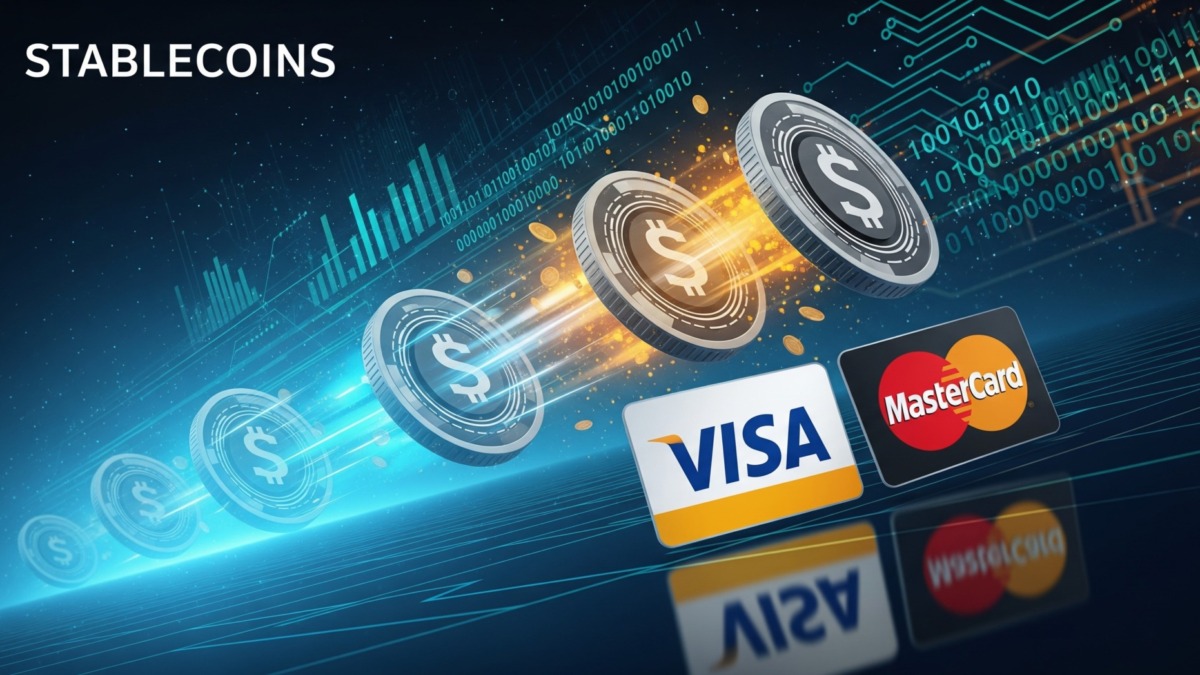
You’ve probably seen the headline by now: stablecoins processed $33 trillion in transaction volume in 2025, surpassing the combined $25.5 trillion handled by Visa and Mastercard in the same period (Forbes). It’s been repeated across crypto media, investor decks, and conference stages throughout 2026, often framed as evidence that card networks are on borrowed time. It’s also, according to the payments specialists who actually understand how these systems work internally, a comparison that misunderstands what’s happening.
Why the Headline Comparison Is Misleading
Here’s the architectural reality most viral commentary skips entirely: when you swipe a credit card, money doesn’t actually move in that moment — data moves. The transaction sends an authorization request through a chain of intermediaries (payment processor, acquiring bank, Visa’s network, issuing bank) that checks available credit and responds “approved” in about two seconds. Your bank simply places a hold on the funds; no actual money transfer occurs at that point (Crossmint).
Stablecoins operate at a fundamentally different layer of the financial stack — settlement, not authorization. When you send USDC from one wallet to another, authorization and final settlement happen simultaneously in a single blockchain transaction, with no separate clearing process or correspondent banking chain required. That means stablecoins are competing directly with ACH and SWIFT — the settlement and cross-border transfer infrastructure — not with Visa and Mastercard’s authorization network (Crossmint).
The clearest evidence this distinction matters: Visa and Mastercard aren’t fighting stablecoins — they’re actively integrating them into their own settlement infrastructure. Visa expanded its stablecoin settlement program in 2025 to support USDC, PYUSD, USDG, and EURC across four blockchains, already settling over $225 million through these channels specifically to help issuers and acquirers fulfill their existing VisaNet settlement obligations faster (Crossmint).
The Real Battle: Card Networks Are Building Their Own Stablecoin
The far more consequential story, and one that’s received comparatively little mainstream attention, is that Visa, Mastercard, Stripe, and Coinbase have moved to build stablecoin infrastructure rather than simply integrate around existing options from Circle and Tether — the two firms that currently control roughly 80% of the $325 billion stablecoin market (Forbes).
This culminated on June 30, 2026, with the public launch of a consortium called Open Standard, which will issue a dollar-pegged stablecoin called Open USD. The group’s members — Visa, Mastercard, Coinbase, and BNY — structured the initiative around collaborative economics, sharing earnings from the reserves backing the token among members after operational costs, and allowing businesses to mint and redeem the stablecoin without fees or volume limits (Crowdfund Insider).
Zach Abrams, Open Standard’s founding CEO, framed the initiative’s rationale around a specific gap: scaling stablecoins for genuine business use requires a system that’s transparent, economical, high-volume capable, and structured to serve participants’ collective interests — implicitly distinguishing the consortium’s approach from the current Tether/Circle duopoly model.
The strategic logic behind this move is worth understanding clearly: an issuer like Tether or Circle sells a token, but has no consumer brand, no merchant acceptance network, and no balance-sheet relationship with the world’s banks. A network like Visa or Mastercard sells the reason a merchant accepts a payment method in the first place, and already holds those banking relationships. That distribution advantage is something Circle and Tether cannot quickly acquire at any price — and it’s exactly the asset Visa and Mastercard already possess (Forbes).
The Prize Underneath: Reserve Yield
There’s a specific financial mechanism driving much of this consortium activity that deserves more attention than it’s getting: stablecoin reserves — the cash and short-term Treasuries backing every token in circulation — earn interest. At a market approaching $325 billion, that yield runs into billions of dollars annually. Under the GENIUS Act, the US federal stablecoin framework signed into law in 2025, issuers are barred from passing that interest directly to stablecoin holders — meaning the yield accrues entirely to whoever issues the coin and controls its circulation (Forbes). That single provision explains much of the strategic urgency behind Open Standard: it’s not just about payments infrastructure, it’s about capturing a growing pool of risk-free reserve income currently flowing almost entirely to Tether and Circle.
Where Stablecoins Are Already Winning: B2B Payments
Beneath the consumer-facing headlines, the more concrete adoption story is happening in business-to-business payments. B2B stablecoin payments expanded from under $100 million per month in 2023 to more than $6 billion by mid-2025, now representing roughly 60% of genuine economic stablecoin activity rather than speculative crypto trading flows. Around 77% of surveyed companies already use stablecoins for supplier payments, and 41% report cost savings of at least 10% (Forbes). Crucially, this growth continued through 2025 even as speculative crypto trading activity cooled — a pattern that specifically distinguishes a structural infrastructure shift from a hype-driven bubble.
The cost advantage for large B2B transactions is genuinely dramatic: a $10,000 US card transaction typically carries roughly $150-250 in combined interchange, network, and acquirer fees, while the same value moved as USDC on a low-cost blockchain settles for mere cents in transaction gas fees, regardless of transaction size (Eco). That structural advantage is largest precisely for the high-ticket B2B flows where stablecoin adoption is concentrating.
The Underexplored Angle: What This Means for Monetary Sovereignty Beyond the US
Here’s the dimension of this story that gets the least attention in payments-industry coverage, but arguably matters most globally: stablecoins function as a form of “digital dollarization.” Historically, countries experiencing high inflation or currency instability have seen citizens shift toward holding foreign currencies, typically US dollars, as a store of value. Stablecoins now allow this same substitution to happen digitally, letting millions of users in unstable economies access dollar-denominated assets without needing a traditional bank account at all (Global Policy Journal).
For individual users in weak-currency economies, this is entirely rational risk management. But at a systemic level, if this substitution becomes widespread, central banks in those countries — particularly those with weak institutions, high inflation, or limited public confidence in the domestic currency — risk gradually losing part of the monetary ecosystem through which they exercise monetary sovereignty (Global Policy Journal). This is precisely the concern that surfaced in the Bloomberg reporting on concerns over economic sovereignty fueling a search for alternatives to Visa and Mastercard — the underlying anxiety isn’t really about card network fees, it’s about which entities, public or private, ultimately control the rails through which a country’s economic activity flows.
There’s also a quieter, related concern: private payment infrastructure companies (Visa, Mastercard, PayPal, and now stablecoin issuers) don’t issue money themselves, but they control the channels through which money circulates, extracting fees on every transaction that function economically similar to a tax — without being collected by, or accountable to, any government (Global Policy Journal).
The Regulatory Split Shaping Where This Goes Next
Regulatory divergence is already visibly shaping stablecoin adoption patterns globally. In the US, the GENIUS Act has provided the first federal stablecoin framework, favoring bank and licensed issuers. In Europe, MiCA (Markets in Crypto-Assets regulation) is creating a passportable EU-wide licensing framework, but its compliance costs are reportedly pushing some firms out of the European market entirely — Tether itself has refused to comply with MiCA, arguing its reserve rules create systemic banking risk (Payment Expert). Asia is moving at varying speeds, with Singapore, Hong Kong, and Japan each building stablecoin-friendly regulatory frameworks specifically designed to attract this activity to their markets.
What This Means for Businesses and Financial Institutions
For treasury and payments teams, the practical decision is no longer whether to engage with stablecoins — the B2B volume data and consortium formation activity have largely settled that question — but how and when. Building internal stablecoin capability from scratch is expensive and slow; partnering with existing infrastructure providers is faster but creates dependencies; and acquiring specialized firms outright, as Mastercard did with its BVNK purchase, is the most decisive path but the best acquisition targets are disappearing quickly as consolidation accelerates (Forbes).
For businesses specifically operating in emerging markets with currency instability, stablecoin-based supplier payments and remittances already offer measurable cost savings and settlement speed advantages worth evaluating now, rather than waiting for the consumer-facing “Visa vs. stablecoin” debate to resolve — that debate is largely beside the point for B2B use cases already delivering value today.
The Bottom Line
The “stablecoins beat Visa and Mastercard” framing captures headlines but ultimately obscures more than it reveals. Card networks aren’t being replaced — they’re integrating stablecoin settlement into their own infrastructure and building competing stablecoins of their own through consortiums like Open Standard, explicitly to capture the reserve-yield economics currently flowing to Tether and Circle. The genuinely disruptive story is happening in B2B payments and cross-border settlement, where stablecoins are displacing slower, costlier rails like ACH and SWIFT — and in the broader, less-discussed question of what happens to monetary sovereignty in weaker-currency economies as dollar-denominated digital assets become accessible to anyone with a smartphone, no bank account required.
Discover more from Startups Pro,Inc
Subscribe to get the latest posts sent to your email.

Bitcoin climbed more than 2% to surpass $61,000 on the same day gold rose after a weaker-than-expected US jobs report, an unusual simultaneous rally across two assets that typically don’t move in tandem, driven by institutional buyers and long-term holders repositioning for a more accommodative Federal Reserve, according to Google Finance’s market summary.
A Rare Joint Rally
Gold and Bitcoin have historically diverged more often than they’ve converged, gold as the traditional inflation hedge and safe haven, Bitcoin as a higher-volatility asset that has behaved more like a risk-on tech proxy than digital gold for much of its history. Their simultaneous rise this week reflects a market pricing in the same underlying catalyst through two different channels: falling expectations for further Federal Reserve tightening. Gold’s rally follows a pattern established earlier in the year, when the metal jumped over 1% and touched a near one-week high immediately after the preliminary US-Iran peace deal was announced, according to CNBC’s coverage of that earlier move.
UBS analyst Giovanni Staunovo offered the clearest explanation of the mechanism at the time, telling CNBC that “market participants are pricing out rate hikes due to lower oil prices, which is lifting the yellow metal,” while cautioning that “near-term, I would expect some consolidation, until we get some clarity from the Fed.” That same dynamic, falling oil prices reducing inflation risk and therefore rate-hike expectations, has now resurfaced following the June jobs report, with gold benefiting from both a weaker dollar and reduced rate-hike odds simultaneously.
The Institutional Bitcoin Story
Bitcoin’s rally carries a distinct institutional dimension. Google Finance’s markets summary attributes the move specifically to “renewed accumulation from long-term holders and institutional buyers like MetaPlanet,” a pattern that reflects Bitcoin’s gradual evolution over the past several years from a primarily retail-driven speculative asset toward one with meaningful institutional balance-sheet demand. That shift matters for how the asset now correlates with macro catalysts: institutional buyers accumulating Bitcoin in response to easing Fed expectations behave more like traditional macro-driven capital allocation than the retail momentum trading that characterized earlier Bitcoin cycles.
Why the Dollar Is the Common Thread
Both rallies trace back to the same currency mechanic. When the preliminary US-Iran deal was announced in mid-June, the US dollar fell to a 10-day low, making dollar-priced gold more affordable for holders of other currencies and providing a direct tailwind to bullion prices independent of any change in underlying demand, per CNBC’s reporting. A weaker dollar similarly benefits Bitcoin, both because dollar-denominated crypto becomes cheaper for international buyers and because a softer greenback typically accompanies the kind of looser monetary policy expectations that favor scarce, non-yield-bearing assets over cash.
Oil’s Falling Price Is the Real Driver
The connective tissue linking gold, Bitcoin, and Fed policy expectations back to a single root cause is the trajectory of oil prices. WTI crude fell nearly 2% to just above $68 a barrel in the days before the June jobs report, down almost 20% over the prior two weeks, according to Schwab’s market update, as indirect US-Iran talks showed signs of progress. Falling oil prices reduce the clearest transmission channel through which the Strait of Hormuz disruption has been pushing global inflation higher since February, and it is precisely that reduced inflation risk, not any independent safe-haven flight from equities, that appears to be driving the current gold and Bitcoin strength.
This distinguishes the current rally from a classic crisis-driven flight to safety. Equity markets were simultaneously hitting records, with the Dow closing at an all-time high of 52,900.07 the same day gold and Bitcoin advanced, according to Google Finance’s coverage, meaning investors were not fleeing risk assets into safe havens so much as repricing the entire asset spectrum, stocks, gold, and crypto alike, around the same underlying expectation of easier Fed policy ahead.
What Could Break the Pattern
The joint rally’s durability depends heavily on two unresolved questions already shaping markets elsewhere: whether the June US-Iran peace deal holds through the summer, given the pattern of repeated violations and re-escalations that followed an earlier April ceasefire attempt, and whether the Federal Reserve’s July 30 decision validates the market’s current dovish positioning. Any renewed disruption to the Strait of Hormuz, a real possibility given continued vessel attacks reported as recently as late June, would likely reverse the oil-price decline that has been the common driver behind both assets’ recent strength, sending inflation expectations, and by extension rate-hike odds, back higher in a move that would complicate the easy-money narrative currently supporting both gold and Bitcoin simultaneously.
Discover more from Startups Pro,Inc
Subscribe to get the latest posts sent to your email.
ETFs are reshaping markets as AI hype drives volatility and oil reversals hit energy. A political‑economy view of risk, power, and flows.
ETFs are “eating the world” because low‑cost indexing has pulled vast amounts of capital into a small set of benchmarks, concentrating ownership and flows. AI‑fueled swings intensify crowding in tech, while oil’s reversal exposes how passive portfolios can lag real‑economy shifts and geopolitics.
Key Takeaways
- ETFs made investing cheaper and easier—but they also concentrate flows, power, and price discovery in a handful of indexes and providers.
- AI‑driven enthusiasm creates crowding risk inside passive vehicles, amplifying both rallies and selloffs.
- Oil’s reversal shows the blind spot of broad indexing: real‑economy shocks can move faster than passive portfolios.
- Regulators see the plumbing risks, but policy still lags the market reality.
- Investors need to understand the political economy of indexing, not just its fees.
The Hook: A Market Built for Speed, Not Reflection
Picture a day when the market opens with a jolt: an AI‑themed mega‑cap sells off on a single earnings comment, energy stocks surge on an OPEC headline, and most retail portfolios barely blink—because the flows are pre‑programmed. That’s the new normal. ETFs have turned markets into a high‑speed logistics network where money moves with incredible efficiency, but not always with great wisdom.
This is the core paradox: ETFs are eating the world, yet the world they’re eating is becoming more concentrated, more narrative‑driven, and more sensitive to macro shocks. The political economy angle matters here—because when capital becomes more passive, power becomes more centralized.
1) ETFs Are Eating the World—And It’s Not Just About Fees
ETFs won because they made investing easy: low costs, intraday liquidity, diversification in one click. The U.S. SEC’s ETF rulemaking in 2019 standardized and accelerated ETF growth by making it easier to launch and operate funds, effectively industrializing the format’s expansion (SEC Rule 6c‑11). Add zero‑commission trading and mobile brokerages, and the ETF wrapper became the market’s default delivery system.
But the bigger story is market structure. When indexing dominates, the market stops being a collection of independent price judgments and starts behaving like an ecosystem of shared pipes. The evidence is in decades of data on active manager underperformance: the persistence of indexing’s edge has been documented by S&P Dow Jones Indices’ SPIVA reports, which track active‑vs‑index outcomes across asset classes and regions (SPIVA Scorecards). As more capital goes passive, the marginal price setter becomes thinner.

The Power Shift You Don’t See in Your Brokerage App
Every ETF is a wrapper around an index. That means index providers and mega‑asset managers now sit at the center of capital allocation. Methodology choices—what gets included, what gets excluded, how often rebalanced—are no longer small technical details; they are de facto policy decisions. Index providers publish their methodologies and governance processes, but their influence has outgrown their public visibility (S&P Dow Jones Indices Methodology, MSCI Index Methodology Hub).
The political economy question is straightforward: who governs the gatekeepers? When a handful of index decisions can redirect billions overnight, “neutral” becomes a powerful political claim—one that deserves scrutiny.
2) Market Plumbing: When the Wrapper Becomes the Market
ETF liquidity is often secondary‑market liquidity—trading of ETF shares between investors. But the primary market (where new shares are created or redeemed via authorized participants) is what keeps the ETF aligned with its underlying holdings. This is sophisticated plumbing that works beautifully—until it doesn’t.
Regulators have flagged the risks of liquidity mismatch and stress dynamics in market‑based finance. The IMF’s Global Financial Stability Reports have repeatedly examined how investment funds can amplify shocks through redemptions and market depth constraints (IMF Global Financial Stability Report). The BIS Quarterly Review has also analyzed how ETFs can transmit stress across markets when liquidity in underlying assets dries up (BIS Quarterly Review).
This doesn’t mean ETFs are fragile by default. It means ETF stability is conditional—on underlying liquidity, dealer balance sheets, and the health of market‑making infrastructure. That’s a systemic issue, not an investor‑education footnote.
3) AI Jitters: Narrative Crowding Meets Passive Plumbing
AI is a genuine technological shift—but the market’s response has a familiar shape: concentration, hype cycles, and correlation spikes.
As AI narratives accelerate, money tends to flow into the same handful of mega‑cap names and thematic ETFs. That can create a feedback loop: flows drive prices, prices validate the narrative, and the narrative attracts more flows. Research institutions and regulators have emphasized how valuation sensitivity and concentrated exposures can heighten market vulnerability, especially when expectations outrun fundamentals (Federal Reserve Financial Stability Report).
The irony? Passive investing is supposed to diversify risk. But when the market’s capitalization itself is concentrated, indexing becomes a lever that amplifies concentration. Index providers track and publish concentration metrics, but the shift is structural: if the index is top‑heavy, the index fund is top‑heavy.
Morningstar’s fund flow research highlights how investor demand often clusters in the same categories at the same time—precisely the behavior that can exacerbate crowding in narrative‑driven sectors (Morningstar Fund Flows Research). In an AI‑fueled cycle, this means the same ETF wrapper that democratized access can also democratize risk.
4) Oil’s Reversal: The Old Economy Bites Back
While AI dominates headlines, oil reminds us that real‑world supply and geopolitics still run the table. When oil reverses—whether due to OPEC decisions, demand surprises, or geopolitical shocks—sector weights and macro assumptions change faster than broad passive portfolios can adapt.
The most credible real‑time oil data comes from institutions that track physical balances and policy developments. The International Energy Agency’s Oil Market Report, the U.S. EIA’s Short‑Term Energy Outlook, and OPEC’s Monthly Oil Market Report provide the market’s core macro narrative (IEA Oil Market Report, EIA Short‑Term Energy Outlook, OPEC MOMR).
Now connect that to ETFs: broad‑market indexes rebalance slowly, while sector ETFs can swing on a dime. If oil’s reversal signals a structural shift—say, prolonged supply constraints or a geopolitical premium—passive portfolios are late to the party by design. In the meantime, ESG‑tilted portfolios may under‑ or over‑expose investors to energy at precisely the wrong time, a tension widely discussed in responsible‑investment circles (UN‑supported PRI).
Oil’s reversal isn’t just a commodity story. It’s a governance and allocation story—about how passive capital interacts with geopolitics, energy policy, and the physical economy.
5) The Political Economy of Passive Power
ETFs feel apolitical because they’re built on formulas. But formulas are choices, and choices accumulate power. When a few providers and index committees control the rules, the market’s “neutrality” becomes a governance issue.
Concentration of Ownership and Voting
Large asset managers now represent substantial voting power across public companies—a fact regulators and policy analysts have debated extensively. The SEC’s resources on proxy voting and fund stewardship underscore the governance significance of fund voting policies (SEC Proxy Voting Spotlight). The OECD’s corporate governance work also highlights how ownership structures influence accountability and long‑term capital allocation (OECD Corporate Governance).
The result is a paradox: indexing reduces fees, but concentrates influence. That influence is often exercised behind closed doors via stewardship teams, policy statements, and index inclusion decisions.
Regulatory Lag
Central banks and financial authorities increasingly focus on market‑based finance and nonbank intermediation. Yet ETF‑specific regulation still looks incremental compared with the speed of market evolution. The IMF and BIS acknowledge these dynamics, but the policy response remains cautious—partly because ETFs have also delivered undeniable investor benefits (IMF GFSR, BIS Annual Economic Report).
In short: we have system‑level dependence on a structure whose governance remains diffuse.
6) What This Means for Investors, Policymakers, and Markets
For long‑term investors
- Know what you own: broad ETFs are only as diversified as the underlying index. If the index is top‑heavy, your portfolio is too.
- Understand liquidity layers: ETF trading liquidity can mask underlying asset illiquidity during stress.
- Treat thematic ETFs as tactical: AI‑focused ETFs can be useful, but they behave like crowded trades, not balanced portfolios.
For policymakers
- Index governance deserves visibility: transparency in methodology changes, inclusion criteria, and stewardship votes matters.
- Stress‑test the plumbing: market‑making capacity and authorized participant resilience should be policy priorities.
- Don’t confuse access with resilience: ETFs democratize investing, but democratization can also democratize systemic risk.
For institutions
- Scenario‑test the narrative: what if AI expectations compress sharply? What if oil flips the inflation story?
- Use active risk where it matters: passive core can coexist with active hedges or sector rotations.
- Engage stewardship intentionally: if you own the market, you own its outcomes.
7) Three Scenarios to Watch
- Crowding unwind: AI‑exposed indexes and ETFs face synchronized selling, revealing liquidity gaps.
- Oil regime shift: a sustained energy price reversal reshapes inflation expectations and sector leadership, forcing passive reweighting.
- Regulatory recalibration: a policy move on ETF transparency or index governance changes the economics of passive flows.
None of these scenarios are destiny—but all are plausible.
Conclusion: Convenience Won. Power Concentrated.
ETFs didn’t just win on price—they won on architecture. They are the pipes through which modern capital flows. But when the pipes grow large enough, they shape the city.
AI jitters and oil’s reversal are not separate stories. They are stress tests for a market that now relies on passive plumbing to allocate active realities. The promise of ETFs was democratization; the risk is centralization without accountability.
The real question isn’t whether ETFs are “good” or “bad.” It’s whether we’re willing to govern the system they’ve become. Because in a world where ETFs are eating the world, the rules of the dinner table matter more than the menu.
Discover more from Startups Pro,Inc
Subscribe to get the latest posts sent to your email.

PM Invites US-Based Pakistani Business Community to Invest in Pakistan as Investment Opportunities Expand

Trump Accounts Reshuffle Tens of Millions in Big Tech & AI Holdings

NIC Islamabad Launches Exclusive Acceleration Program with Up to PKR 5 Million Equity-Free Grant Support

World School Summit 2026 Malaysia: 41st Edition

Global Digital Trade Expo 2026: Dates, Schedule, Venue, Registration and Everything You Need to Know

How to Claim Your Sony PlayStation Store Credit Settlement (Up to $33.66)

CES 2027 Las Vegas: Registration Details, Dates and Venue [Ultimate Guide]

IPhone 18 Pro Specifications, Pricing, and Thermal Architecture Leaks Analyzed

Pre-IPO Investing Strategies: How Institutional Money is Approaching Anthropic

Smash Bros Ultimate 13.0.5 Patch Notes: What Actually Changed
CES 2027 Las Vegas: Registration Details, Dates and Venue [Ultimate Guide]
Global Digital Trade Expo 2026: Dates, Schedule, Venue, Registration and Everything You Need to Know
How to Claim Your Sony PlayStation Store Credit Settlement (Up to $33.66)
IPhone 18 Pro Specifications, Pricing, and Thermal Architecture Leaks Analyzed
NIC Islamabad Launches Exclusive Acceleration Program with Up to PKR 5 Million Equity-Free Grant Support
World School Summit 2026 Malaysia: 41st Edition
Trump Accounts Reshuffle Tens of Millions in Big Tech & AI Holdings
PM Invites US-Based Pakistani Business Community to Invest in Pakistan as Investment Opportunities Expand
-
Digital5 years ago
Social Media and polarization of society
-
Digital6 years ago
Pakistan Moves Closer to Train One Million Youth with Digital Skills
-
Digital5 years ago
Karachi-based digital bookkeeping startup, CreditBook raises $1.5 million in seed funding
-
Kashmir6 years ago
Pakistan Mission Islamabad Celebrates “KASHMIRI SOLIDARITY DAY “
-
Digital6 years ago
WHATSAPP Privacy Concerns Affecting Public Data -MOIT&T Pakistan
-
News6 years ago
Dr . Arif Alvi visits the National Museum of Pakistan, Karachi
-
China5 years ago
TIKTOK’s global growth and expansion : a bubble or reality ?
-
Business5 years ago
Are You Ready to Start Your Own Business? 7 Tips and Decision-Making Tools