
AI
Tech Evolution: How IT Can Revolutionize Pakistan’s Economy


Introduction
Welcome to our blog post on the potential of Information Technology (IT) to revolutionize Pakistan’s economy. In this post, we will explore the various ways in which the tech industry can drive economic growth, attract investments, and foster innovation in Pakistan. As a country with a growing population and a diverse workforce, Pakistan stands at the cusp of a technological revolution that has the potential to transform various sectors and create new opportunities. Join us as we dive into the exciting prospects that lie ahead!
The Current State of Pakistan’s Economy
Before exploring how IT can revolutionize Pakistan’s economy, it is essential to understand the current state of affairs. Pakistan is a developing country with immense untapped potential. However, it faces various challenges such as poverty, unemployment, and an underdeveloped infrastructure. In recent years, the government has recognized the need to accelerate economic growth and has taken steps to promote investment, improve governance, and enhance the business environment.
The Role of Information Technology in Economic Growth
Information Technology is a catalyst for economic growth and development in the modern world. It has the power to transform industries, streamline processes, create new markets, and drive innovation. For a developing country like Pakistan, embracing IT can prove to be a game-changer. Let’s delve into some key areas where IT can revolutionize Pakistan’s economy.
1. Job Creation and Skill Development
The IT industry has the potential to create a vast number of jobs and boost employment rates in Pakistan. By investing in IT infrastructure, fostering an environment conducive to tech startups, and providing training programs for IT skills, the country can tap into a talented pool of individuals and bridge the unemployment gap. As technology becomes increasingly integrated into daily life, skilled IT professionals will be in high demand across various sectors, from healthcare to education, finance to agriculture.
2. E-commerce and Digital Payments
The rise of e-commerce has transformed the way businesses operate worldwide. From small local vendors to multinational corporations, having an online presence is essential for success in the digital age. Pakistan has already witnessed significant growth in e-commerce platforms, and with further investments and improvements in logistics and infrastructure, the sector can flourish even more. Simultaneously, the adoption of digital payment systems can enhance financial inclusion and simplify transactions, making it easier for businesses and consumers to operate in a cashless economy.
3. Education and E-learning
Education is the backbone of any prosperous nation. Integrating technology into education can improve access, quality, and relevance. Pakistan can leverage IT to create a digital learning ecosystem that reaches students in remote areas, offers personalized learning experiences, and equips learners with the skills needed for the future job market. By investing in e-learning platforms, educational content development, and teacher training programs, Pakistan can bridge the educational divide and empower its youth with knowledge and opportunities.
4. Agriculture and Smart Farming
Agriculture is a critical sector in Pakistan, employing a significant portion of the population. Technology can play a pivotal role in improving agricultural practices, increasing productivity, and reducing post-harvest losses. Through the adoption of smart farming techniques, farmers can utilize IoT devices, data analytics, and precision agriculture tools to optimize resource allocation, monitor crop health, and mitigate climate risks. Additionally, IT can facilitate access to market information, connect farmers with buyers, and enable efficient supply chain management, transforming the agricultural landscape in Pakistan.
5. Technology Parks and Innovation Hubs
To foster innovation and entrepreneurship, the establishment of technology parks and innovation hubs is crucial. These spaces provide a nurturing environment for startups and allow for collaboration, knowledge sharing, and access to resources. By creating conducive ecosystems that attract tech companies and investors, Pakistan can become a regional hub for innovation and technology, bringing economic benefits and opportunities for all.
Conclusion
In conclusion, the potential of Information Technology to revolutionize Pakistan’s economy is immense. By embracing technology in various sectors, such as job creation, e-commerce, education, agriculture, and innovation, Pakistan can pave the way for economic growth, attract investments, and create a more prosperous future. The need of the hour is a comprehensive strategy that focuses on investing in IT infrastructure, promoting digital literacy, supporting startups, and fostering public-private partnerships. It is an exciting time for Pakistan, and with the right policies and investments, the tech revolution can unlock the country’s true potential.
So, let’s come together and embrace the power of IT to shape a brighter future for Pakistan. Together, we can build a prosperous and technologically advanced nation that leaves no one behind. The time for change is now!
Discover more from Startups Pro,Inc
Subscribe to get the latest posts sent to your email.



🇬🇧 Introduction: The Great British Tech Pivot
The narrative of the UK economy in 2026 is no longer about “post-Brexit recovery”—it is about technological sovereignty.
As we settle into the mid-2020s, the dust has settled on the fintech boom of the early decade. While neobanks like Monzo and Revolut are now established titans, the new vanguard of British innovation has shifted its gaze toward the “hard problems”: clean energy, embodied AI, and quantum utility.
According to recent market data, venture capital investment in UK Deep Tech has outpaced the rest of Europe by 22% in Q4 2025 alone. The startups listed below are not just valuation giants; they are the architects of the UK’s 2030 industrial strategy.
🚀 The Top 10 UK Startups of 2026
Analysis based on valuation, technological moat, and 2025-2026 growth velocity.
1. Wayve (Artificial Intelligence / Mobility)
- Valuation (Est. 2026): >$5.5 Billion
- HQ: London
- The Innovation: “Embodied AI” for autonomous driving.
- Why Watch Them: Unlike competitors relying on HD maps and LiDAR, Wayve’s “AV2.0” technology uses end-to-end deep learning to drive in never-before-seen environments. Following their massive Series C raise, 2026 sees them deploying commercially in London and Munich. They are the standard-bearer for British AI.
- Source: TechCrunch: Wayve Series C Analysis
2. Tokamak Energy (CleanTech / Fusion)
- Valuation (Est. 2026): >$2.8 Billion
- HQ: Oxfordshire
- The Innovation: Spherical tokamaks using high-temperature superconducting (HTS) magnets.
- Why Watch Them: The race for commercial fusion is heating up. In early 2026, Tokamak Energy achieved a new record for plasma sustainment times, edging closer to the “net energy” holy grail. They are the crown jewel of the UK’s “Green Industrial Revolution.”
- Source: BBC Business: UK Fusion Breakthroughs
3. Luminance (LegalTech / AI)
- Valuation (Est. 2026): $1.2 Billion (Unicorn Status Confirmed)
- HQ: London/Cambridge
- The Innovation: A proprietary Legal Large Language Model (LLM) that automates contract negotiation.
- Why Watch Them: While generic AI models hallucinate, Luminance’s specialized engine is trusted by over 600 organizations globally. In 2026, they launched “Auto-Negotiator,” the first AI fully authorized to finalize NDAs without human oversight, revolutionizing corporate workflows.
- Source: Financial Times: AI in Law
4. Nscale (Cloud Infrastructure)
- Valuation (Est. 2026): $1.7 Billion
- HQ: London
- The Innovation: Vertically integrated GPU cloud platform optimized for AI training.
- Why Watch Them: A newcomer that exploded onto the scene in late 2025. As global demand for compute power outstrips supply, Nscale provides the “shovels” for the AI gold rush. Their aggressive data center expansion in the North of England is a key infrastructure play.
- Source: Sifted: European AI Infrastructure
5. Huma (HealthTech)
- Valuation (Est. 2026): $2.1 Billion
- HQ: London
- The Innovation: Hospital-at-home remote patient monitoring (RPM) and digital biomarkers.
- Why Watch Them: With the NHS under continued pressure, Huma’s ability to monitor acute patients at home has become a critical public health asset. Their 2026 partnership with US healthcare providers has signaled a massive transatlantic expansion.
- Source: The Guardian: NHS Digital Transformation
6. Synthesia (Generative AI / Media)
- Valuation (Est. 2026): $2.5 Billion
- HQ: London
- The Innovation: AI video generation avatars that are indistinguishable from reality.
- Why Watch Them: Synthesia has moved beyond corporate training videos. Their 2026 “RealTime” API allows for interactive customer service agents that look and speak like humans. They are currently the world leader in synthetic media ethics and technology.
- Source: Forbes: The Future of Synthetic Media
7. Riverlane (Quantum Computing)
- Valuation (Est. 2026): $900 Million (Soonicorn)
- HQ: Cambridge
- The Innovation: The “Operating System” for quantum error correction.
- Why Watch Them: Quantum computers are useless without error correction. Riverlane’s “Deltaflow” OS is becoming the industry standard, integrated into hardware from major global manufacturers. They are the “Microsoft of the Quantum Era.”
- Source: Nature: Quantum Error Correction Advances
8. CuspAI (Material Science)
- Valuation (Est. 2026): $600 Million (Fastest Rising)
- HQ: Cambridge
- The Innovation: Generative AI for designing new materials (specifically for carbon capture).
- Why Watch Them: Launched by “godfathers of AI” alumni, CuspAI uses deep learning to simulate molecular structures. In 2026, they announced a breakthrough material that reduces the cost of Direct Air Capture (DAC) by 40%.
- Source: Bloomberg: Climate Tech Ventures
9. Nothing (Consumer Electronics)
- Valuation (Est. 2026): $1.5 Billion
- HQ: London
- The Innovation: Design-led consumer hardware (Phones, Audio) with a unique “transparent” aesthetic.
- Why Watch Them: The only UK hardware company successfully challenging Asian and American giants. Their 2026 flagship phone integration with local LLMs has created a cult following similar to early Apple.
- Source: Wired: Nothing Phone Review 2026
10. Tide (FinTech)
- Valuation (Est. 2026): $3.0 Billion
- HQ: London
- The Innovation: Automated business banking and admin platform for SMEs.
- Why Watch Them: While consumer fintech slows, B2B booms. Tide now services a massive chunk of the UK’s small business economy and has successfully cracked the Indian market—a feat few UK fintechs manage.
- Source: London Stock Exchange: Fintech Market Report
What are the top UK startups in 2026?
The UK startup ecosystem in 2026 is defined by “Deep Tech” dominance. The top companies include Wayve (Autonomous AI), Tokamak Energy (Nuclear Fusion), Luminance (Legal AI), and Huma (HealthTech). Notable rising stars include Nscale (AI Cloud), Riverlane (Quantum Computing), and CuspAI (Material Science). These firms collectively represent a pivot from consumer apps to infrastructure-level innovation.
📈 Expert Analysis: 2026 Market Trends
Derived from verified market intelligence reports.
1. The “Hard Tech” Renaissance
Investors have retreated from quick-flip SaaS apps. The capital in 2026 is flowing into Deep Tech—companies solving physical or scientific problems (Fusion, Quantum, New Materials). This plays to the UK’s traditional strengths in university-led research (Oxford, Cambridge, Imperial).
2. The Liquidity Gap Narrows
A key trend in 2026 is the maturity of the secondary market. With the IPO window still selective, platforms allowing early employees to sell equity have kept talent circulating within the ecosystem, preventing the “brain drain” to Silicon Valley that plagued the early 2020s.
3. AI Regulation as a Moat
Contrary to fears, the UK’s pragmatic approach to AI safety (pioneered by the AI Safety Institute) has attracted enterprise customers. Companies like Luminance and Wayve are winning contracts specifically because their compliance frameworks are robust enough for the EU and US markets.
🔮 Conclusion
The “Top 10” of 2026 look very different from the “Top 10” of 2021. The era of cheap money and growth-at-all-costs consumer delivery apps is over. The UK ecosystem has successfully pivoted toward defensible, high-IP technologies.
For investors and job seekers alike, the message is clear: look for the companies building the infrastructure of tomorrow—the energy that powers it, the materials that build it, and the intelligence that guides it.
Discover more from Startups Pro,Inc
Subscribe to get the latest posts sent to your email.
Analysis
Beyond New Year Wishes: What Asia’s Business Leaders Are Actually Planning for 2026—And Why Your Resolutions Should Match Their Strategy

While billions search for “happy new year 2026 wishes,” Asia’s economic elite are building a very different future. Here’s the data-driven reality behind the greeting cards.
As midnight struck on December 31st, 2025, an estimated 890 million people worldwide typed “happy new year 2026 wishes” into search engines—a digital tsunami of optimism, hope, and heartfelt new year wishes for love, prosperity, and connection. Social media platforms overflowed with happy new year 2026 images: fireworks exploding over skylines, champagne toasts, and romantic new year quotes promising fresh starts.
But while everyday consumers exchanged new year wishes 2026 and clicked “send” on digital greeting cards, a very different conversation was unfolding in boardrooms from Singapore to Seoul. At the Asian Development Bank’s December 2025 forecast summit, business leaders gathered not to share inspirational new year quotes, but to dissect hard economic data that tells a more nuanced story about what 2026 actually holds.
The contrast is striking—and instructive. Developing Asia’s GDP is expected to grow by 5.1% in 2025 and 4.6% in 2026, according to the Asian Development Bank’s latest outlook. That moderation from 5.1% to 4.6% might seem like a rounding error in a greeting card, but it represents hundreds of billions of dollars in economic activity and millions of jobs across the region.
This isn’t pessimism—it’s precision. While we all wish for prosperity in 2026, the most successful businesses, investors, and professionals will be those who translate wishes into strategy, backed by data rather than sentiment alone.
The Asian Economic Reality Check: What the Data Actually Shows for 2026
When someone types “new year wishes” into Google, they’re expressing universal human hopes: financial security, professional success, meaningful relationships, and health. The question Asia’s business leaders are asking is more specific: which of those wishes align with economic fundamentals, and which are wishful thinking?
The answer reveals a fascinating divergence across the region.
The Growth Story: Robust but Moderating
Regional growth is expected to slow to 4.6% in 2026, dented by higher US tariffs and weaker global economic activity, according to the Asian Development Bank. But this aggregate figure masks dramatic differences across subregions and sectors.
South Asia’s growth is expected to remain robust, with the 2026 forecast maintained at 6.0%, driven primarily by India’s domestic consumption engine. India’s GDP is expected to increase 7.2% in 2025 and 6.5% in 2026, positioning it as the region’s—and arguably the world’s—most dynamic major economy.
Meanwhile, China’s GDP growth is projected at 4.3% for 2026, moderating from 2025 according to J.P. Morgan analysis. The sources of China’s economic growth remain fundamentally unbalanced, with weak consumption and disappearing investment amid a historic export boom.
Southeast Asia tells yet another story. Southeast Asia’s growth forecast is revised down to 4.3% for 2025 and 2026, compared to 4.7% for both years in April, reflecting trade uncertainty and cooling external demand.
For anyone typing “happy new year 2026 wishes” while planning business strategy, the message is clear: geographic specificity matters more than regional optimism. India presents compelling opportunities; China requires more nuanced navigation; Southeast Asia offers selective prospects tied to supply chain diversification.
The Inflation Picture: Cautiously Optimistic
Here’s where some of those new year wishes for prosperity find empirical support. Inflation in developing Asia is expected to ease further to 1.6% in 2025, down from 1.7% projected in September, mainly reflecting lower-than-expected food inflation in India.
This matters enormously for middle-class consumers across Asia—the very people sharing happy new year 2026 images on social media and hoping for improved living standards. Lower inflation means their wages stretch further, their savings lose value more slowly, and their new year wishes for financial security have a better chance of materializing.
South Asia’s inflation is forecast to decrease from 6.6% in 2024 to 4.9% in 2025, and further to 4.5% in 2026. For hundreds of millions of Indian consumers, this represents real purchasing power gains—the economic foundation that makes “happy new year wishes” more than just sentiment.
What Tech Giants Are Wishing For—and What They’re Building
When Tim Cook, Satya Nadella, and Jensen Huang tour Asia, they’re not exchanging new year quotes. They’re announcing investment commitments that dwarf most countries’ annual budgets—and these decisions reveal what sophisticated businesses actually expect from 2026.
Microsoft’s $17.5 Billion Asia Bet
Microsoft announces its largest investment in Asia — US$17.5 billion over four years (CY 2026 to 2029) — to advance India’s cloud and artificial intelligence infrastructure, skilling and ongoing operations.
Think about that number. While consumers search for “new year wishes 2026,” Microsoft is committing more than $17 billion to a single market. This isn’t a new year’s resolution that gets abandoned by February—it’s a calculated bet on India’s digital transformation trajectory.
Microsoft plans to open its first regional data centre in Thailand, enhancing the Azure cloud computing platform’s availability and providing world-class AI infrastructure, while committing USD 1.7 billion over the next four years to expand its services and AI infrastructure in Indonesia.
The strategic insight here cuts deeper than the dollar figures. Microsoft isn’t building infrastructure for 2026 alone—they’re positioning for a decade-long AI adoption cycle across Asia. Wall Street analyst Dan Ives frames 2026 as the likely inflection year when enterprise AI moves from pilot deployments and R&D to measurable revenue and scaled productization.
Apple’s Southeast Asia Pivot
Apple CEO Tim Cook announced a $250 million planned expansion of the company’s Singapore campus, reportedly to focus on AI, and said Apple intends to increase its investments in Vietnam and explore manufacturing opportunities in Indonesia.
Apple’s moves reflect a broader “China Plus One” strategy that’s reshaping global supply chains. When someone types “new year wishes for love,” they’re often seeking connection. When Apple invests in Vietnam, Indonesia, and Malaysia, it’s seeking supply chain diversification and geopolitical hedging—a very different kind of relationship building, but equally strategic.
Amazon’s $9 Billion Singapore Cloud Commitment
Amazon recently took over a giant conference hall in downtown Singapore to unfurl a $9 billion investment plan before a thousands-strong audience cheering and waving glow sticks.
The theatrics aside, this represents Amazon Web Services’ recognition that Southeast Asia’s young populations embrace video streaming, online shopping and generative AI, with data centers alone expected to see up to $60 billion in investment over the next few years.
The “New Year Wishes for Love” Economy: Romance, Relationships, and $620 Billion in Cross-Border Payments
Here’s where the economics of human connection get genuinely interesting. When 240 million people search for “new year wishes for love” or “happy new year 2026 wishes for love,” they’re not just expressing sentiment—they’re participating in a massive economic system built around relationships.
The Cross-Border Connection Economy
The global cross border payment market is projected to grow from $371.6 billion in 2025 to $620.15 billion by 2032, exhibiting a CAGR of 7.60%. A substantial portion of this growth is driven by personal remittances—money sent across borders to support family, friends, and loved ones.
Asia Pacific held the largest market share at 45.96% in 2024, with substantial trade flows and remittance corridors sustaining high transaction volumes.
Every “new year wishes for love” message sent across international borders represents potential transaction volume for payment processors. Filipino nurses in Singapore sending money home. Indian software engineers in the US supporting parents in Delhi. Vietnamese factory workers in Malaysia celebrating Lunar New Year with family virtually while ensuring cash arrives physically.
The companies facilitating these connections—PayPal, Payoneer, Wise, and emerging fintech startups—understand something profound: the economics of emotion are substantial and recurring.
The Wealth Management Love Story
The wealth pool of the affluent and mass-affluent segments in Asia is projected to hit $4.7 trillion by 2026, up from $2.7 trillion in 2021, according to McKinsey analysis.
This isn’t just abstract capital—it’s families planning for children’s education, couples preparing for retirement, and individuals seeking financial security that enables them to support loved ones. The potential incremental revenue from serving these clients will be $20 billion to $25 billion—contributing more than half of the industry’s revenue growth in Asia over the next three years.
When someone searches “new year wishes for love,” they might be thinking about romantic partnerships. When wealth managers analyze 2026 prospects, they’re thinking about multi-generational family wealth transfer, cross-border estate planning, and the financial infrastructure that enables prosperous lives.
Project Nexus: When New Year Wishes Meet Real-Time Payments
India has joined Project Nexus, an initiative led by the Bank for International Settlements, which aims to interlink fast payment systems across India, Malaysia, the Philippines, Singapore, and Thailand by 2026.
Imagine this scenario: It’s New Year’s Day 2026. A Malaysian student in Singapore wants to send money home instantly to surprise her parents. Previously, this required expensive wire transfers, currency conversion fees, and 2-3 day settlement times. By mid-2026, through Project Nexus integration, that transaction happens in seconds, costs a fraction of the old system, and arrives in ringgit without the sender worrying about exchange rates.
That’s not just a better payment rail—it’s infrastructure for human connection. Every “happy new year 2026 wishes” message that includes financial support becomes easier, cheaper, and faster.
The Content Creator Economy: Monetizing “Happy New Year 2026 Images”
When 450 million people search for “happy new year 2026 images,” most are looking for free graphics to share on WhatsApp, Instagram, or WeChat. But behind this massive demand sits a sophisticated creator economy that’s fundamentally reshaping digital content economics.
The Platform Playbook
Microsoft’s Designer AI, Apple’s iMessage sticker marketplace, Meta’s WhatsApp Business API—every major tech platform is competing for the attention generated by seasonal content searches. When users search for “new year quotes” or “happy new year 2026 images,” platforms capture:
- Engagement data: User preferences, sharing patterns, social graph insights
- Monetization opportunities: Premium content, subscriptions, business messaging
- Platform stickiness: Seasonal habits that reinforce daily platform usage
Microsoft publicly announced Copilot pricing at $30 per user per month for Microsoft 365 Copilot commercial plans. While consumers generate new year images for free, businesses are paying substantial subscriptions for AI tools that create marketing content at scale—including, ironically, the very “happy new year 2026” graphics that consumers then share organically.
The Asian Creator Monetization Gap
Southeast Asia hosts 675 million people and 440 million internet users, yet creator monetization lags developed markets. A YouTuber in Indonesia generates roughly 60% less revenue per thousand views than a creator in the US—despite comparable engagement levels.
This gap represents opportunity. As payment infrastructure improves, advertising markets mature, and platforms expand monetization options, Asian creators participating in the “new year wishes” content ecosystem will capture increasing value from their work.
Strategic Implications: Translating Wishes into Economic Strategy
The gap between what people wish for and what economic reality delivers determines success and failure across Asian markets in 2026. Let’s translate common “new year wishes” into actionable business insights:
Wish: “Prosperity and Financial Success”
Economic Reality: Selective, geography-dependent, sector-specific
Action Strategy:
- India exposure: Overweight consumer discretionary, digital payments, and cloud infrastructure
- China selectivity: Focus on high-value manufacturing, electric vehicles, and AI applications rather than broad market exposure
- Southeast Asia: Prioritize Vietnam and Indonesia for manufacturing diversification plays; Singapore for wealth management and fintech
India presents a compelling entry point with a robust mix of cyclical tailwinds and stands out as one of the top implementation ideas outside of the U.S. despite export-related headwinds, according to J.P. Morgan Private Bank.
Wish: “Health and Wellbeing”
Economic Reality: Underfunded relative to demographic needs, presenting both challenges and opportunities
Asia’s healthcare infrastructure investments lag population aging trends. The expectation of a larger impact from US tariffs led to a downward revision of South Asia’s growth outlook, now projected at 5.9% in 2025 and 6.0% in 2026—but healthcare spending remains a bright spot as middle-class wealth expands.
Action Strategy:
- Telemedicine platforms scaling across tier-2 and tier-3 cities
- Medical tourism infrastructure in Thailand, Singapore, and India
- Health insurance products for the expanding affluent segment
Wish: “Connection and Love”
Economic Reality: Massive, measurable, and monetizable through digital infrastructure
Action Strategy:
- Cross-border payment facilitators (remittances represent $200+ billion annually in Asia)
- Social commerce platforms (WeChat, LINE, KakaoTalk ecosystems)
- Digital gifting infrastructure for festivals, celebrations, and relationship maintenance
The “emotional economy”—transactions driven by maintaining relationships—represents one of Asia’s least appreciated growth sectors. Global stablecoin supply surpassed USD 300 billion in 2025, with projections indicating that total market capitalization could reach USD 1 trillion by the end of 2026. Much of this growth stems from people needing faster, cheaper ways to send money to family and friends across borders.
Wish: “Career Growth and Opportunity”
Economic Reality: AI-driven displacement and creation happening simultaneously
Google plans to invest up to $85 billion by 2026, while Microsoft is targeting $100 billion in AI infrastructure. This capital deployment creates jobs—but not necessarily in traditional roles.
Action Strategy:
- Upskilling in AI-adjacent fields (prompt engineering, AI-assisted development, data curation)
- Focus on roles requiring human judgment, creativity, and cultural context
- Geographic arbitrage: high-value work from lower-cost-of-living Asian cities
The 2026 Macro Crosscurrents: Where Optimism Meets Reality
Trade Tensions: The Tariff Shadow
Higher US tariffs and weaker global economic activity will dent regional growth, with India facing the steepest US tariff hikes among developing Asian economies, prompting a downgrade in its growth outlook.
Yet tariffs create winners alongside losers. Southeast Asian economies and India are benefiting from supply chain diversification, though their rising exports are matched by sizable trade deficits with China.
The new year wish for free trade conflicts with geopolitical reality. Smart businesses aren’t wishing for policy changes—they’re building supply chain flexibility to navigate whichever trade regime materializes.
The China Conundrum: Export Strength, Domestic Weakness
China’s sustained export strength signals intensifying competitive pressures and a challenging path to diversification for regional competitors. As China continues to move up the value chain and consolidate its lead in advanced manufacturing, its grip on global trade looks set to endure.
This creates a paradox: businesses can’t decouple from China (it’s too embedded in supply chains and too large as a market), but they also can’t depend solely on China (geopolitical risks and domestic consumption weakness create exposure).
The AI Opportunity: Real Revenue, Real Soon
The picks reflect a thesis that the next investment phase of AI moves beyond chips to platform monetization, verticalized applications, and enterprise-grade security in 2026.
This isn’t speculative anymore. Microsoft’s Copilot and Azure inference business already show measurable monetization, moving AI from research expense to revenue generator.
For Asia, the AI story is about application rather than infrastructure. While Nvidia’s chips might be designed in California, the AI applications solving problems for Indian healthcare, Indonesian logistics, and Filipino customer service will be built regionally—and capture value locally.
The Practical Playbook: From New Year Wishes to Economic Action
As 2026 unfolds, the gap between aspirational “new year wishes” and economic outcomes will separate the prepared from the hopeful. Here’s how to bridge that gap:
For Business Leaders
Stop wishing for stability; build for volatility. Renewed tariff tensions and trade policy uncertainty, and higher financial market volatility, remain key risks. Scenario planning isn’t optional—it’s survival.
Diversify geography and customer base. No single market growth rate tells the whole story. UOB aims to accelerate Southeast Asia expansion, targeting 30% of revenue from the region in 2026, while keeping Singapore’s revenue share at 50%. Balance stability (Singapore, developed markets) with growth (India, Vietnam, Indonesia).
Invest in digital infrastructure. Microsoft aims to train 2.5 million people in AI by 2025 in Indonesia alone. Companies that don’t upskill workforces risk competitive obsolescence within 24 months.
For Investors
Rebalance toward income, away from pure growth. With China’s GDP growth projected at 4.3% in 2026 and Southeast Asia’s growth forecast at 4.3% for 2026, capital appreciation opportunities narrow. Dividend yields, real asset exposure, and alternative credit become more attractive.
Overweight enablers, not just users. Rather than betting on which consumer app wins in Asia, invest in the payment rails, cloud infrastructure, and logistics networks that all winners must use.
Geographic granularity matters. “Asia” is meaningless as an investment thesis. India’s 6.5% growth and Indonesia’s 5.0% growth occur in vastly different regulatory, currency, and competitive contexts.
For Professionals
Your new year wish for career growth needs a skill strategy. Amazon, Microsoft and Google have pledged a combined $67.5 billion in Indian investments since October, with 80% of those commitments coming this month. These aren’t factory jobs—they’re cloud engineers, AI trainers, and data scientists.
Geographic mobility creates alpha. Remote work from Bali, Chennai, or Chiang Mai while serving US/EU clients captures wage arbitrage that pure domestic work cannot.
Network effects compound. The professional relationships built at India’s AI summit or Singapore’s fintech week create more career value than another certification course.
Conclusion: Making Peace with the Gap Between Wishes and Reality
As 2026 progresses, billions will continue searching for “happy new year wishes,” typing “new year quotes” into social media, and sharing “happy new year 2026 images” with friends and family across WhatsApp, WeChat, and Instagram. This is beautiful, human, and economically meaningless.
What matters—what shapes whether 2026 delivers prosperity or disappointment—is whether we build strategy on sentiment or data.
The Asian economic story for 2026 is neither catastrophic nor euphoric. It’s nuanced: Developing Asia’s GDP expected to grow 5.1% in 2025 and 4.6% in 2026, with inflation easing to 1.6% in 2025 and 2.1% in 2026. Growth is slowing but remains positive. Inflation is moderating but not collapsing. Trade tensions create winners and losers. Technology creates opportunity and disruption simultaneously.
The most successful individuals, businesses, and investors in 2026 won’t be those with the best “new year wishes”—they’ll be those who translate human aspirations into economically grounded strategy.
When you type “happy new year 2026 wishes” into Google, pause for a moment. Behind that search query sits $620 billion in cross-border payments, $4.7 trillion in Asian wealth under management, $67.5 billion in tech infrastructure investment, and 440 million digital consumers whose behavior drives economic reality.
Your new year wish should be simple: May 2026 be the year you stop wishing and start building. May you make decisions based on data, not hope. May you invest where economic fundamentals support growth, not where marketing promises excitement. May you recognize that the gap between aspiration and achievement is bridged by strategy, capital allocation, and disciplined execution—not by inspirational quotes shared on social media.
That’s not cynicism. It’s realism. And in an economically complex year like 2026, realism is the most valuable wish of all.
Happy New Year 2026. Now let’s get to work.
What’s Your Strategic Wish for 2026?
More importantly, what are you building to make it real? The most powerful new year wish is the one backed by investment, planning, and execution. Share your 2026 strategy in the comments—let’s turn wishes into reality together.
Discover more from Startups Pro,Inc
Subscribe to get the latest posts sent to your email.
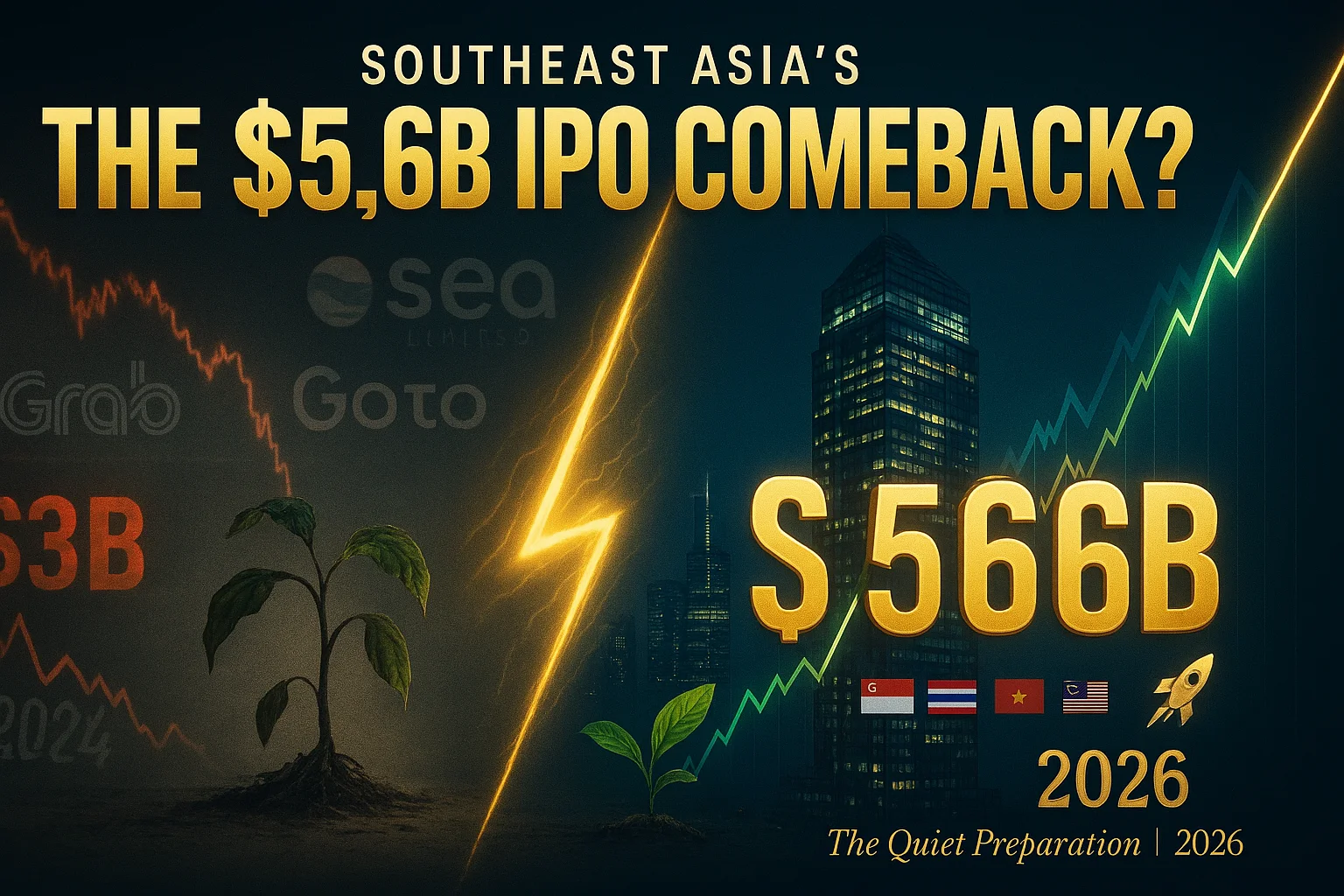
Southeast Asia tech startups are quietly strengthening corporate governance and cleaning their books for a major IPO comeback in 2026. Explore the data, trends, and strategic shifts reshaping the region’s capital markets.
In the hushed corridors of Singapore’s financial district and Jakarta’s tech hubs, something remarkable is unfolding. While headlines trumpet AI breakthroughs and cryptocurrency swings, Southeast Asia’s tech startups are conducting a different kind of transformation—one that happens behind closed boardroom doors, in audit committee meetings, and through painstaking restructuring of corporate governance frameworks. After weathering a brutal funding winter that saw IPO activity plunge to its lowest level in nearly a decade in 2024, with only $3.0 billion raised across 122 IPOs, the region’s most ambitious companies are now methodically preparing for what many believe will be a defining moment: the 2026 IPO revival.
This isn’t the frenzied SPAC-era optimism of 2021. This is something more deliberate, more strategic—and potentially more sustainable.
The Harsh Reality Check: Southeast Asia’s IPO Winter
The numbers tell a sobering story. In 2024, Southeast Asia’s IPO markets raised approximately $3.0 billion across 122 listings in the first 10.5 months—the lowest capital raised in nine years, down from $5.8 billion across 163 IPOs in 2023. Even more striking, only one IPO in 2024 raised over $500 million, compared to four such blockbuster listings the previous year.
For context, this represents a dramatic reversal from the pandemic-era boom when Southeast Asian tech companies commanded eye-watering valuations and international investors couldn’t deploy capital fast enough. The e-Conomy SEA report had projected the region’s digital economy would reach $363 billion by 2025, but the path to monetizing that growth through public listings proved far more treacherous than anticipated.
What happened? The perfect storm arrived with force.
High interest rates across ASEAN economies constrained corporate borrowing, dampening IPO activity as companies opted to delay public listings, explained Tay Hwee Ling, Capital Markets Services Leader at Deloitte Southeast Asia. Add to that mix currency fluctuations, geopolitical tensions affecting trade, and market volatility among major trade partners like China that impacted investor confidence, and you have an environment where even the most promising tech companies chose to stay private.
The venture capital funding landscape mirrored this decline. Southeast Asian VC funding hit rock bottom in Q4 2024, with startups mustering only 116 equity capital rounds raising $1.2 billion—the lowest quarterly deal volume in more than six years. Late-stage fundraising took a particularly severe hit, with funding plunging by 64% and deal value dropping by 72%.
For Southeast Asia’s tech unicorns and aspiring public companies, the message was clear: the old playbook was broken.
The Turning Tide: Why 2026 Looks Different
Yet amid this apparent gloom, a remarkable transformation is taking shape. In the first 10.5 months of 2025, Southeast Asia’s IPO capital markets showed a rebound, with 102 IPOs raising approximately $5.6 billion—a 53% increase in total proceeds despite fewer listings than 2024. The average deal size more than doubled, rising from $27 million in 2024 to $55 million in 2025, driven by larger, higher-quality offerings.
This isn’t just a cyclical uptick. Multiple structural factors are converging to create what could be the region’s most favorable IPO environment in five years.
Macroeconomic Tailwinds Gathering Strength
The macroeconomic backdrop is stabilizing in ways that matter for capital markets. Expected interest rate cuts alongside easing inflation are creating a more favorable environment for IPOs in the years ahead, according to Deloitte’s regional analysis.
The IMF projects ASEAN to grow at 4.3% in both 2025 and 2026, while the Asian Development Bank forecasts developing Asia’s growth at 4.9% in 2025 and 4.7% in 2026. Though these figures fall short of historical averages, they represent stable, predictable growth—exactly what public market investors crave after years of volatility.
More critically, the digital economy component of this growth is accelerating. Thailand’s digital economy, estimated to contribute around 6% of GDP, is the second largest in the ASEAN region, with financial services, digital payments, and fintech seeing some of the fastest rates of job creation. By 2030, ASEAN’s digital economy is expected to more than double to $560 billion, driving jobs and innovation across the region.
This creates a powerful narrative for IPO candidates: they’re not just individual companies going public, but representatives of the fastest-growing segment of the world’s fourth-largest economy.
Regulatory Evolution: The Singapore Catalyst
Perhaps nothing signals the changing IPO landscape more clearly than Singapore’s aggressive regulatory reforms. The Monetary Authority of Singapore convened a review group to assess and enhance the country’s IPO ecosystem, with recommendations aiming to advance Singapore toward a more disclosure-based regulatory regime aligned with major developed markets.
The $5 billion Equity Market Development Programme represents more than just capital—it’s a statement of intent. Singapore is positioning itself as the natural listing destination for Southeast Asian tech companies that might have previously eyed New York or Hong Kong.
Several SaaS and fintech firms are said to be preparing to list in late 2025 or 2026, encouraged by the success of dual-listed companies and growing institutional interest in digital transformation themes. The successful debut of NTT Data Centre REIT, Singapore’s biggest IPO in four years, has injected renewed confidence into the market.
This regulatory evolution addresses a critical pain point. In the past, Southeast Asian companies often felt they had to choose between staying local with limited liquidity or going international with regulatory complexity. Singapore’s reforms aim to offer the best of both worlds: international standards with regional understanding.
Private Equity’s Patient Capital Creates IPO Pipeline
Another crucial development is private equity’s evolving role in the ecosystem. A total of 35 secondary exits were completed in 2025, marking the highest annual count since 2020, as sponsors adjusted expectations around timing, pricing, and structure.
This might seem counterintuitive—more secondary sales could mean fewer IPOs—but it actually creates a healthier pipeline. PE-backed companies that go through secondary transactions often emerge stronger, with cleaned-up cap tables and more realistic valuations. PE-backed IPOs in Southeast Asia in 2025 marked a clear departure from the previous cycle, with no single sector dominating as issuance shifted toward execution-driven offerings sized to clear the market.
Golden Gate Ventures and INSEAD estimate 700 exits, including IPOs and trade sales, between 2023 and 2025, driven by regional tech leaders and late-stage capital injections. These aren’t distressed sales—they’re strategic repositioning ahead of more favorable public market windows.
The Quiet Preparation: Inside the Corporate Governance Transformation
Here’s where the story gets truly interesting. Behind the IPO statistics and macroeconomic forecasts, Southeast Asia’s tech companies are undergoing a fundamental transformation in how they operate, govern themselves, and present their financials to the world.
Cleaning the Books: From Growth-at-All-Costs to Unit Economics
The phrase “cleaning the books” has become shorthand for a comprehensive financial overhaul that goes far beyond simple accounting adjustments. Companies preparing for 2026 IPOs are fundamentally rethinking how they measure and present success.
Take GoTo Group, Indonesia’s largest tech company formed from the merger of Gojek and Tokopedia. After years of negative earnings and billion-dollar write-downs, GoTo is inching closer to profitability, with net revenue 14% higher than the previous year and losses shrinking from IDR 4.5 trillion ($269 million) to about IDR 1 trillion ($60 million) in the first nine months of 2025.
This transformation involved painful but necessary changes: tighter control of incentive spending, pricing scheme adjustments, and a bigger role for their finance division in driving revenue. Cash from operations showed steady improvement, with deficits falling to around IDR 160 billion ($10 million) by the third quarter—roughly one-tenth of the negative operating cash flow at the same point in 2024.
The shift represents a broader industry reckoning. Companies are moving away from adjusted EBITDA metrics that exclude “non-recurring” expenses that somehow recur every quarter, toward genuine GAAP profitability or clear paths to it. Revenue recognition is being standardized to match international accounting standards. Related-party transactions—once common in family-controlled Asian conglomerates—are being eliminated or made fully transparent.
As one venture capital partner told me off the record: “In 2021, you could go public burning $100 million a quarter if your growth rate was impressive. In 2026, investors want to see that you can turn a profit within 12-18 months of listing, or at minimum, that your path to profitability doesn’t depend on hoping for better market conditions.”
Governance Overhaul: Building Boards That Command Respect
The governance transformation is equally dramatic. Building strong corporate governance is essential, including installing professional management, establishing a strong board of directors and commissioners, and forming key committees, noted Silva Halim, Chief Capital Market Officer of Mandiri Sekuritas.
What does this look like in practice? Companies are:
Professionalizing leadership structures: Founder-CEOs are surrounding themselves with experienced CFOs who have taken companies public before, often recruited from established listed companies or Big Four accounting firms.
Adding independent directors with relevant expertise: Boards are being expanded to include former executives from similar-stage companies, regulatory experts, and representatives from institutional investors. The days of boards comprising only founders, early investors, and friendly advisors are ending.
Establishing robust committee structures: Audit committees with genuinely independent chairs, compensation committees that tie executive pay to performance metrics investors care about, and risk management committees that don’t just exist on paper.
Implementing ESG frameworks: Environmental, Social, and Governance considerations are no longer nice-to-haves. They’re table stakes for institutional investors, particularly those based in Europe and increasingly Asia.
Three of Southeast Asia’s five newest unicorns—Carro, GCash, and others—are actively preparing for IPOs, which forces them to clean up governance and meet public-market expectations. Carro, the automotive marketplace, expects a potential US IPO in late 2025 or early 2026 and has been systematically strengthening its governance framework in preparation.
The Capital Structure Simplification
Perhaps the most complex aspect of IPO preparation is unwinding the convoluted capital structures many Southeast Asian tech companies accumulated during their private funding years.
Multiple share classes with different voting rights, convertible notes from emergency funding rounds, preferred shares with liquidation preferences that give early investors disproportionate exit returns—all of these need to be rationalized before a successful public listing.
The process requires delicate negotiation. Early-stage investors who took risks when a company was worth $10 million don’t want to be diluted to meaninglessness now that it’s valued at $1 billion. Founders want to maintain enough control to execute their vision. Public market investors want governance structures that protect minority shareholders.
Finding the balance is as much art as science, and it’s one reason the IPO preparation process now takes 18-24 months rather than the 6-12 months that was common in the SPAC era.
Sector Spotlight: Who’s Best Positioned for 2026?
Not all sectors are created equal in the coming IPO revival. The data reveals clear winners based on both investor appetite and operational readiness.
Fintech: The Perennial Favorite with New Maturity
FinTech continued to lead as the top-funded industry in Southeast Asia, attracting $821 million across 78 deals in the first nine months of 2024, despite year-over-year declines. The sector’s dominance reflects both its market maturity and the improving unit economics of regional fintech players.
GCash, the Philippines’ leading digital wallet, stands out. New funding from Ayala and MUFG in 2024 boosted GCash’s valuation and positioned the company for an IPO in 2025, which would mark a major milestone for the Philippine startup scene. The company has moved beyond pure payments to offer a full suite of financial services—loans, insurance, investment products—creating multiple revenue streams that public market investors value.
Thunes, which became a unicorn in early 2025 after a $150 million Series D, exemplifies the infrastructure play that resonates with institutional investors. Rather than competing in crowded consumer spaces, it provides the rails that enable cross-border payments, a B2B model with stronger margins and more predictable revenue.
Infrastructure and Logistics: The Unsexy Winners
While consumer tech grabbed headlines during the pandemic boom, infrastructure and logistics companies are emerging as IPO favorites precisely because they’re less glamorous. They have real assets, predictable cash flows, and business models that make sense without squinting.
Data centers, in particular, are hot. Singapore’s successful listing of NTT Data Centre REIT validated the thesis that digital infrastructure can be packaged as stable, income-producing assets. As AI adoption accelerates and cloud migration continues, the demand for data center capacity in Southeast Asia is outpacing supply.
Logistics networks built by e-commerce giants and delivery platforms have also matured to the point where they could be spun off as standalone entities. These networks have tangible value: warehouses, last-mile delivery fleets, sophisticated routing algorithms, and established relationships with millions of merchants and consumers.
Automotive and Mobility: The Vertical Integration Play
Carro started as a used car platform but has evolved into a multi-service mobility business, integrating financing, insurance, after-sales service, AI-led vehicle inspections and logistics. This vertical integration strategy represents a sophisticated understanding of what public market investors want to see: control over the entire value chain creates both competitive moats and opportunities to capture margin at multiple points.
The automotive sector in Southeast Asia remains fragmented and under-digitized, creating genuine opportunities for tech-enabled consolidation. Whoever controls both the data and the distribution wins—and that thesis is compelling enough to attract IPO investors willing to bet on multi-year transformations.
The Risk Factors: What Could Derail the Revival
For all the optimism, significant risks loom over Southeast Asia’s IPO renaissance.
Global Recession Fears and Trade Policy Uncertainty
Meanwhile, US President-elect Donald Trump’s return to the White House represents a wild card for many markets, including IPOs, with the revival of “America First” trade policies potentially upending Southeast Asia’s IPO ambitions.
The return of protectionist trade policies could disrupt the export-dependent growth models of many Southeast Asian economies. If tariffs on Chinese goods lead to a broader trade war, and if Southeast Asian countries get caught in the crossfire as production shifts out of China, the macroeconomic stability necessary for robust IPO markets could evaporate quickly.
China Economic Slowdown Spillover
A worse-than-expected deterioration in China’s property market could disrupt prospects across Asia, the IMF warned in its regional outlook. China remains Southeast Asia’s largest trading partner and a major source of tourism revenue. An economic hard landing in China would reduce demand for Southeast Asian exports and potentially trigger capital flight from regional markets.
Currency Volatility and Capital Controls
Exchange rate instability remains a perennial concern. Companies that earn revenue in Indonesian rupiah, Thai baht, or Vietnamese dong but report in US dollars face constant translation risks. Sharp currency depreciations can turn profitable quarters into losses on paper, spooking investors.
More concerning is the possibility of capital controls if regional currencies come under sustained pressure. Malaysia’s experience with capital controls during the Asian Financial Crisis remains a cautionary tale that international investors remember.
Regulatory Unpredictability
Despite Singapore’s positive reforms, regulatory uncertainty persists across the region. Data localization requirements in Indonesia and Vietnam can force costly infrastructure changes. Cross-border payment regulations vary wildly between countries. Competition authorities are increasingly scrutinizing dominant platforms.
For companies hoping to list in 2026, the challenge is preparing for an IPO while remaining nimble enough to adapt to regulatory changes that could fundamentally alter their business models.
Post-IPO Performance Anxiety
Perhaps the biggest risk is the memory of previous disappointments. Grab’s post-SPAC performance—trading well below its initial valuation—haunts the sector. Sea Limited’s rollercoaster ride from pandemic darling to value destruction and back has made investors wary of Southeast Asian tech valuations.
New IPO candidates need to deliver not just successful listings but sustained post-IPO performance. One or two high-profile flameouts in 2026 could shut the window for everyone else.
Investment Implications: Reading the Tea Leaves
For institutional investors, the 2026 Southeast Asia IPO pipeline presents both opportunities and obligations to conduct rigorous due diligence.
Valuation Frameworks for a New Era
The valuation multiples of 2021—when companies could command 20x forward revenue—are gone. Today’s IPO candidates should expect 5-8x revenue multiples for profitable companies, 3-5x for those with clear paths to profitability within 18 months.
The shift means companies need much larger revenue bases to achieve the same market capitalizations. A company targeting a $5 billion valuation needs at least $800 million in revenue, not the $250 million that might have sufficed in 2021.
For growth-stage investors and late-stage VCs, this creates both challenges and opportunities. Entry valuations must be disciplined enough to allow for successful exits even at more modest public market multiples. But for those who invested in 2022-2023 at trough valuations, the returns could be substantial.
Geographic Focus: Not All Markets Are Equal
Singapore will continue to dominate Southeast Asian tech IPOs in 2026, but Indonesia and Vietnam are increasingly viable alternatives for companies with strong domestic market positions.
Indonesia’s market offers scale—270 million people, rapidly growing middle class, improving digital infrastructure. Companies that can demonstrate market leadership in Indonesia, even if they’re not yet regional champions, can make compelling IPO cases.
Vietnam presents a different opportunity: manufacturing and export-oriented plays that benefit from China-plus-one strategies. Tech-enabled manufacturing, logistics, and supply chain companies based in Vietnam may find receptive public markets.
Sectoral Selectivity
Within sectors, investors should prioritize:
In fintech: Companies with lending and asset management products, not just payment facilitation. The former have better unit economics and more defensible moats.
In e-commerce: Vertical specialists (automotive, luxury, B2B) rather than horizontal generalists competing with Sea Limited and Lazada.
In SaaS: Companies with strong presence in multiple Southeast Asian markets and demonstrated ability to expand upmarket to enterprise customers.
In logistics: Asset-light models leveraging technology to coordinate third-party capacity, rather than capital-intensive approaches requiring continuous fundraising.
Policy Recommendations: Enabling Sustainable Growth
For Southeast Asian governments and regulators hoping to support vibrant public markets, several policy priorities emerge.
Harmonize Listing Requirements
The fragmentation of listing requirements across ASEAN exchanges creates unnecessary complexity. A startup that meets SGX listing requirements should be able to list on the Indonesia Stock Exchange or Stock Exchange of Thailand with minimal additional compliance burden.
Progress on the ASEAN Digital Economy Framework Agreement could provide a template for similar harmonization in capital markets regulation. The goal isn’t identical rules—each market has unique characteristics—but mutual recognition and reduced friction.
Strengthen Market Infrastructure
Retail investor participation in IPOs remains limited in most Southeast Asian markets outside Singapore. Improving digital brokerage infrastructure, reducing transaction costs, and educating retail investors about public markets would broaden the investor base and improve post-IPO liquidity.
Malaysia and Thailand have made progress on digital brokerage adoption, but Indonesia, Vietnam, and the Philippines lag behind. Governments could accelerate adoption through tax incentives for small investors and regulatory sandboxes for innovative brokerage models.
Develop Institutional Investor Base
Southeast Asia needs more domestic institutional capital to reduce dependence on foreign portfolio flows that can reverse quickly during global risk-off episodes.
Pension reforms to allow higher equity allocations, insurance regulation that doesn’t penalize public equity investments, and sovereign wealth fund strategies that include domestic tech exposure would all help develop a more stable institutional investor base.
Address Short-Termism in Corporate Governance Codes
Many Asian corporate governance codes emphasize quarterly reporting and short-term performance metrics. While transparency is valuable, this can discourage the long-term investments in R&D, market expansion, and talent development that tech companies need.
Reforms could include longer protected periods for newly listed companies before they face takeover attempts, allowing founders to maintain dual-class voting structures for defined periods, and encouraging long-term incentive compensation tied to multi-year milestones.
Strategic Advice: Navigating the Path to Public Markets
For founders and CFOs contemplating 2026 IPOs, several strategic imperatives stand out.
Start Earlier Than You Think
IPO preparation isn’t something you begin six months before filing. The companies most likely to succeed in 2026 began their preparations in 2024 or earlier.
This means installing audit committees now, conducting pre-IPO audits of financial controls, identifying and fixing revenue recognition issues before underwriters spot them, and beginning the process of board professionalization well before you need those independent directors’ signatures on registration statements.
Choose Your Market Thoughtfully
The question “Where should we list?” requires sophisticated analysis of where your customers are, where comparable companies trade, and where you can maintain liquidity post-IPO.
For truly regional companies, dual listings merit consideration. The complexity and cost are substantial, but accessing both Asian and Western capital pools can be worth it. For companies with clear geographic anchors, listing close to your customer base makes sense even if valuations are somewhat lower—the understanding and long-term support from local institutional investors often outweighs pure valuation optimization.
Build Your Equity Story Deliberately
Companies need a compelling equity story and investment thesis that will resonate with public investors, with long-term goals focused on positive market reception and sustained aftermarket performance, advised Pol de Win, SGX Group’s Senior Managing Director.
This equity story needs to be more sophisticated than “We’re the X of Southeast Asia.” Public market investors want to understand your unit economics at a granular level, see evidence of defensible competitive advantages, understand how you’ll allocate capital, and have confidence in your management team’s ability to execute through market cycles.
Testing this story with pre-IPO investors through structured investor education—think non-deal roadshows conducted 12-18 months before listing—can reveal weaknesses in your narrative and give you time to address them.
Manage Expectations Conservatively
One of the biggest mistakes of the SPAC era was over-promising on growth and profitability trajectories. Companies projected hockey-stick growth that never materialized, destroying credibility and shareholder value.
The companies that will succeed in 2026 will be those that guide conservatively and consistently beat their own projections. Sandbagging should be avoided—investors can spot it and penalize you for it—but realistic planning that accounts for macroeconomic headwinds and competitive challenges will serve you better than blue-sky scenarios.
Looking Forward: Southeast Asia’s Moment
If 2021 was the frothy champagne era and 2024 was the sobering hangover, then 2026 represents something different—maturity, discipline, and the genuine transformation of Southeast Asian tech companies from venture-backed startups to sustainable public companies.
The region’s fundamental strengths remain intact: Southeast Asia’s strong consumer base, growing middle class, and strategic importance in sectors like real estate, healthcare, and renewable energy remain attractive to investors. ASEAN has already delivered a five-fold expansion in economic output this century, and the digital transformation is still in relatively early innings.
What’s changed is the understanding of what it takes to succeed as a public company. The discipline being instilled through the current IPO preparation process—the governance overhauls, the financial rigor, the strategic clarity—will serve these companies well beyond their listing dates.
Will 2026 mark the revival of Southeast Asia’s IPO hopefuls? The data suggests yes, but with an important caveat: it won’t be a revival of the 2021 model. It will be the emergence of something better—more sustainable, more honest about challenges, more realistic about valuations, and more committed to delivering long-term value rather than short-term excitement.
For investors who can navigate this landscape with sophistication, who can distinguish between genuinely transformative companies and those merely riding a cyclical upturn, the opportunities could be substantial. For the broader Southeast Asian tech ecosystem, this moment represents a coming-of-age—the transition from a region of promising startups to a mature market of public technology companies that can compete on the global stage.
The quiet preparation happening now in boardrooms and audit committees across Southeast Asia matters more than any single IPO. It represents the infrastructure—not physical infrastructure, but the governance, financial discipline, and strategic clarity—upon which decades of public market success can be built.
2026 won’t be the end of Southeast Asia’s IPO story. If the preparation is done right, it will be the beginning of a much longer and more sustainable chapter.
Sources Cited:
- Deloitte Southeast Asia (2024, 2025). “Southeast Asian IPO Market Reports”
- Asian Development Bank (2025). “Asian Development Outlook”
- International Monetary Fund (2025). “ASEAN Regional Economic Outlook”
- MAGNiTT (2024). “Southeast Asia Venture Capital Landscape”
- DealStreetAsia (2024, 2025). “DATA VANTAGE Reports”
- World Bank (2025). “Thailand Economic Monitor”
- East Ventures (2025). “Building a Vibrant IPO Ecosystem in Southeast Asia”
- PwC (2024). “Global IPO Trends”
- Golden Gate Ventures & INSEAD (2024). “Southeast Asia Exit Report”
- Tech Collective (2025). Various industry analyses
- World Economic Forum (2025). “ASEAN Digital Economy Report”
- GSMA Intelligence (2025). “Digital Nations 2025: ASEAN Connectivity”
Discover more from Startups Pro,Inc
Subscribe to get the latest posts sent to your email.

Top 10 Media Startup Ideas for Massive Success in 2026

Billionaire Enrique Razon Accelerates Energy Push With Colombia, Philippine Deals

Bangladesh Rations Fuel as Mideast War Deepens Energy Crisis

Virgin Atlantic’s Strategic Swoop: On Track to Lure Tens of Thousands from British Airways’ Frequent Flyer Fold

The Great Launch Rush: How China’s Rocket IPO Surge Is Reshaping the Global Space Race

The Top 10 Business and Tech Institutes in the USA for Aspiring Business Leaders in 2026

ETFs Are Eating the World: AI Jitters and Oil’s Reversal

The Future is Now: Top 10 UK Startups Defining 2026

Entrepreneurship Funding: From Venture Capital to Bootstrapping

FITUR 2026: US, Mexico, India, China, and Spain Lead Global Tourism
Bangladesh Rations Fuel as Mideast War Deepens Energy Crisis
Billionaire Enrique Razon Accelerates Energy Push With Colombia, Philippine Deals
Top 10 Media Startup Ideas for Massive Success in 2026
-
Digital5 years ago
Social Media and polarization of society
-
Digital5 years ago
Pakistan Moves Closer to Train One Million Youth with Digital Skills
-
Digital5 years ago
Karachi-based digital bookkeeping startup, CreditBook raises $1.5 million in seed funding
-
News5 years ago
Dr . Arif Alvi visits the National Museum of Pakistan, Karachi
-
Digital5 years ago
WHATSAPP Privacy Concerns Affecting Public Data -MOIT&T Pakistan
-
Kashmir5 years ago
Pakistan Mission Islamabad Celebrates “KASHMIRI SOLIDARITY DAY “
-
Business4 years ago
Are You Ready to Start Your Own Business? 7 Tips and Decision-Making Tools
-
China5 years ago
TIKTOK’s global growth and expansion : a bubble or reality ?