
AI
The Groq Deal: How a $20 Billion AI Chip Acquisition Rewrites the Geopolitics of Machine Intelligence

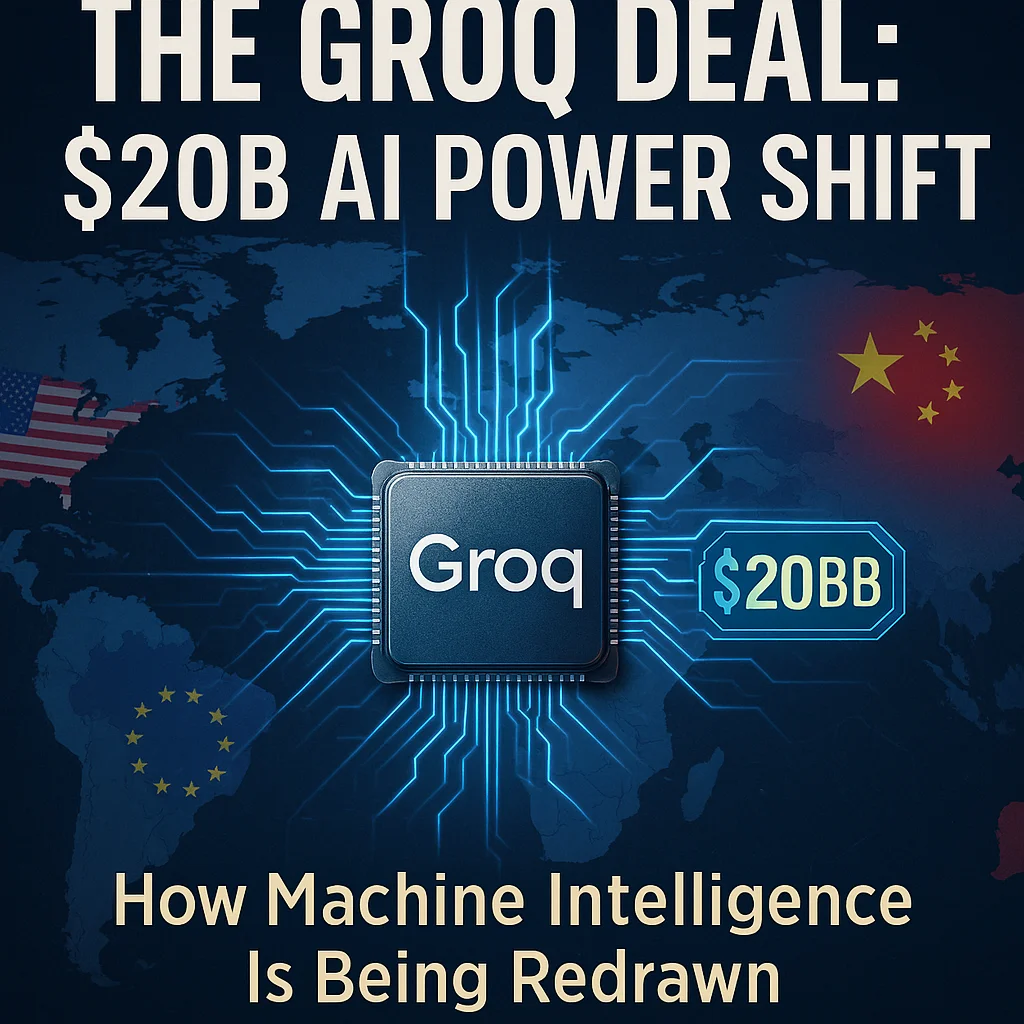
When Nvidia announced its $20 billion licensing agreement with AI chip startup Groq on Christmas Eve 2025, the move initially appeared to be another Silicon Valley acquisition story. But this transaction represents something far more consequential—a watershed moment in the technological competition that will define the 21st century balance of power.
The deal, structured as a non-exclusive licensing agreement with key personnel transfers rather than a traditional acquisition, marks Nvidia’s largest transaction ever and signals a profound shift in how advanced nations approach AI infrastructure as strategic capability. For policymakers in Washington, Brussels, and Beijing, the message is unmistakable: the race to control inference computing—the deployment stage where AI systems actually serve users—has become inseparable from questions of economic competitiveness and national security.
The Groq Innovation and Why It Matters
Founded in 2016 by Jonathan Ross, a former Google engineer who helped create the Tensor Processing Unit, Groq emerged with a radically different approach to AI computing. While Nvidia’s dominance rests on Graphics Processing Units optimized for training massive AI models, Groq developed the Language Processing Unit specifically engineered for inference—the moment when a trained AI responds to user queries.
The technical distinction matters immensely. Groq’s LPU architecture achieves inference speeds reportedly ten times faster than traditional GPUs while consuming one-tenth the energy. The company demonstrated this capability dramatically by becoming the first API provider to break 100 tokens per second while running Meta’s Llama2-70B model. In the AI economy, where milliseconds of latency determine user experience and energy costs shape profitability, these performance gains translate directly into competitive advantage.
Groq’s approach relies on deterministic processing architecture, using on-chip SRAM memory rather than the high-bandwidth memory that constrains global chip supply. This design allows precise control over computational timing, eliminating the unpredictable delays that plague conventional processors. The result is a chip that can serve chatbot responses, analyze medical images, or process autonomous vehicle sensor data with unprecedented speed and efficiency.
By September 2024, Groq had raised $750 million at a $6.9 billion valuation and was serving more than 2 million developers through its GroqCloud platform—nearly sixfold growth in a single year. The company projected $500 million in revenue for 2024, remarkable for a hardware startup operating in Nvidia’s shadow.
Nvidia’s Strategic Calculus
For Nvidia, which commands between 70% and 95% of the AI accelerator market according to Mizuho Securities estimates, the Groq acquisition reveals both strength and vulnerability. The company’s flagship H100 and newer H200 chips dominate AI model training, the computationally intensive process of teaching neural networks. This dominance has propelled Nvidia to a $3.65 trillion market valuation and generated over $80 billion in data center revenue in 2024 alone.
Yet training represents only half of the AI computing lifecycle. As models move from development to deployment, the economics shift dramatically. Training is where companies spend capital; inference is where they generate revenue. An AI model might be trained once over weeks or months, but it performs inference billions of times serving users. As OpenAI’s ChatGPT, Google’s Gemini, and Anthropic’s Claude scale to hundreds of millions of users, inference computing becomes the primary cost driver.
Industry analysts estimate that inference accounted for approximately 40% of Nvidia’s data center revenue in 2024. But this market faces far more competition than training, where Nvidia’s CUDA software ecosystem creates powerful switching costs. Companies including AMD, Intel, and startups like Cerebras Systems are actively developing specialized inference accelerators. Tech giants such as Google, Amazon, and Microsoft are designing custom chips to reduce dependence on Nvidia hardware.
The competitive landscape is intensifying. Google’s sixth-generation Tensor Processing Units and new Trillium chips target inference workloads. Microsoft’s Maia and Cobalt processors aim to optimize its Azure cloud infrastructure. Amazon’s Inferentia chips power AWS inference services. Meta has developed its own inference accelerators for internal use.
Against this backdrop, Groq represented both a threat and an opportunity. The startup’s technology demonstrated that specialized inference architectures could challenge GPU-based approaches on performance and efficiency. Groq’s rapid customer growth showed that developers would embrace alternatives when they delivered measurable advantages. Left independent, Groq might have evolved into a significant competitor. Integrated into Nvidia’s portfolio, the LPU architecture extends Nvidia’s reach into inference-optimized computing while neutralizing a potential rival.
CEO Jensen Huang’s internal memo to employees framed the acquisition explicitly: “We plan to integrate Groq’s low-latency processors into the Nvidia AI factory architecture, extending the platform to serve an even broader range of AI inference and real-time workloads.” The message signals Nvidia’s recognition that maintaining its AI infrastructure leadership requires excellence across both training and inference.
The Geopolitical Dimension: AI Chips as Strategic Assets
The Groq transaction unfolds against the most aggressive technology export control regime in modern history. Since October 2022, the United States has systematically restricted China’s access to advanced computing hardware and semiconductor manufacturing equipment. These controls, refined and expanded multiple times, aim to slow China’s AI development by denying access to the chips that make frontier AI possible.
The global AI chip market, valued at approximately $84 billion in 2025, is projected to reach between $459 billion and $565 billion by 2032, representing compound annual growth rates of 27% or higher. This explosive expansion reflects AI’s transformation from experimental technology to core economic infrastructure. Countries that control advanced chip design and manufacturing will shape how artificial intelligence develops and who benefits from its deployment.
China has responded to export restrictions with unprecedented investment in semiconductor self-sufficiency. Beijing’s Made in China 2025 initiative and successive Five-Year Plans have channeled tens of billions of dollars into domestic chip companies including Huawei HiSilicon, Cambricon Technologies, and Semiconductor Manufacturing International Corporation. Despite these efforts, China remains the world’s largest chip importer and continues to struggle producing the most advanced processors.
The effectiveness of export controls remains contested. Controls have demonstrably slowed China’s chipmaking capability by blocking access to extreme ultraviolet lithography tools essential for cutting-edge production. SMIC, China’s leading foundry, would likely have become the second-largest producer of advanced AI chips had it acquired EUV equipment as planned in 2019. Instead, Chinese manufacturers remain multiple technology generations behind Taiwan’s TSMC and South Korea’s Samsung.
Yet controls have not prevented Chinese AI developers from producing competitive models. DeepSeek’s release of the R1 model in early 2025 demonstrated that Chinese researchers could achieve performance comparable to American frontier systems despite hardware constraints. The development suggests that algorithmic innovation and efficient training techniques can partially compensate for inferior computing infrastructure.
The situation creates a complex strategic calculus. Export controls buy time for the United States and its allies to maintain AI leadership, but they simultaneously accelerate China’s drive toward technological independence. They protect American competitive advantage today while potentially strengthening Chinese capabilities tomorrow. This dynamic explains why the Trump administration’s December 2025 decision to conditionally allow H200 chip sales to approved Chinese buyers sparked immediate controversy.
The Inference Market as New Battleground
Within this geopolitical context, Groq’s specialized inference technology takes on strategic significance beyond its commercial value. Inference computing will increasingly determine which countries can deploy AI at scale, who controls the infrastructure that serves billions of users, and whose technological ecosystem becomes the global standard.
Consider the arithmetic. Training GPT-4 reportedly required approximately 25,000 Nvidia A100 GPUs running for roughly 100 days at an estimated cost exceeding $100 million. Yet serving that model to users requires far greater computational resources over time. Microsoft’s integration of GPT-4 into Bing search reportedly necessitated substantial infrastructure expansion. Google’s Gemini deployment across Gmail, Docs, and other services demands massive inference computing capacity. Alibaba and ByteDance face similar challenges deploying Qwen and other large language models to Chinese users.
The country that produces the most efficient, cost-effective inference chips will capture a disproportionate share of the AI economy’s value creation. Cloud providers will optimize around those chips. Software developers will design applications to leverage them. Users will gravitate toward services that offer superior performance and responsiveness.
Nvidia’s acquisition of Groq ensures that American companies maintain leadership in both AI training and inference. It prevents Chinese firms from licensing or acquiring Groq’s LPU technology, which could have accelerated China’s ability to deploy AI at scale. The deal effectively extends export controls through market consolidation—a form of private sector national security policy executed through commercial transactions.
This pattern is becoming familiar. In September 2025, Nvidia conducted a similar transaction with Enfabrica, spending over $900 million to hire the AI hardware startup’s CEO and license its technology. Other tech giants have pursued comparable deals. Microsoft’s hiring of Inflection AI’s leadership team came through a $650 million licensing agreement. Meta’s acquisition of key Scale AI personnel reportedly cost $15 billion. Amazon hired founders from Adept AI in a similar arrangement.
These “reverse acquihires” allow tech companies to acquire talent and intellectual property while avoiding the antitrust scrutiny traditional acquisitions attract. They also serve strategic technology policy objectives by keeping critical capabilities within allied ecosystems. As Bernstein analyst Stacy Rasgon noted regarding the Groq deal, structuring it as a non-exclusive license “may keep the fiction of competition alive” while achieving consolidation in practice.
The Trump Administration’s AI Statecraft
The timing of the Groq acquisition coincides with significant shifts in U.S. technology policy under the Trump administration. President Trump’s relationships with major tech CEOs, including Nvidia’s Jensen Huang, have become important channels for technology diplomacy. Trump has framed AI leadership as central to maintaining American global preeminence while simultaneously pursuing pragmatic engagement with China where commercial interests align.
The administration’s December 2025 decision to allow conditional exports of Nvidia’s H200 chips to approved Chinese buyers illustrates this complex approach. The policy permits sales to vetted end users while imposing a 25% revenue fee payable to the U.S. government. Proponents argue the controlled channel generates revenue while maintaining oversight. Critics contend it weakens strategic restrictions and potentially enables Chinese AI capabilities that could be used for military applications or surveillance.
Senator Elizabeth Warren and other lawmakers questioned whether the timing coordinated with Justice Department prosecution of illegal chip smuggling operations, suggesting possible political interference in enforcement. The White House drew distinctions between licensed exports to known buyers and illicit shipments to unknown parties, but the debate reflects deeper tensions about balancing economic interests against security concerns.
China’s reported consideration of its own limits on H200 chips adds another dimension. Beijing has increasingly deployed its domestic market access as leverage in technology negotiations. The country’s antitrust investigation into Nvidia for alleged violations during its 2020 Mellanox acquisition demonstrates China’s willingness to use regulatory tools as countermeasures against American restrictions.
These dynamics create an unstable equilibrium. Neither the United States nor China benefits from complete technological decoupling, yet neither trusts the other’s intentions sufficiently to embrace open technology transfer. The result is selective restriction punctuated by tactical accommodation—a pattern likely to characterize U.S.-China technology relations for years to come.
Implications for Allied Coordination
Export controls are only effective with allied cooperation. The Netherlands’ ASML produces the extreme ultraviolet lithography machines essential for cutting-edge chip production. Japan’s Tokyo Electron and other firms manufacture critical semiconductor equipment. South Korea’s Samsung and SK Hynix supply advanced memory chips. Taiwan’s TSMC fabricates most of the world’s leading-edge processors.
The United States has successfully coordinated with key allies on restricting advanced chip technology exports to China. In 2023, Japan and the Netherlands imposed controls similar to American restrictions after extensive negotiations. This alignment creates a more effective technology control regime than unilateral U.S. action could achieve.
Yet allied interests don’t always align perfectly. ASML derived 29% of its revenue from Chinese customers in 2023, creating significant economic incentives against further restrictions. European policymakers worry about triggering Chinese retaliation that could harm their companies while American firms capture market share. South Korean manufacturers fear losing competitiveness if Chinese firms develop alternative suppliers.
The Groq acquisition highlights how market consolidation by American firms can complement export controls. By integrating advanced inference technology into Nvidia’s U.S.-based operations, the deal ensures allied governments control access to these capabilities. This creates options for coordinated technology policy that pure export restrictions cannot achieve.
For European allies investing heavily in semiconductor manufacturing and AI capabilities through the Chips Act and related initiatives, Nvidia’s move sends a clear signal: the United States intends to maintain leadership across the full AI stack. European policymakers must decide whether to develop independent capabilities, deepen integration with American firms, or pursue some combination.
Market Structure and Antitrust Considerations
Nvidia’s consolidation of inference technology alongside its training dominance raises significant competition policy questions. The company’s 70-95% market share in AI accelerators already exceeds levels that would trigger antitrust scrutiny in most contexts. The Groq acquisition further concentrates market power in a sector critical to the broader AI economy.
Structuring the deal as a non-exclusive license rather than a traditional acquisition may help navigate regulatory review. Groq continues operating independently under new CEO Simon Edwards, maintaining its GroqCloud business. This preserves a nominal competitor while effectively transferring key technology and talent to Nvidia.
Yet the economic substance suggests significant consolidation. Groq’s founder and president join Nvidia, likely bringing deep technical knowledge and customer relationships. Nvidia gains rights to LPU intellectual property and can integrate it into product roadmaps. The $20 billion valuation represents nearly three times Groq’s September 2024 funding round valuation, suggesting Nvidia paid a substantial premium to secure these assets.
Competition authorities in the United States, European Union, and other jurisdictions will need to evaluate whether the arrangement harms innovation and consumer welfare. Traditional antitrust analysis might focus on whether Nvidia’s increased market power enables anticompetitive pricing or exclusionary practices. A more forward-looking assessment would consider whether the deal reduces the diversity of technical approaches in AI infrastructure, potentially slowing innovation or creating single points of failure.
The counterargument emphasizes that Nvidia faces intense competition from tech giants developing custom chips and from semiconductor firms including AMD and Intel introducing competitive products. Google, Amazon, Microsoft, and Meta collectively spend tens of billions annually on AI infrastructure and have strong incentives to avoid vendor lock-in. This buyer-side power may constrain Nvidia’s ability to exploit dominant positions.
From a national security perspective, concentration in Nvidia’s hands may be preferable to fragmentation across many smaller firms, some potentially vulnerable to foreign acquisition or influence. A consolidated American champion can more effectively compete with Chinese state-backed alternatives and serve as a reliable partner for allied governments.
The Energy-Infrastructure Nexus
The explosive growth of AI computing creates corresponding demands on energy infrastructure that carry their own geopolitical implications. Data centers housing AI chips consume enormous amounts of electricity for computation and cooling. Nvidia’s most powerful systems require kilowatts of power per chip, and a single large training run can consume electricity equivalent to hundreds of U.S. homes for weeks.
Industry forecasts suggest that AI chip deployment will drive global electricity demand increases comparable to adding entire countries’ worth of consumption. Utilities across North America, Europe, and Asia are racing to upgrade grid infrastructure to support planned hyperscale data center buildouts. The interconnection queue for new data center power connections has grown to record levels, creating bottlenecks that could constrain AI deployment even when chips are available.
This dynamic creates new forms of strategic advantage. Countries with abundant clean energy capacity and existing grid infrastructure can more readily deploy AI at scale. China’s massive investments in renewable energy and nuclear power—building new generation capacity ten times faster than the United States according to some estimates—position it to power extensive AI computing despite chip access limitations.
Groq’s energy efficiency gains take on strategic importance in this context. LPUs consuming one-tenth the power of equivalent GPUs enable deploying AI capabilities with significantly smaller infrastructure footprints. A country or company using Groq-based systems could achieve similar inference throughput with a fraction of the electrical capacity required for GPU-based alternatives.
The chip that wins the inference market may ultimately be determined as much by kilowatt-hours per billion tokens generated as by raw processing speed. Energy-constrained deployments—whether in data centers facing grid limits, edge computing scenarios with restricted power budgets, or mobile applications running on battery power—create opportunities for specialized architectures optimized for efficiency rather than peak performance.
Scenarios for the Next Decade
The confluence of technological innovation, geopolitical competition, and market concentration creates several plausible pathways for how AI chip markets might evolve through 2035.
In an optimistic scenario, Nvidia’s integration of Groq technology accelerates development of increasingly efficient inference systems that make AI deployment more affordable and accessible globally. Competition from tech giants’ custom chips and semiconductor rivals AMD, Intel, and others prevents monopolistic stagnation. Allied coordination on export controls successfully slows adversary AI capabilities while domestic innovation policies strengthen American and European semiconductor ecosystems. Energy infrastructure expands to meet demand without triggering climate or reliability crises. AI benefits diffuse broadly across economies and societies.
A baseline scenario sees continued U.S.-China technological competition without catastrophic conflict. Export controls remain in place with periodic adjustments as technologies evolve. Nvidia maintains dominant but not monopolistic market positions as major customers develop hybrid chip strategies balancing Nvidia hardware with custom alternatives. China achieves partial semiconductor self-sufficiency in trailing-edge technologies while remaining dependent on foreign suppliers for the most advanced chips. The global AI industry fragments into American and Chinese spheres with European and other allies navigating between them. Energy constraints occasionally limit AI deployment but don’t fundamentally block progress.
A pessimistic scenario features escalating technology confrontation between the United States and China, with export controls tightening to near-total bans on advanced chip exports. China responds with aggressive industrial espionage, illicit procurement networks, and potentially military pressure on Taiwan to secure semiconductor supplies. A Taiwan Strait crisis disrupts TSMC production, triggering supply chain chaos across the global economy. Nvidia’s market concentration enables rent extraction that slows AI innovation and deployment. Energy grid limitations become binding constraints on AI scaling. The promised benefits of AI technology fail to materialize for most of the world’s population as capabilities concentrate in wealthy nations and large corporations.
Policy Recommendations
Policymakers navigating these complex dynamics should consider several priorities:
First, maintain flexibility in export control regimes to adapt as technologies evolve. Static restrictions risk becoming either irrelevant as China develops workarounds or excessively broad as American innovation creates new capabilities. Regular review and adjustment based on intelligence assessments and technical developments can help controls achieve security objectives without unnecessarily harming innovation or allied cooperation.
Second, invest comprehensively in domestic semiconductor capabilities beyond export restrictions. The bipartisan CHIPS and Science Act represents important progress, but ensuring American leadership requires sustained commitment to research and development, workforce development, advanced manufacturing, and supporting startup ecosystems. No level of restrictions on competitors can substitute for maintaining innovation advantages through investment.
Third, strengthen allied coordination through multilateral frameworks that align economic interests with security objectives. The U.S.-EU Trade and Technology Council and similar forums provide venues for developing common approaches. Japan, South Korea, Taiwan, and other partners must be integral to technology strategies that acknowledge their central roles in semiconductor supply chains.
Fourth, monitor market concentration carefully through modernized antitrust frameworks suited to technology sectors. While some consolidation may serve strategic objectives, excessive concentration in any firm creates vulnerabilities and potentially slows innovation. Competition authorities should assess both competitive effects and national security implications of major technology transactions.
Fifth, anticipate and plan for energy infrastructure requirements of AI deployment. Grid modernization, clean energy capacity expansion, and efficient computing architectures should receive coordinated policy attention. Countries that solve the energy-AI nexus will gain significant advantages in the technology’s deployment phase.
Sixth, develop clearer principles for technology-security tradeoffs in commercial transactions. The Groq acquisition exemplifies how private sector deals can achieve national security objectives through market mechanisms. Establishing transparent criteria for when such consolidation serves strategic interests versus when it creates unacceptable concentration would help companies and investors navigate uncertain terrain.
Conclusion: The New Geopolitics of Silicon
Nvidia’s $20 billion Groq acquisition represents far more than a business transaction. It marks a defining moment in the emerging order where semiconductor technology and artificial intelligence capabilities have become inseparable from questions of national power, economic competitiveness, and global influence.
The inference computing market that Groq pioneered will shape how AI deploys at scale in the coming decade. The country or coalition that produces the most efficient, cost-effective inference infrastructure will capture disproportionate value from the AI revolution. Users will gravitate toward services built on that infrastructure. Developers will optimize for its capabilities. Standards and ecosystems will form around its architecture.
By bringing Groq’s LPU technology into its portfolio, Nvidia extends American leadership across the full AI computing stack while preventing this crucial capability from migrating to competitors or adversaries. The deal illustrates how market concentration can serve strategic objectives when properly structured, though it also highlights the need for vigilant oversight to prevent monopolistic abuse.
For policymakers, the message is clear: artificial intelligence is not merely a commercial technology but a foundational capability that will determine economic vitality and national security for decades to come. The chips that power AI systems are becoming as strategically significant as nuclear technology, biotechnology, and other dual-use capabilities that require careful management.
The challenge ahead involves maintaining technological leadership through innovation rather than restriction alone, coordinating effectively with allies whose interests may not perfectly align, balancing competition policy with security objectives, and managing the infrastructure requirements that AI deployment demands.
The Groq acquisition will not be the last major consolidation in AI hardware markets. As the technology matures and competition intensifies, we should expect continued market concentration through similar transactions. Whether this concentration serves innovation and broad prosperity or creates concerning dependencies and vulnerabilities will depend significantly on how policymakers shape the regulatory environment and invest in alternatives.
The geopolitics of machine intelligence has entered a new phase. The countries and companies that recognize this reality and act accordingly will shape the 21st century’s technological landscape. Those that fail to adapt will find themselves dependent on others’ infrastructure, standards, and ultimately strategic choices.
In this contest, $20 billion for specialized inference technology is not merely a business expense—it is an investment in technological sovereignty for an AI-powered era. History will judge whether it proves sufficient to maintain American leadership in the defining technology of our time.
Statistical data drawn from: Coherent Market Insights, MarketsandMarkets, IDTechEx, Mizuho Securities, CNBC, Reuters, TechCrunch, and congressional research reports on semiconductor export controls.
Discover more from Startups Pro,Inc
Subscribe to get the latest posts sent to your email.



Shares of major Indian information technology companies tumbled this week, with declines of as much as 7%, after US consulting and technology services giant Accenture trimmed its revenue outlook, reviving concerns about a broader slowdown in global IT spending. The selloff, reported by CNBC, hit a sector that has long been viewed as a bellwether for enterprise technology demand worldwide.
Accenture’s Warning Ripples Through the Sector
Accenture’s results and guidance are closely watched by investors in Indian IT services firms because of the deep linkages between the two markets — Indian firms count many of the same global enterprise clients as Accenture and often compete for similar outsourcing and digital transformation contracts. A cut to Accenture’s revenue outlook is typically read as a signal that corporate clients are pulling back on technology spending more broadly, and Indian markets reacted accordingly.
Renewed Growth Concerns
CNBC noted that the slump has fueled fresh concerns over sector growth, adding to a list of headwinds facing Indian technology exporters, including currency fluctuations, competition from AI-driven automation that could reduce demand for traditional outsourcing work, and softer discretionary IT budgets among Western corporate clients still adjusting to higher interest rates and geopolitical uncertainty.
Part of a Broader Global IT Spending Story
The Indian IT slump comes against the backdrop of an AI investment boom that is reshaping how enterprises allocate technology budgets. While spending on AI infrastructure and chips has surged — evident in the rally in semiconductor stocks that helped lift the Nasdaq nearly 2% this week, according to CNBC — that boom has not necessarily translated into stronger demand for the traditional IT services and outsourcing work that has historically been the bread and butter of large Indian technology firms.
Investors will be watching upcoming earnings from other major global IT services and consulting firms for confirmation of whether Accenture’s cautious guidance reflects a broader, sector-wide pullback or a company-specific issue.
Discover more from Startups Pro,Inc
Subscribe to get the latest posts sent to your email.
Inside the sprawling halls of Paris’s Porte de Versailles, the atmosphere at the tenth anniversary of Europe’s premier technology gathering feels remarkably sober. The flashing holograms and robotic dogs of previous years have been quietly pushed to the periphery. Instead, the defining VivaTech AI trends centre on something far less cinematic: immediate, measurable commercial utility. Ten years since its inception, the conference has outgrown its adolescent fascination with what technology could do. Now, European founders and international investors are betting everything on artificial intelligence that actually works on the factory floor, in the back office, and across the supply chain.
This shift at VivaTech mirrors a broader correction across the global technology sector. The initial speculative frenzy surrounding generative models has collided with the harsh realities of corporate budgets and data privacy constraints. We have officially entered the deployment phase. Executives no longer want to pay for experimental software that hallucinates legal precedents or hallucinates customer service responses. They demand secure, ring-fenced tools that drive margin expansion.
The numbers reflect this systemic maturation. According to recent data synthesized by the Organisation for Economic Co-operation and Development (OECD), enterprise adoption of applied AI models is projected to drive a 1.4% annual increase in labour productivity across the Eurozone by 2027. Yet, the same dataset reveals a glaring friction point: only 18% of mid-sized firms have successfully integrated these models beyond pilot programs.
The gap between pilot and production is where the money is now being made. European venture capital has adjusted its focus accordingly. According to the Financial Times, funding for pure-play foundation model startups dropped by 22% in the first quarter of 2026, while capital allocated to vertical-specific AI applications surged. Investors are no longer funding the picks and shovels; they are funding the extraction.
Walking the convention floor this May, the changing guard is impossible to ignore. Startup booths are stripping the phrase Large Language Models (LLMs) from their primary marketing copy. The pitches have transformed. Founders are no longer selling the intelligence of their neural networks; they are selling automated invoice reconciliation, predictive supply chain routing, and immediate cost reduction.
Arthur Mensch, CEO of Paris-based Mistral AI, summarised this shift during a closed-door briefing on Tuesday. He noted that enterprise clients have abandoned open-ended experimentation in favour of strict, highly defined use cases. This pragmatism is fundamentally reshaping the European tech ecosystem. The continent, long criticised for failing to produce consumer internet giants, is leaning heavily into its traditional strengths: industrial engineering, regulatory compliance, and complex B2B software.
The capital backing these ventures is equally pragmatic. The French state investment bank, Bpifrance, announced a €500 million facility specifically earmarked for enterprise AI adoption within legacy manufacturing firms. This is not speculative capital. It is modernisation infrastructure. By targeting established industries, European policymakers are attempting to engineer an economic transition rather than merely chasing Silicon Valley’s consumer-focused tail.
That said, selling applied intelligence requires an entirely different sales motion. Startups must now prove integration capabilities with legacy SAP and Oracle databases. They have to navigate complex procurement cycles. The romantic era of the overnight AI unicorn is dead. We are now in the era of the gruelling enterprise sales cycle, where security audits matter more than parameter counts.
This transition toward utility is not happening in a vacuum. It is being heavily engineered by Brussels. The enforcement of the European AI Act has fundamentally altered the structural economics of software development on the continent. Critics initially warned that the legislation would stifle innovation, but the reality on the ground at VivaTech suggests a different outcome. Regulation has inadvertently created a massive market for compliance-grade, sovereign AI solutions.
What are the main AI trends at VivaTech?
At VivaTech, the primary AI trends centre on applied artificial intelligence, strict regulatory compliance under the EU AI Act, and enterprise-grade deployment. Companies are actively abandoning generative novelty in favour of measurable productivity gains, secure sovereign data solutions, and demonstrable return on investment.
This compliance-first approach offers a distinct competitive moat. American tech giants are currently battling copyright infringement lawsuits and regulatory scrutiny regarding their data scraping methodologies. European startups, conversely, are building models explicitly trained on licensed, opt-in data. They are offering guarantees that foreign competitors cannot match. When a German automotive manufacturer integrates a predictive maintenance model, they require absolute certainty that their proprietary telematics data will not be used to train a public model.
The picture is more complicated than a simple trans-Atlantic rivalry. It is a divergence in product philosophy. The US model prioritises general intelligence and rapid consumer adoption. The emerging European model, showcased vividly across the VivaTech pavilions, prioritises domain-specific accuracy, data sovereignty, and legal safety. In the enterprise sector, safety is rapidly becoming a premium feature rather than a bureaucratic burden.
The downstream consequences of this shift are profound for both policymakers and small-to-medium enterprises (SMEs). For the latter, the barriers to entry are finally lowering. For the last three years, AI deployment was effectively restricted to multinational corporations with vast engineering resources. The current generation of applied tools, heavily promoted at VivaTech, operates as plug-and-play software.
This democratization of capability will aggressively disrupt traditional B2B service sectors. Legal research, entry-level accounting, and supply chain logistics are facing immediate margin compression. According to a recent analysis by Bloomberg Intelligence, professional services firms that fail to adopt automated workflows will see their operating margins contract by up to 15% over the next 24 months. The cost of remaining analogue is becoming fatal.
Still, this transition requires massive infrastructure. The bottleneck has shifted from software capability to physical compute. Sovereign data solutions demand localized data centres. European nations are currently scrambling to build the requisite energy and cooling infrastructure to support this localized compute demand. The next major geopolitical battleground will not be the algorithms themselves, but the raw gigawatts required to run them domestically.
Governments are acutely aware of this vulnerability. French President Emmanuel Macron used his opening address at the conference to announce accelerated permitting processes for green-energy data centres. The goal is clear: to ensure that the intellectual property generated by European applied AI remains physically housed within the borders of the European Union.
Competing Perspectives: The Compute Deficit and Market Fragmentation
Not everyone in the halls of Porte de Versailles shares this optimistic vision of a European industrial renaissance. A vocal contingent of investors argues that the continent’s focus on applied AI is essentially a concession of defeat in the foundational model race. The bear case is structural and compelling.
Europe remains fragmented. A startup cannot scale across the continent without navigating 27 different legal jurisdictions and language barriers. More critically, the hardware deficit is severe. According to Reuters technology analysts, Europe currently accounts for less than 12% of the global advanced GPU supply. You cannot build a sovereign AI ecosystem if you rely entirely on Californian hardware manufactured in Taiwan.
Dissenting voices argue that by focusing purely on B2B applications, European firms risk becoming entirely dependent on the foundational API layers controlled by OpenAI, Google, and Anthropic. If the base cost of inference rises, the profit margins of these European applied AI companies will collapse. In this view, the regulatory moat created by the AI Act is a temporary illusion, easily breached once the foundational models reach a threshold of undeniable superiority.
Yet, the counter-argument remains potent. Foundational models are rapidly commoditising. Open-source alternatives are narrowing the performance gap weekly. If intelligence becomes a cheap, ubiquitous utility, the real economic value will accrue to the companies that own the proprietary workflow integrations and the industry-specific data.
Ten years on, VivaTech has shed its adolescent idealism. The focus on artificial intelligence that practically functions within the rigid constraints of modern business represents a necessary maturation. Europe is no longer attempting to clone Silicon Valley. It is building an ecosystem tailored to its own industrial and regulatory DNA.
The tension between foundational dependence and applied utility will define the next decade of enterprise technology. However, the mood in Paris suggests a quiet confidence that the pendulum is swinging back toward business fundamentals. The era of the speculative demo has officially concluded; the era of ruthless execution has begun.
Discover more from Startups Pro,Inc
Subscribe to get the latest posts sent to your email.
The Week Wall Street Ran Two Separate Races
On Monday, May 11, three of America’s most-watched indices — the S&P 500, the Nasdaq Composite, and the Dow Jones Industrial Average — closed simultaneously at record highs. By Friday, the party was over for tech, with Nvidia shedding 4.4% and Intel retreating more than six percent in a single session, as Treasury yields spiked and traders remembered that gravity is still a law. Yet even in that churn, a clear list of winners emerged: companies levered to artificial intelligence infrastructure, geopolitically sensitive energy, and a rearming defence sector. Here are the ten US stocks that mattered most this week — and why.
Context: A Market at an Altitude It’s Never Seen Before
The S&P 500 achieved its seventh consecutive weekly gain as of May 11, with the index sitting at 7,412.84. Information Technology, Communication Services, and Consumer Discretionary led sector performance, while the rally was notably narrow — the equal-weight S&P significantly underperformed its cap-weighted counterpart, pointing to concentration in a handful of mega-cap names. Tradingkey
Underneath that headline number, the macro picture is genuinely complicated. First-quarter 2026 real GDP grew at an annualised rate of 2.0%, driven primarily by business investment in AI-related equipment and software, while consumer spending grew at a slower 1.6% pace. The Federal Open Market Committee held the federal funds rate steady at 3.5% to 3.75% at its April meeting, even as Jerome Powell concluded his tenure on May 15 and Kevin Warsh took over as Fed Chair. Oil is the wild card in the room: Brent crude surged 2.9% to above $104 per barrel on May 11 after President Trump described the US-Iran ceasefire as “on life support,” rekindling inflation fears. Tradingkey + 2
The market, in other words, is running two separate races. One is the AI infrastructure buildout, where capital expenditure is still accelerating. The other is a geopolitical energy trade that is increasingly testing consumer resilience. The ten stocks below sit at the intersection of both.
The Top 10 US Stocks Profitable This Week
These are not predictions. They are a snapshot of where market energy, earnings momentum, and institutional conviction converged during the week of May 12–19, 2026.
1. Rackspace Technology (RXT)
The week’s most dramatic story belongs to a company that was written off as a legacy data-centre casualty two years ago. Rackspace Technology surged over 165% in May on the back of hyperscaler partnerships and AI infrastructure capacity expansion, with strong Q1 results and an upgraded full-year outlook triggering a wave of short-covering and institutional buying. Analysts have upgraded the stock to Buy with price targets above $15. It’s a small-cap proxy on the same AI infrastructure theme powering the giants — but with the volatility that comes with a fraction of their market cap. Tradingkey
2. Nvidia (NVDA)
Nvidia reached its all-time high of $236.54 on May 14, 2026, with a market capitalisation of $5.46 trillion as of this week. Every number that matters is pointed upward. In fiscal year 2026, Nvidia’s revenue hit $215.94 billion — a 65.47% increase year-on-year — with earnings of $120.07 billion. The company reports Q1 fiscal 2027 results on May 20. What Jensen Huang says about the forward demand picture may matter more than the print itself. TradingViewStockAnalysis
3. Alphabet (GOOGL)
Alphabet has been the single biggest engine of the S&P 500’s 2026 rally, contributing 1.27 percentage points to the index’s return — more than 20% of the index’s total gain from one name alone. Google Cloud demand is accelerating, Gemini is gaining traction in the enterprise market, and the market is finally giving Alphabet credit for its custom AI chips — TPUs — as a credible alternative to Nvidia’s GPUs. The stock recently leapfrogged Apple for the number two spot by global market capitalisation. ETF.com
4. Arista Networks (ANET)
Arista reported Q1 2026 revenue of $2.71 billion against a consensus of $2.62 billion, representing 35% year-on-year revenue growth, with net income rising to $1.02 billion from $813.8 million. The company raised its full-year 2026 revenue guidance to $11.5 billion. Microsoft, Meta, Alphabet, and Amazon have guided combined capital expenditure above $320 billion for 2026, and every dollar of that spend on GPU clusters eventually flows through the ethernet switching market that Arista dominates. StockAnalysisGotrade
5. Broadcom (AVGO)
Broadcom sits second only to Alphabet in its contribution to the S&P 500’s 2026 gains, adding 0.6 percentage points from an average index weight of just 2.8%. Its custom AI silicon partnerships with Google, Meta, and other hyperscalers give it a structural position in the AI supply chain that is less visible than Nvidia’s but no less valuable. ETF.com
6. Innodata (INOD)
Innodata posted triple-digit gains in May on the back of AI data annotation contracts with large-language-model developers. It’s a pick-and-shovel play on the one input that every AI model needs before it can generate a single token: high-quality labelled training data. With frontier model labs locked in an arms race, demand for that service isn’t slowing. Tradingkey
7. Fluence Energy (FLNC)
Fluence Energy soared close to 30% in the week after HSBC and Roth Capital both upgraded the stock following fiscal second-quarter EBITDA that topped Wall Street estimates — the stock had already rocketed roughly 40% the prior session. AI data centres are power-hungry at a scale that demands grid-scale battery storage solutions. Fluence, which sells exactly that, is riding the intersection of energy demand and AI infrastructure. CNBC
8. Lockheed Martin (LMT)
Lockheed Martin was among the week’s gainers as renewed US-Iran tension kept WTI crude near $105 per barrel, with markets pricing in increased Pentagon outlays for Middle East uncertainty and sustained great-power competition with China. The company announced a quarterly cash dividend of $3.45 per share with an ex-date of June 1. In a week where growth stocks slid on Friday, LMT offered something that few technology names can: a reason to hold that doesn’t depend on the next earnings beat. Tradingkey
9. RTX Corporation (RTX)
The same geopolitical current lifted RTX. The energy sector was the sole sector to post gains on Friday, May 15, rising 1.6%, while defence names including RTX benefited from the market pricing in higher Pentagon spending tied to Middle East friction and the broader US military posture. RTX’s exposure to both the missile stockpile-replenishment cycle and the commercial aerospace aftermarket gives it two separate earnings engines — a rare structural advantage in an uncertain macro environment. Tradingkey
10. P3 Health Partners (PIII)
The month’s most extreme mover. P3 Health Partners posted the highest monthly gain of any NYSE or Nasdaq stock in May 2026, with a rise of 285%. The managed-care company’s surge is event-driven, tied to Medicare Advantage contract developments and a reassessment of its financial trajectory. It is also exactly the kind of move that attracts momentum traders, which can amplify both the upside and the eventual correction. Stocktitan
The Structural Story Behind the Numbers: Why Are These Stocks Really Moving?
Is the AI stock rally sustainable heading into the second half of 2026?
The AI rally’s staying power ultimately rests on one question: are the hyperscalers getting returns on their capital expenditure, or are they building infrastructure that will take years to monetise? The evidence so far favours optimism — cautiously. With approximately 89% of S&P 500 companies having reported Q1 results, the index showed year-on-year revenue growth of 10.4% and earnings growth of 25.3%. Those are not the numbers of a market hallucinating its own prosperity. Tradingkey
Yet the rally’s narrowness is a legitimate concern. When Alphabet alone accounts for more than a fifth of the S&P 500’s total 2026 return, portfolio concentration has moved from a feature to a risk. The market’s gains have been described by analysts as narrow, with the equal-weight S&P significantly underperforming its cap-weighted version — a sign that broader market participation has not kept pace with mega-cap appreciation. CNBC
Featured snippet answer — What are the top performing US stocks this week? The top performing US stocks for the week of May 12–19, 2026 include Rackspace Technology (RXT), Nvidia (NVDA), Alphabet (GOOGL), Arista Networks (ANET), Broadcom (AVGO), Innodata (INOD), Fluence Energy (FLNC), Lockheed Martin (LMT), RTX Corporation (RTX), and P3 Health Partners (PIII). Their gains are driven by AI infrastructure demand, rising defence spending, and geopolitical oil premiums from the ongoing Iran conflict.
The second structural driver — energy and defence — is less discussed but may prove stickier. The Strait of Hormuz carries roughly 20% of global oil and LNG supply, and geopolitical scenarios around the US-Iran ceasefire have become materially priced into markets, with WTI trading near $105 per barrel. That’s not a trade; it’s a repricing of geopolitical risk that could persist for months. Tradingkey
Implications and Second-Order Effects
The week’s price action carries downstream consequences that go well beyond the tick-by-tick narrative.
First, Nvidia’s May 20 earnings report will function as a referendum on the entire AI supply chain. Consensus estimates for the report point to continued data centre revenue growth exceeding 60%, and a beat-and-raise result would likely sustain the infrastructure buildout trade across chips, networking, and cloud computing names. A miss, or a conservative guide on data centre demand, would reprice not just NVDA but Arista, Broadcom, and the broader semiconductor ecosystem simultaneously. As the TradingKey analysis put it bluntly: every AI trade next week is binary to that print. Tradingkey
Second, the spike in 30-year Treasury yields — which jumped above 5.1% on Friday, May 15, the highest since May 2025 — introduces a genuine valuation headwind for long-duration growth assets. Higher yields compress the present value of future earnings. For companies like Arista and Broadcom, whose valuations embed years of high-growth assumptions, that compression isn’t trivial. The bond market, in other words, is not convinced that the AI story justifies current multiples. CNBC
Third, the energy premium from the Iran situation is starting to attract the attention of recession forecasters. Dan Niles, founder of Niles Investment Management, told CNBC on May 15 that ten of the last twelve recessions were preceded by an oil price spike, and that the Federal Reserve’s ability to cut rates could be compromised by oil’s inflationary effect. Traders now lean toward rate hikes as the Fed’s next move — a reversal of expectations that would represent a significant tightening of financial conditions for the consumer. CNBC
For investors in defence stocks like LMT and RTX, the implications are more favourable. Pentagon budgets tend to expand under geopolitical pressure regardless of the broader economic cycle, and the current administration’s posture toward both Iran and China suggests a multi-year tailwind that doesn’t depend on any single quarter’s earnings surprise.
The Bear Case Deserves a Hearing
Not everyone is reading the rally’s signal the same way.
Michael Burry drew attention this week by comparing the Philadelphia Semiconductor Index’s trajectory — up more than 10% in a single week, with 2026 gains reaching 65% — to the run-up that preceded the technology collapse of March 2000. The comparison is inexact: the current semiconductor cycle is underpinned by real revenue growth rather than projected eyeballs. Still, the pace of the move has concentrated enough wealth in a narrow band of names to make a reversal systemically significant. CNBC
The sceptics also point to the rally’s engine. Alphabet’s outsized contribution to S&P 500 returns is, structurally, the same problem the index had in 2020–21 with a different name at the top. Single-name concentration at the index level means passive investors are more exposed to Alphabet’s fortunes than they may realise — and more exposed to any negative development in the EU’s regulatory approach to Google’s AI integration or its search dominance.
There’s a third concern: the retail investor sentiment data suggests that individual traders have been buying heavily into the top momentum names. The SPDR S&P Retail ETF fell more than 6% across the week of May 12–16, its fourth consecutive weekly decline, as investors grew cautious on the consumer backdrop and discretionary spending. A divergence between the market that Wall Street trades and the economy that Main Street inhabits is not indefinitely sustainable. CNBC
That said, earnings remain the ultimate arbiter. With year-on-year earnings growth across the S&P 500 running at 25.3%, the fundamental case for current valuations is more defensible today than it was in early 2000 — when many of the index’s leaders were pre-revenue concepts dressed up as infrastructure plays. Tradingkey
Closing
The ten stocks that led the market this week are not a random collection of fortunate names. They are a map of where capital is flowing in 2026: into the infrastructure of artificial intelligence, into the energy markets shaped by geopolitical fracture, and into the defence complex of an America that is visibly rearming. Whether that map remains accurate depends on what Nvidia says Wednesday evening, what Kevin Warsh signals about the rate path, and whether WTI can stay above $100 without breaking the consumer who ultimately funds all of it.
The week offered a sharp reminder that the best-performing stocks are rarely the whole story. The energy sole sector that rose on Friday while technology fell was not a coincidence. It was a rotation — provisional, perhaps, but pointed. In markets running at this altitude, what leads one week can lag the next. The investors who’ll do well in the second half of 2026 won’t be the ones who bought the top of the momentum list. They’ll be the ones who understood why each stock was on it.
The rally is still alive. The questions are just getting harder.
Discover more from Startups Pro,Inc
Subscribe to get the latest posts sent to your email.

NASA Cyberattack 2026: What the China Hack Means for Your Data Security

X (Twitter) Privacy Updates 2026 & The Best VPNs to Protect Your Data

Why Tech Giants Are Investing in Corporate Fitness Programs in 2026

Intel, Dell Stock, and AMAT: Hardware Supercycle Check

CXMT IPO: How a 466% Debut Made China’s Chipmaker Worth More Than ICBC

Samsung’s Profit Jumped 1,800% — So Why Did Its Stock Fall 9%?

Singapore GDP Q1 2026: The 6% Beat MTI Won’t Fully Explain

Stablecoins vs Visa/Mastercard 2026: What’s Really Happening

UK Digital Identity Framework Could Unlock £5bn — Here’s How

Gold and Bitcoin Are Rallying Together. That Almost Never Happens.
Intel, Dell Stock, and AMAT: Hardware Supercycle Check
X (Twitter) Privacy Updates 2026 & The Best VPNs to Protect Your Data
CXMT IPO: How a 466% Debut Made China’s Chipmaker Worth More Than ICBC
NASA Cyberattack 2026: What the China Hack Means for Your Data Security
Why Tech Giants Are Investing in Corporate Fitness Programs in 2026
-
Digital5 years ago
Social Media and polarization of society
-
Digital6 years ago
Pakistan Moves Closer to Train One Million Youth with Digital Skills
-
Digital5 years ago
Karachi-based digital bookkeeping startup, CreditBook raises $1.5 million in seed funding
-
News6 years ago
Dr . Arif Alvi visits the National Museum of Pakistan, Karachi
-
Kashmir6 years ago
Pakistan Mission Islamabad Celebrates “KASHMIRI SOLIDARITY DAY “
-
Digital6 years ago
WHATSAPP Privacy Concerns Affecting Public Data -MOIT&T Pakistan
-
China5 years ago
TIKTOK’s global growth and expansion : a bubble or reality ?
-
Business4 years ago
Are You Ready to Start Your Own Business? 7 Tips and Decision-Making Tools