
Analysis
Beyond New Year Wishes: What Asia’s Business Leaders Are Actually Planning for 2026—And Why Your Resolutions Should Match Their Strategy

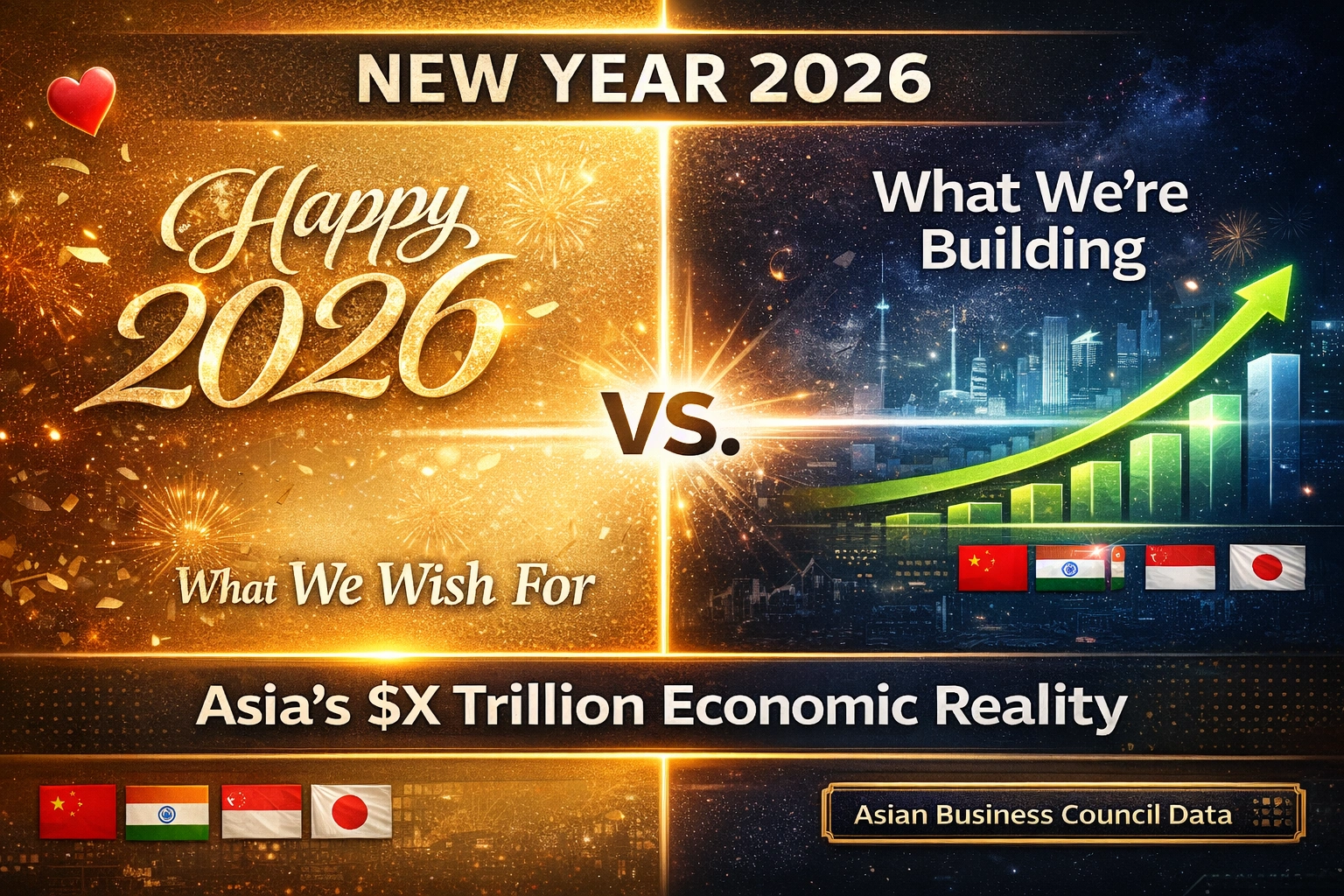
While billions search for “happy new year 2026 wishes,” Asia’s economic elite are building a very different future. Here’s the data-driven reality behind the greeting cards.
As midnight struck on December 31st, 2025, an estimated 890 million people worldwide typed “happy new year 2026 wishes” into search engines—a digital tsunami of optimism, hope, and heartfelt new year wishes for love, prosperity, and connection. Social media platforms overflowed with happy new year 2026 images: fireworks exploding over skylines, champagne toasts, and romantic new year quotes promising fresh starts.
But while everyday consumers exchanged new year wishes 2026 and clicked “send” on digital greeting cards, a very different conversation was unfolding in boardrooms from Singapore to Seoul. At the Asian Development Bank’s December 2025 forecast summit, business leaders gathered not to share inspirational new year quotes, but to dissect hard economic data that tells a more nuanced story about what 2026 actually holds.
The contrast is striking—and instructive. Developing Asia’s GDP is expected to grow by 5.1% in 2025 and 4.6% in 2026, according to the Asian Development Bank’s latest outlook. That moderation from 5.1% to 4.6% might seem like a rounding error in a greeting card, but it represents hundreds of billions of dollars in economic activity and millions of jobs across the region.
This isn’t pessimism—it’s precision. While we all wish for prosperity in 2026, the most successful businesses, investors, and professionals will be those who translate wishes into strategy, backed by data rather than sentiment alone.
The Asian Economic Reality Check: What the Data Actually Shows for 2026
When someone types “new year wishes” into Google, they’re expressing universal human hopes: financial security, professional success, meaningful relationships, and health. The question Asia’s business leaders are asking is more specific: which of those wishes align with economic fundamentals, and which are wishful thinking?
The answer reveals a fascinating divergence across the region.
The Growth Story: Robust but Moderating
Regional growth is expected to slow to 4.6% in 2026, dented by higher US tariffs and weaker global economic activity, according to the Asian Development Bank. But this aggregate figure masks dramatic differences across subregions and sectors.
South Asia’s growth is expected to remain robust, with the 2026 forecast maintained at 6.0%, driven primarily by India’s domestic consumption engine. India’s GDP is expected to increase 7.2% in 2025 and 6.5% in 2026, positioning it as the region’s—and arguably the world’s—most dynamic major economy.
Meanwhile, China’s GDP growth is projected at 4.3% for 2026, moderating from 2025 according to J.P. Morgan analysis. The sources of China’s economic growth remain fundamentally unbalanced, with weak consumption and disappearing investment amid a historic export boom.
Southeast Asia tells yet another story. Southeast Asia’s growth forecast is revised down to 4.3% for 2025 and 2026, compared to 4.7% for both years in April, reflecting trade uncertainty and cooling external demand.
For anyone typing “happy new year 2026 wishes” while planning business strategy, the message is clear: geographic specificity matters more than regional optimism. India presents compelling opportunities; China requires more nuanced navigation; Southeast Asia offers selective prospects tied to supply chain diversification.
The Inflation Picture: Cautiously Optimistic
Here’s where some of those new year wishes for prosperity find empirical support. Inflation in developing Asia is expected to ease further to 1.6% in 2025, down from 1.7% projected in September, mainly reflecting lower-than-expected food inflation in India.
This matters enormously for middle-class consumers across Asia—the very people sharing happy new year 2026 images on social media and hoping for improved living standards. Lower inflation means their wages stretch further, their savings lose value more slowly, and their new year wishes for financial security have a better chance of materializing.
South Asia’s inflation is forecast to decrease from 6.6% in 2024 to 4.9% in 2025, and further to 4.5% in 2026. For hundreds of millions of Indian consumers, this represents real purchasing power gains—the economic foundation that makes “happy new year wishes” more than just sentiment.
What Tech Giants Are Wishing For—and What They’re Building
When Tim Cook, Satya Nadella, and Jensen Huang tour Asia, they’re not exchanging new year quotes. They’re announcing investment commitments that dwarf most countries’ annual budgets—and these decisions reveal what sophisticated businesses actually expect from 2026.
Microsoft’s $17.5 Billion Asia Bet
Microsoft announces its largest investment in Asia — US$17.5 billion over four years (CY 2026 to 2029) — to advance India’s cloud and artificial intelligence infrastructure, skilling and ongoing operations.
Think about that number. While consumers search for “new year wishes 2026,” Microsoft is committing more than $17 billion to a single market. This isn’t a new year’s resolution that gets abandoned by February—it’s a calculated bet on India’s digital transformation trajectory.
Microsoft plans to open its first regional data centre in Thailand, enhancing the Azure cloud computing platform’s availability and providing world-class AI infrastructure, while committing USD 1.7 billion over the next four years to expand its services and AI infrastructure in Indonesia.
The strategic insight here cuts deeper than the dollar figures. Microsoft isn’t building infrastructure for 2026 alone—they’re positioning for a decade-long AI adoption cycle across Asia. Wall Street analyst Dan Ives frames 2026 as the likely inflection year when enterprise AI moves from pilot deployments and R&D to measurable revenue and scaled productization.
Apple’s Southeast Asia Pivot
Apple CEO Tim Cook announced a $250 million planned expansion of the company’s Singapore campus, reportedly to focus on AI, and said Apple intends to increase its investments in Vietnam and explore manufacturing opportunities in Indonesia.
Apple’s moves reflect a broader “China Plus One” strategy that’s reshaping global supply chains. When someone types “new year wishes for love,” they’re often seeking connection. When Apple invests in Vietnam, Indonesia, and Malaysia, it’s seeking supply chain diversification and geopolitical hedging—a very different kind of relationship building, but equally strategic.
Amazon’s $9 Billion Singapore Cloud Commitment
Amazon recently took over a giant conference hall in downtown Singapore to unfurl a $9 billion investment plan before a thousands-strong audience cheering and waving glow sticks.
The theatrics aside, this represents Amazon Web Services’ recognition that Southeast Asia’s young populations embrace video streaming, online shopping and generative AI, with data centers alone expected to see up to $60 billion in investment over the next few years.
The “New Year Wishes for Love” Economy: Romance, Relationships, and $620 Billion in Cross-Border Payments
Here’s where the economics of human connection get genuinely interesting. When 240 million people search for “new year wishes for love” or “happy new year 2026 wishes for love,” they’re not just expressing sentiment—they’re participating in a massive economic system built around relationships.
The Cross-Border Connection Economy
The global cross border payment market is projected to grow from $371.6 billion in 2025 to $620.15 billion by 2032, exhibiting a CAGR of 7.60%. A substantial portion of this growth is driven by personal remittances—money sent across borders to support family, friends, and loved ones.
Asia Pacific held the largest market share at 45.96% in 2024, with substantial trade flows and remittance corridors sustaining high transaction volumes.
Every “new year wishes for love” message sent across international borders represents potential transaction volume for payment processors. Filipino nurses in Singapore sending money home. Indian software engineers in the US supporting parents in Delhi. Vietnamese factory workers in Malaysia celebrating Lunar New Year with family virtually while ensuring cash arrives physically.
The companies facilitating these connections—PayPal, Payoneer, Wise, and emerging fintech startups—understand something profound: the economics of emotion are substantial and recurring.
The Wealth Management Love Story
The wealth pool of the affluent and mass-affluent segments in Asia is projected to hit $4.7 trillion by 2026, up from $2.7 trillion in 2021, according to McKinsey analysis.
This isn’t just abstract capital—it’s families planning for children’s education, couples preparing for retirement, and individuals seeking financial security that enables them to support loved ones. The potential incremental revenue from serving these clients will be $20 billion to $25 billion—contributing more than half of the industry’s revenue growth in Asia over the next three years.
When someone searches “new year wishes for love,” they might be thinking about romantic partnerships. When wealth managers analyze 2026 prospects, they’re thinking about multi-generational family wealth transfer, cross-border estate planning, and the financial infrastructure that enables prosperous lives.
Project Nexus: When New Year Wishes Meet Real-Time Payments
India has joined Project Nexus, an initiative led by the Bank for International Settlements, which aims to interlink fast payment systems across India, Malaysia, the Philippines, Singapore, and Thailand by 2026.
Imagine this scenario: It’s New Year’s Day 2026. A Malaysian student in Singapore wants to send money home instantly to surprise her parents. Previously, this required expensive wire transfers, currency conversion fees, and 2-3 day settlement times. By mid-2026, through Project Nexus integration, that transaction happens in seconds, costs a fraction of the old system, and arrives in ringgit without the sender worrying about exchange rates.
That’s not just a better payment rail—it’s infrastructure for human connection. Every “happy new year 2026 wishes” message that includes financial support becomes easier, cheaper, and faster.
The Content Creator Economy: Monetizing “Happy New Year 2026 Images”
When 450 million people search for “happy new year 2026 images,” most are looking for free graphics to share on WhatsApp, Instagram, or WeChat. But behind this massive demand sits a sophisticated creator economy that’s fundamentally reshaping digital content economics.
The Platform Playbook
Microsoft’s Designer AI, Apple’s iMessage sticker marketplace, Meta’s WhatsApp Business API—every major tech platform is competing for the attention generated by seasonal content searches. When users search for “new year quotes” or “happy new year 2026 images,” platforms capture:
- Engagement data: User preferences, sharing patterns, social graph insights
- Monetization opportunities: Premium content, subscriptions, business messaging
- Platform stickiness: Seasonal habits that reinforce daily platform usage
Microsoft publicly announced Copilot pricing at $30 per user per month for Microsoft 365 Copilot commercial plans. While consumers generate new year images for free, businesses are paying substantial subscriptions for AI tools that create marketing content at scale—including, ironically, the very “happy new year 2026” graphics that consumers then share organically.
The Asian Creator Monetization Gap
Southeast Asia hosts 675 million people and 440 million internet users, yet creator monetization lags developed markets. A YouTuber in Indonesia generates roughly 60% less revenue per thousand views than a creator in the US—despite comparable engagement levels.
This gap represents opportunity. As payment infrastructure improves, advertising markets mature, and platforms expand monetization options, Asian creators participating in the “new year wishes” content ecosystem will capture increasing value from their work.
Strategic Implications: Translating Wishes into Economic Strategy
The gap between what people wish for and what economic reality delivers determines success and failure across Asian markets in 2026. Let’s translate common “new year wishes” into actionable business insights:
Wish: “Prosperity and Financial Success”
Economic Reality: Selective, geography-dependent, sector-specific
Action Strategy:
- India exposure: Overweight consumer discretionary, digital payments, and cloud infrastructure
- China selectivity: Focus on high-value manufacturing, electric vehicles, and AI applications rather than broad market exposure
- Southeast Asia: Prioritize Vietnam and Indonesia for manufacturing diversification plays; Singapore for wealth management and fintech
India presents a compelling entry point with a robust mix of cyclical tailwinds and stands out as one of the top implementation ideas outside of the U.S. despite export-related headwinds, according to J.P. Morgan Private Bank.
Wish: “Health and Wellbeing”
Economic Reality: Underfunded relative to demographic needs, presenting both challenges and opportunities
Asia’s healthcare infrastructure investments lag population aging trends. The expectation of a larger impact from US tariffs led to a downward revision of South Asia’s growth outlook, now projected at 5.9% in 2025 and 6.0% in 2026—but healthcare spending remains a bright spot as middle-class wealth expands.
Action Strategy:
- Telemedicine platforms scaling across tier-2 and tier-3 cities
- Medical tourism infrastructure in Thailand, Singapore, and India
- Health insurance products for the expanding affluent segment
Wish: “Connection and Love”
Economic Reality: Massive, measurable, and monetizable through digital infrastructure
Action Strategy:
- Cross-border payment facilitators (remittances represent $200+ billion annually in Asia)
- Social commerce platforms (WeChat, LINE, KakaoTalk ecosystems)
- Digital gifting infrastructure for festivals, celebrations, and relationship maintenance
The “emotional economy”—transactions driven by maintaining relationships—represents one of Asia’s least appreciated growth sectors. Global stablecoin supply surpassed USD 300 billion in 2025, with projections indicating that total market capitalization could reach USD 1 trillion by the end of 2026. Much of this growth stems from people needing faster, cheaper ways to send money to family and friends across borders.
Wish: “Career Growth and Opportunity”
Economic Reality: AI-driven displacement and creation happening simultaneously
Google plans to invest up to $85 billion by 2026, while Microsoft is targeting $100 billion in AI infrastructure. This capital deployment creates jobs—but not necessarily in traditional roles.
Action Strategy:
- Upskilling in AI-adjacent fields (prompt engineering, AI-assisted development, data curation)
- Focus on roles requiring human judgment, creativity, and cultural context
- Geographic arbitrage: high-value work from lower-cost-of-living Asian cities
The 2026 Macro Crosscurrents: Where Optimism Meets Reality
Trade Tensions: The Tariff Shadow
Higher US tariffs and weaker global economic activity will dent regional growth, with India facing the steepest US tariff hikes among developing Asian economies, prompting a downgrade in its growth outlook.
Yet tariffs create winners alongside losers. Southeast Asian economies and India are benefiting from supply chain diversification, though their rising exports are matched by sizable trade deficits with China.
The new year wish for free trade conflicts with geopolitical reality. Smart businesses aren’t wishing for policy changes—they’re building supply chain flexibility to navigate whichever trade regime materializes.
The China Conundrum: Export Strength, Domestic Weakness
China’s sustained export strength signals intensifying competitive pressures and a challenging path to diversification for regional competitors. As China continues to move up the value chain and consolidate its lead in advanced manufacturing, its grip on global trade looks set to endure.
This creates a paradox: businesses can’t decouple from China (it’s too embedded in supply chains and too large as a market), but they also can’t depend solely on China (geopolitical risks and domestic consumption weakness create exposure).
The AI Opportunity: Real Revenue, Real Soon
The picks reflect a thesis that the next investment phase of AI moves beyond chips to platform monetization, verticalized applications, and enterprise-grade security in 2026.
This isn’t speculative anymore. Microsoft’s Copilot and Azure inference business already show measurable monetization, moving AI from research expense to revenue generator.
For Asia, the AI story is about application rather than infrastructure. While Nvidia’s chips might be designed in California, the AI applications solving problems for Indian healthcare, Indonesian logistics, and Filipino customer service will be built regionally—and capture value locally.
The Practical Playbook: From New Year Wishes to Economic Action
As 2026 unfolds, the gap between aspirational “new year wishes” and economic outcomes will separate the prepared from the hopeful. Here’s how to bridge that gap:
For Business Leaders
Stop wishing for stability; build for volatility. Renewed tariff tensions and trade policy uncertainty, and higher financial market volatility, remain key risks. Scenario planning isn’t optional—it’s survival.
Diversify geography and customer base. No single market growth rate tells the whole story. UOB aims to accelerate Southeast Asia expansion, targeting 30% of revenue from the region in 2026, while keeping Singapore’s revenue share at 50%. Balance stability (Singapore, developed markets) with growth (India, Vietnam, Indonesia).
Invest in digital infrastructure. Microsoft aims to train 2.5 million people in AI by 2025 in Indonesia alone. Companies that don’t upskill workforces risk competitive obsolescence within 24 months.
For Investors
Rebalance toward income, away from pure growth. With China’s GDP growth projected at 4.3% in 2026 and Southeast Asia’s growth forecast at 4.3% for 2026, capital appreciation opportunities narrow. Dividend yields, real asset exposure, and alternative credit become more attractive.
Overweight enablers, not just users. Rather than betting on which consumer app wins in Asia, invest in the payment rails, cloud infrastructure, and logistics networks that all winners must use.
Geographic granularity matters. “Asia” is meaningless as an investment thesis. India’s 6.5% growth and Indonesia’s 5.0% growth occur in vastly different regulatory, currency, and competitive contexts.
For Professionals
Your new year wish for career growth needs a skill strategy. Amazon, Microsoft and Google have pledged a combined $67.5 billion in Indian investments since October, with 80% of those commitments coming this month. These aren’t factory jobs—they’re cloud engineers, AI trainers, and data scientists.
Geographic mobility creates alpha. Remote work from Bali, Chennai, or Chiang Mai while serving US/EU clients captures wage arbitrage that pure domestic work cannot.
Network effects compound. The professional relationships built at India’s AI summit or Singapore’s fintech week create more career value than another certification course.
Conclusion: Making Peace with the Gap Between Wishes and Reality
As 2026 progresses, billions will continue searching for “happy new year wishes,” typing “new year quotes” into social media, and sharing “happy new year 2026 images” with friends and family across WhatsApp, WeChat, and Instagram. This is beautiful, human, and economically meaningless.
What matters—what shapes whether 2026 delivers prosperity or disappointment—is whether we build strategy on sentiment or data.
The Asian economic story for 2026 is neither catastrophic nor euphoric. It’s nuanced: Developing Asia’s GDP expected to grow 5.1% in 2025 and 4.6% in 2026, with inflation easing to 1.6% in 2025 and 2.1% in 2026. Growth is slowing but remains positive. Inflation is moderating but not collapsing. Trade tensions create winners and losers. Technology creates opportunity and disruption simultaneously.
The most successful individuals, businesses, and investors in 2026 won’t be those with the best “new year wishes”—they’ll be those who translate human aspirations into economically grounded strategy.
When you type “happy new year 2026 wishes” into Google, pause for a moment. Behind that search query sits $620 billion in cross-border payments, $4.7 trillion in Asian wealth under management, $67.5 billion in tech infrastructure investment, and 440 million digital consumers whose behavior drives economic reality.
Your new year wish should be simple: May 2026 be the year you stop wishing and start building. May you make decisions based on data, not hope. May you invest where economic fundamentals support growth, not where marketing promises excitement. May you recognize that the gap between aspiration and achievement is bridged by strategy, capital allocation, and disciplined execution—not by inspirational quotes shared on social media.
That’s not cynicism. It’s realism. And in an economically complex year like 2026, realism is the most valuable wish of all.
Happy New Year 2026. Now let’s get to work.
What’s Your Strategic Wish for 2026?
More importantly, what are you building to make it real? The most powerful new year wish is the one backed by investment, planning, and execution. Share your 2026 strategy in the comments—let’s turn wishes into reality together.
Discover more from Startups Pro,Inc
Subscribe to get the latest posts sent to your email.



In a single 48-hour stretch, Prime Infrastructure’s chairman has agreed to acquire Colombia’s largest independent oil producer from Carlyle Group and secured a landmark ₱273.5 billion green-loan package to build 2 gigawatts of pumped-storage hydro in the Philippines — moves that recast him as one of emerging Asia’s most consequential energy investors.
MANILA — On the morning of March 11, 2026, two transactions landed almost simultaneously in the inboxes of energy-sector deal-trackers. The first: Prime Infrastructure Capital, the infrastructure arm of Philippine billionaire Enrique K. Razon Jr., had agreed to buy Carlyle Group’s full stake in SierraCol Energy Ltd., Colombia’s largest independent oil-and-gas producer. The second: Prime Infra was signing a historic ₱273.47 billion ($4.6 billion) green-loan financing package to build two pumped-storage hydropower stations totalling 2 gigawatts on the Philippine island of Luzon.
Taken individually, each deal would rank as a landmark event for an infrastructure group more familiar to investors as the steward of Manila’s container terminals and casino resorts. Taken together, they announce something more ambitious: Razon’s deliberate repositioning as one of emerging Asia’s — and now Latin America’s — most consequential private energy investors, at a moment when global capital flows into hydrocarbons and clean power are simultaneously reshaping the geopolitical map.
A Casino King Becomes a Global Energy Player
To understand the audacity of these moves, it helps to appreciate how recently Razon’s world looked entirely different. A decade ago, his International Container Terminal Services (ICTSI) dominated his public profile and his balance sheet. Bloomberry Resorts, operator of the landmark Solaire casino complex in Manila Bay, added a glittering second pillar. Energy was an afterthought — a sector dominated in the Philippines by the Lopez and Gokongwei dynasties and, for hydrocarbons, by the government-linked Philippine National Oil Company.
The pivot began quietly but has accelerated with striking velocity. Prime Infra’s acquisition of a 60% stake in First Gen Corporation’s gas assets — the Malampaya deepwater field is the Philippines’ single largest domestic gas source [[see: Razon’s Malampaya Gas Play]] — signalled that Razon was prepared to own the infrastructure that powers the country rather than simply move the containers that fill it. The subsequent 40% stake sale in First Gen’s hydropower portfolio, structured as a strategic alliance with the Lopez family, deepened the grid-balancing play. Now, the SierraCol transaction extends that arc to an entirely new continent.
“This acquisition strengthens our oil and gas expertise and complements our existing asset base in the Philippines.” — Guillaume Lucci, CEO, Prime Infrastructure Capital
Those fourteen words from Prime Infra chief executive Guillaume Lucci, spare as they are, contain a strategic thesis. The Colombia deal is not merely opportunistic capital deployment. It is a statement that Prime Infra intends to build genuine upstream hydrocarbon competence — not just own assets, but operate them, optimise them, and eventually export the expertise homeward, to assets like Malampaya as its existing reserves enter their declining years.
Why Enrique Razon’s Colombia Move Is a Masterstroke for Energy Diversification
SierraCol Energy is not a marginal asset. The company produces roughly 77,000 barrels of oil equivalent per day (boe/d) gross — approximately 10% of Colombia’s total national output — making it the country’s largest independent oil-and-gas producer by volume. Its flagship properties, the Caño Limón and La Cira Infantas fields, are among Colombia’s most storied hydrocarbon addresses, with Caño Limón having produced over 1.5 billion barrels since its discovery by Occidental Petroleum in the 1980s.
Under Carlyle’s stewardship, the financial engineering is as instructive as the operational profile. The private equity giant stabilised net production at roughly 45,000 boe/d — a meaningful discount to the gross figure, reflecting royalties, partner takes, and operational realities — but generated $205 million in free cash flow over the twelve months to October 2025. That is a cash conversion rate that most listed oil majors would envy. The company carries $618 million in net debt, a leverage ratio that is manageable given the asset’s cash generation, and which Carlyle had been working to reduce ahead of a sale process that, at one point, was expected to yield approximately $1.5 billion.
The final transaction price has not been disclosed. But Prime Infra is acquiring a platform with a proven cash engine, mature operational infrastructure, and a reserve life sufficient to justify long-horizon investment — precisely the characteristics Razon has sought in every major asset he has acquired. This is Prime Infra’s first overseas energy asset, which makes it a beachhead transaction: not the end of a strategy, but the opening of one.
The $618 Million Question: What Prime Infra Is Really Buying
Sceptics of the Colombia deal will note — correctly — that acquiring a mature hydrocarbon asset in Latin America in 2026 carries risks that a purely financial reading understates. Environmental, social, and governance pressures are real. Colombia’s Amazonian and Andean production zones have been flashpoints for community conflict, pipeline sabotage by armed groups, and biodiversity litigation. The Caño Limón pipeline, a 780-kilometre artery to the Caribbean coast, has been bombed hundreds of times over its operational life.
More immediately pressing: timing. The transaction is expected to close within a month, subject to Colombian regulatory approvals — but Colombia heads to a presidential election whose outcome could materially reshape energy policy. The current Petro administration has already restricted new oil-and-gas exploration licences and championed a managed energy transition agenda that has chilled upstream investment. A continuation of that direction, or a further lurch leftward, would constrain SierraCol’s ability to replace reserves over time. A centrist or right-of-centre successor, conversely, could restore confidence and unlock a secondary re-rating of the asset.
Prime Infra appears to have priced this political risk into the acquisition rather than running from it. The company is buying existing production — mature fields with contracted infrastructure — rather than greenfield exploration exposure. Cash flow from current operations is the investment thesis, not speculative upside from new discovery. That framing makes the deal more defensible than it might initially appear to ESG-conscious investors. It also suggests that Razon’s team has done serious political scenario analysis, not merely financial modelling.
The key SierraCol metrics at a glance:
- Gross production: ~77,000 boe/d (~10% of Colombia’s national output)
- Net stabilised production (under Carlyle): ~45,000 boe/d
- Free cash flow (12 months to Oct 2025): $205 million
- Net debt: $618 million
- Flagship assets: Caño Limón and La Cira Infantas fields (Reuters, March 11, 2026)
- Transaction close: expected within one month, subject to regulatory approvals
- Significance: Prime Infra’s first overseas energy asset
Philippines’ 2GW Pumped-Storage Bet: Powering the 2030 Renewable Target
If the Colombia deal is Prime Infra’s outward-facing gambit, the Philippine hydropower financing announced on March 12 is its home-front anchor. The ₱273.47 billion ($4.6 billion) package — described by Prime Infra as “historic” and structured as a green loan — covers two pumped-storage hydropower projects that together represent 2 gigawatts of new grid-balancing capacity: the 600-megawatt Wawa facility in Rizal province and the larger 1,400-megawatt Pakil/Ahunan project in Laguna, both targeting completion by 2030.
Pumped-storage is, in essence, a giant rechargeable battery carved from geography. Water is pumped uphill during periods of low electricity demand and released through turbines when demand peaks, providing dispatchable, on-demand power generation that is uniquely valuable for grids absorbing large quantities of intermittent solar and wind. The Philippines, with its aggressive renewable-energy mandate — 35% of the power mix by 2030, rising to 50% by 2040 — desperately needs exactly this capability. Variable renewables without grid-balancing infrastructure are, as engineers politely put it, destabilising.
The syndicate assembled to finance the projects is itself a statement of institutional confidence. Eight Philippine lenders — BPI, BDO, China Banking Corporation, Land Bank of the Philippines, Metrobank, Philippine National Bank, Security Bank, and UnionBank — joined forces with three Japanese financial institutions: MUFG, Mizuho, and SMBC. The Japanese presence is particularly significant. Tokyo’s major banks have become the most active green-infrastructure lenders in Southeast Asia, drawn by a combination of domestic yield scarcity, geopolitical alignment, and the long-duration asset profiles that match their liability books. Their participation in a Philippine green-loan structure carries an implicit endorsement that few other validations could replicate.
“₱273.47 billion. Eleven lenders. Two reservoirs. One grid-balancing bet that could determine whether the Philippines’ renewable transition succeeds or stalls.”
The Wawa and Pakil/Ahunan projects also position Prime Infra directly at the intersection of the First Gen alliance and the national grid. First Gen’s hydropower assets — the Pantabangan-Masiway complex and the Botocan plant — are among the most efficient large-scale generators in the Luzon grid. By owning both a stake in those operating assets and the development rights to the next generation of pumped-storage capacity, Prime Infra is assembling a vertically integrated clean-power position that will be difficult for competitors to replicate within the decade.
Geopolitical Timing: Colombia Election Risks and Philippine Energy Security
The two deals, separated by an ocean and seemingly disparate in character, share a deeper thematic logic when viewed through the lens of emerging-market infrastructure capital flows in the mid-2020s. Private equity, which dominated infrastructure deal-making in the previous decade, is increasingly ceding the field to strategic family-controlled holding companies — Razon in the Philippines, the Adanis in India, the Salims in Indonesia — that can absorb political risk over longer time horizons than a fund with a fixed exit mandate. Carlyle’s willingness to sell SierraCol, a genuinely high-quality cash-generating asset, is itself a data point: the ten-year fund clock that governs private equity logic creates a structural disadvantage when the seller needs to monetise precisely when macro and political conditions are unfavourable.
For Razon, there is no such clock. His family holding structure allows Prime Infra to hold Colombian oil production through an electoral cycle or two, reinvest free cash flow at the asset level, and eventually decide on the appropriate exit timeline based on value rather than fund life. That patient capital advantage is exactly what makes the deal rational for him where it would be irrational for Carlyle to hold.
In the Philippines, the energy-security calculus is more acute. The country imports the vast majority of its liquid fuel requirements and remains exposed to LNG price volatility through its gas-fired power fleet. The Malampaya field, which Prime Infra now co-owns, is scheduled to deplete significantly within the coming decade. Building 2 gigawatts of pumped-storage capacity is, in part, a hedge: a way to maximise the economic value of intermittent renewable additions — solar in particular — without increasing dependence on imported fossil-fuel backup power. If the Bloomberg analysis of the Colombia acquisition is correct that Razon is building integrated hydrocarbon competence to bolster the Malampaya position, then the two deals are not merely complementary — they are sequential chapters of a single strategy.
Compared with his Philippine conglomerate peers, Razon is moving faster and at greater scale. The Lopez family’s First Gen, his partner in the hydro alliance, has focused predominantly on gas and geothermal within the archipelago. The Gokongwei-linked JG Summit has energy exposure through Cebu Air’s fuel hedging and some utility assets, but lacks Prime Infra’s infrastructure depth. Razon appears to have concluded that in the next phase of the Philippine — and now Colombian — energy story, scale and operational expertise will be the decisive competitive variables, and that the window to acquire both is narrower than markets currently appreciate.
What Comes Next: Three Implications for Global Energy Capital
For investors and policymakers tracking the intersection of ASEAN energy security, Latin American upstream investment, and green-transition financing, the Razon deals carry implications that extend well beyond the balance sheets of Prime Infra and SierraCol.
First, the Colombia acquisition signals that Asian strategic capital — patient, family-anchored, politically sophisticated — is beginning to fill the vacuum left by Western private equity retreating from hydrocarbon assets under ESG pressure. This is not the first such transaction — Abu Dhabi’s ADNOC and Saudi Aramco have made similar moves globally — but it is the first time a Southeast Asian privately controlled group has acquired a major Latin American oil producer. The template, if it succeeds, will be studied across the region.
Second, the Philippine pumped-storage financing structure is a model that other ASEAN governments will seek to replicate. The combination of domestic bank syndication with Japanese green-loan capital, structured around long-duration infrastructure assets with government-aligned energy policy targets, represents exactly the blended-finance architecture that multilateral development institutions have advocated for years. That Prime Infra achieved it through pure commercial negotiation — without concessional development-finance support — is a meaningful benchmark.
Third, and most consequentially: Razon’s dual-deal gambit implies a conviction that the global energy transition will be neither as fast as climate advocates hope nor as slow as hydrocarbon incumbents prefer. The Colombian oil acquisition makes sense only if oil demand persists strongly enough over the next decade to justify the acquisition premium. The Philippine pumped-storage investment makes sense only if renewables scale fast enough to need grid-balancing capacity at 2-gigawatt scale. Razon is, in effect, betting on both — a rational hedge that positions Prime Infra to profit whichever half of the energy transition narrative proves dominant over the coming decade.
Whether the political gods of Bogotá cooperate remains the variable that financial models cannot capture. But in a world where energy security has displaced pure cost optimisation as the organising principle of infrastructure capital, Enrique Razon’s 48-hour deal blitz looks less like opportunism than like strategy — the kind that takes years to plan and a fortnight to execute.
Discover more from Startups Pro,Inc
Subscribe to get the latest posts sent to your email.
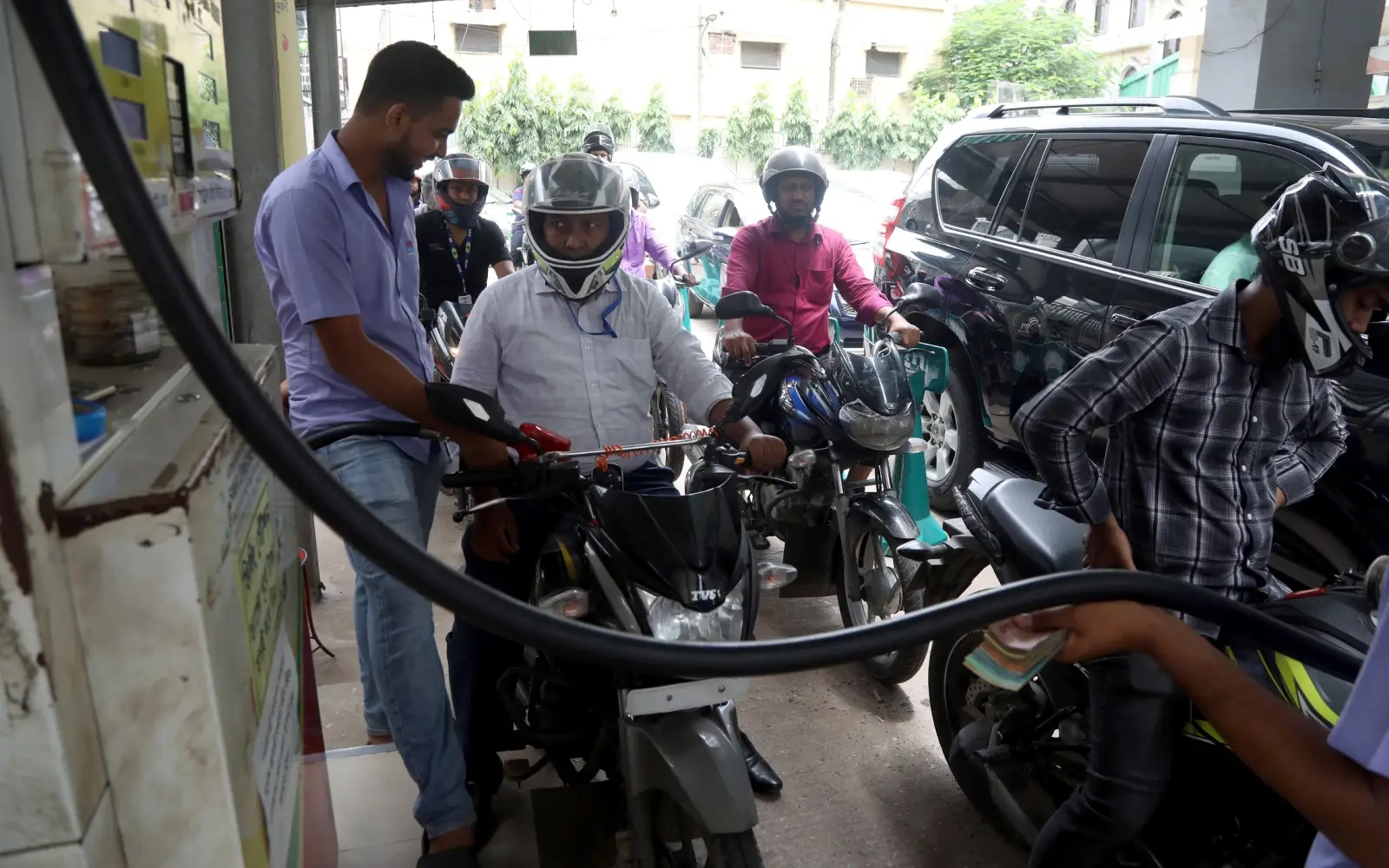
Bangladesh imposes emergency fuel rationing — 2L for motorcycles, 10L for cars — as the US-Israel-Iran war shuts the Strait of Hormuz, triggering a deepening energy crisis for South Asia’s most import-dependent nation.
In Dhaka’s Tejgaon district on the morning of March 8, daily fuel sales at a single filling station leapt from 5 million taka to 8 million taka overnight — mostly octane, mostly panic. Motorcyclists who once stopped by their local pump without a second thought now queue for an hour under the March sun, elbows out, tanks nearly dry, waiting for a ration the government has capped at two litres. Two litres. Barely enough to cross the city twice. Across town, a ride-share driver named Subrata Chowdhury waited in line at Chattogram’s QC Petrol Pump, then received a quantity he described as “not enough to stay on the road even half a day.” Meanwhile, five of Bangladesh’s six fertiliser factories fell silent, their gas lines cut on government orders until at least March 18.
A war 5,000 kilometres away had just reached inside every Bangladeshi household.
The Spark: How the US-Israel-Iran War Hit the Strait of Hormuz
The crisis arrived with the precision of a laser-guided munition. On February 28, 2026, coordinated US-Israeli airstrikes — codenamed Operation Epic Fury — struck Iranian military and nuclear facilities, killing Supreme Leader Ali Khamenei and several senior IRGC commanders. Within hours, Iran’s Islamic Revolutionary Guard Corps broadcast a blunt message across the Persian Gulf: the Strait of Hormuz was closed.
What followed was the fastest seizure of a global energy chokepoint in modern history. Tanker transits dropped from an average of 24 vessels per day to just four by March 1, according to energy intelligence firm Kpler. By March 2, no tankers were broadcasting AIS signals inside the strait at all. Insurance protection and indemnity coverage was stripped for any vessel attempting passage from March 5, making the economic risk effectively prohibitive for shipowners worldwide. At least 150 supertankers anchored in limbo outside the strait’s entrance. MSC, Maersk, and Hapag-Lloyd suspended transits. The waterway that carries roughly one-fifth of the world’s daily oil supply and 20 percent of global LNG exports had become, for practical purposes, a naval exclusion zone.
Brent crude, which had closed at $73 per barrel on Friday, gapped higher through the weekend. By March 6, it reached $92.69 — the highest level since 2024, representing a roughly 27 percent surge in under two weeks. Iran’s retaliatory strikes targeted Gulf energy infrastructure, including Qatar’s Ras Laffan industrial complex — home to the largest LNG export facilities on the planet. QatarEnergy confirmed it had ceased LNG production entirely. Daily freight rates for LNG tankers jumped more than 40 percent on a single Monday. European natural gas benchmarks nearly doubled in 48 hours before pulling back slightly on diplomatic signals.
The Strait of Hormuz, as geopolitical theorists have long warned, had ceased to be a mere waterway. It had become a weapon.
On the Ground: Dhaka’s Fuel Queues and Public Anger
Bangladesh’s Energy Division moved with unusual urgency. On March 5, the Bangladesh Petroleum Corporation held an emergency online meeting with the Petrol Pump Owners Association, instructing operators to cease selling fuel in drums or containers and to halt open-market sales. Two days later, on March 6, BPC published formal purchase caps across all vehicle categories. By Sunday, March 8, the rationing system was formally in effect nationwide.
The street-level anger was immediate and undisguised. A survey of six petrol stations in Dhaka’s Gabtoli district found four with no fuel at all; the remaining two had imposed their own informal cap of 500 taka per customer. Long queues of cars and motorcycles had formed before dawn. One motorcyclist reported waiting nearly an hour — only to receive enough fuel to reach work and little more. In Chattogram, ride-sharing motorcyclists emerged as the worst-affected group: their entire livelihood depends on continuous movement through the city, and two litres does not allow continuous movement.
At Tejgaon station in Dhaka, daily octane sales more than doubled as consumers raced to top up whatever they could before restrictions tightened further. Authorities responded by deploying vigilance teams from Border Guard Bangladesh alongside district-level BPC monitoring units to prevent illegal stockpiling and price gouging — the latter carrying criminal penalties under Bangladeshi law. Prime Minister Tarique Rahman moved symbolically, switching off half the lights in his office and setting air conditioning to 25°C, urging citizens to car-pool, reduce private travel, and cut household gas use.
The optics were telling. When a prime minister publicly dims his own office lights, the message is clear: this is not a routine supply hiccup.
The Numbers: 95% Import Dependency and BPC’s Emergency Caps
No country in South Asia enters this crisis more exposed than Bangladesh. The arithmetic is stark and largely inescapable.
Bangladesh imports approximately 95 percent of its oil and gas needs, a figure the BPC itself cited in its rationing notice. The country requires around 7 million tonnes of fuel annually, including more than 4 million tonnes of diesel. On the gas side, the structural deficit is even more alarming: Bangladesh is already running a shortfall of more than 1,300 million cubic feet per day, according to the Institute for Energy Economics and Financial Analysis — a gap that was being bridged, precariously, by spot-market LNG purchases before the war began.
The BPC’s emergency rationing caps, announced March 6, are as follows: motorcycles are limited to 2 litres of petrol or octane per day; private cars to 10 litres; SUVs, jeeps, and microbuses to 20–25 litres; pickup vans and local buses to 70–80 litres; and long-distance buses, trucks, and container carriers to 200–220 litres of diesel. BPC officials confirmed that diesel stocks at national depots had fallen to a nine-day reserve — a figure that concentrates the mind considerably.
Of Bangladesh’s LNG imports, 72 percent originates from Qatar and the UAE. Qatar’s decision to halt LNG exports following strikes on Ras Laffan was not a marginal inconvenience for Dhaka — it was an amputation of nearly three-quarters of the country’s gas supply chain. QatarEnergy had two cargo deliveries scheduled for March 15 and March 18. Kuwait Energy, whose terminal was also struck, confirmed it could not deliver its own two planned cargoes. Petrobangla Chairman Md Arfanul Hoque acknowledged both cancellations, noting that replacement bookings had been made on the spot market — but as of mid-week, no sellers had been found. Indonesia, traditionally a secondary supplier, confirmed it could not supply additional LNG to Bangladesh, citing priority for its own domestic demand. Global LNG spot prices had already surged roughly 35 percent since the strikes began.
Ripple Effects: Power Rationing, Fertiliser Crisis, Economic Fallout
The downstream consequences are spreading faster than the government’s containment efforts.
Five of Bangladesh’s six urea fertiliser factories — Ghorashal Palash, Chittagong Urea Fertiliser Factory, Jamuna Fertiliser Company, Ashuganj Fertiliser and Chemical Company, and the privately run Karnaphuli Fertiliser Company — have been shuttered through at least March 18, following suspension of gas supply to the plants as part of broader energy rationing. Their combined daily production capacity of approximately 7,100 tonnes is now offline. Over a 15-day closure, that represents more than 100,000 tonnes of urea production lost.
Officials from the Bangladesh Chemical Industries Corporation have offered cautious reassurance: the country holds 468,000 tonnes of urea in stock, sufficient to cover the current Boro rice cultivation season through roughly June. But the Boro season is Bangladesh’s most water-intensive and fertiliser-heavy agricultural cycle. If the Middle East conflict lingers into the summer planting cycle, the country would be forced to import urea from the same region — Saudi Arabia, the UAE, and Qatar — where supply chains are already fractured. “If the crisis lingers,” warned Riaz Uddin Ahmed, executive secretary of the Bangladesh Fertiliser Association, “there will be a problem.”
The power sector is the next domino in line. Energy officials have warned that a gas shortage could emerge after March 15 if LNG shipments cannot be replaced, at which point rationing would extend to electricity generation — prioritising households and industries while reducing supply to power plants. The Bangladesh Garment Manufacturers and Exporters Association (BGMEA), whose member factories account for more than 80 percent of the country’s export earnings, called for waivers on duties, taxes, and VAT on fuel and gas imports to cushion the immediate blow. The garment sector’s energy costs are about to rise sharply, threatening margins already squeezed by global demand softness.
The macroeconomic arithmetic is brutal. Bangladesh’s import bill, already pressured by the taka’s weakness, will surge with every additional week of elevated LNG and crude prices. At $92 per barrel of Brent — and analysts at JPMorgan have placed the severe-scenario band at $130 per barrel — the fiscal calculus becomes genuinely alarming for a country that already runs a significant current account deficit. Dr M. Tamim of the Bangladesh University of Engineering and Technology warned plainly that the situation “could deteriorate gradually” as long as the Strait of Hormuz remains effectively closed, and that securing LNG from alternative Asian suppliers would prove deeply challenging.
Geopolitical Lens: Why Bangladesh Is the First Domino
Bangladesh is not merely an energy victim in this crisis. It is a structural case study in the geography of vulnerability — and a preview of the pain that dozens of similarly exposed economies will face if the Hormuz disruption endures.
The architecture of South Asian energy dependency was built over decades on a set of assumptions that have now been invalidated in a single weekend. Cheap, reliable Gulf energy — piped in the form of LNG from Qatar, crude from Saudi Arabia and the UAE — was not merely a commodity preference. For Bangladesh, it was the physical infrastructure of industrial growth. The garment factories, the power plants, the fertiliser sector: all were built with the assumption that Gulf flows would continue uninterrupted. The Strait of Hormuz disruption of 2026 has exposed that assumption as a geopolitical single point of failure.
What makes Bangladesh’s position particularly acute compared to, say, India or China, is the combination of three factors simultaneously: extreme import concentration (72 percent of LNG from Qatar and the UAE, according to Kpler data cited by CNBC); essentially zero domestic strategic petroleum reserves capable of absorbing more than nine days of consumption; and minimal procurement flexibility — no long-term contracts with American, Australian, or West African LNG suppliers that could be called upon at short notice.
India and China, by contrast, hold buffer reserves and diversified supply portfolios that buy days and weeks of political manoeuvre. Bangladesh has neither. “Pakistan and Bangladesh have limited storage and procurement flexibility,” Kpler principal analyst Go Katayama noted, “meaning disruption would likely trigger fast power-sector demand destruction rather than aggressive spot bidding.” That is a polite way of saying: Dhaka will not outbid Tokyo or Beijing for emergency LNG cargoes. It will simply do without.
The deeper geopolitical lesson is one of concentrated risk masquerading as ordinary commerce. For three decades, global energy markets encouraged developing economies to import from the cheapest, most proximate source. For South Asia, that meant the Gulf. No one built the redundancy that resilience requires because redundancy costs money and politics rewards short-termism. The bill has now arrived.
What Comes Next: Outlook for 2026 and Global Lessons
Dhaka is scrambling for alternatives. Emergency import negotiations are under way with Singapore, Malaysia, Indonesia (who declined), China, and African suppliers. Saudi Aramco has pledged refined oil shipments routed outside Saudi Arabia’s normal Gulf terminals — a logistical workaround that adds cost and delay. The government holds master sale and purchase agreements with 23 international companies for spot-market LNG access, though finding willing sellers at non-punishing prices has proved difficult. The government of Saudi Arabia is also reportedly considering diverting crude exports through Yanbu’s Red Sea terminal — bypassing Hormuz entirely — following a formal Pakistani request on March 4.
The outlook, however, remains contingent on the duration of the military confrontation. If the US Navy follows through on President Trump’s pledge to escort commercial tankers through Hormuz — and if diplomatic back-channels reported by The New York Times regarding Iranian outreach produce results — then some partial resumption of Gulf traffic could stabilise markets within weeks. Goldman Sachs estimates Brent could average around $76 for the second quarter if disruptions are contained to roughly five more days of near-zero transit followed by a gradual recovery. But Mizuho Bank cautioned that even with US naval escorts, the “war premium” of $5–$15 per barrel would persist in insurance costs alone, keeping prices elevated indefinitely.
For Bangladesh specifically, the immediate weeks are critical. Gas rationing targeting power plants is likely after March 15 if replacement LNG cargoes are not secured. Rolling electricity cuts would ripple through every sector of the economy simultaneously. The garment industry, which cannot produce without power and is already navigating global demand headwinds, faces a direct threat to the country’s primary source of foreign exchange. The agriculture sector, if the fertiliser shutdown extends beyond March 18, risks undersupply heading into critical planting windows later in the year.
The broader lesson, one that should reach every finance ministry and energy regulator from Colombo to Manila, is that energy security is not a market problem — it is a strategic one. Markets optimised Bangladesh’s fuel imports toward cheap and proximate. Strategy would have diversified them toward resilient and redundant. Qatar’s Energy Minister Saad al-Kaabi warned in a Financial Times interview that Gulf energy producers could halt exports within weeks, potentially pushing oil to $150 per barrel. Whether that scenario materialises or not, the warning itself encodes a profound truth about the architecture of globalisation: supply chains optimised for efficiency are, by design, brittle under stress.
Bangladesh did not build the Strait of Hormuz crisis. But it may pay for it longer than almost anyone else.
Discover more from Startups Pro,Inc
Subscribe to get the latest posts sent to your email.
Analysis
Virgin Atlantic’s Strategic Swoop: On Track to Lure Tens of Thousands from British Airways’ Frequent Flyer Fold

There’s a particular kind of frustration that frequent flyers know intimately — the moment you realize the loyalty program you’ve spent years nurturing has quietly moved the goalposts. For thousands of British Airways Executive Club members, that moment arrived in 2024 when BA announced sweeping changes to its tier points structure, effectively raising the bar for elite status in ways that left many road warriors feeling, as one London-based consultant put it, “more grounded than airborne.” Now, with Virgin Atlantic’s enhanced status match promotion closing February 23, 2026, a competitor is turning that discontent into a mass migration — and the numbers are staggering.
According to <a href=”https://www.ft.com/content/6384ee81-fab6-4024-a9ec-a0d18303a48f”>reporting by the Financial Times</a>, Virgin Atlantic is on track to poach tens of thousands of British Airways’ most loyal customers, capitalizing on what may be the most consequential loyalty program overhaul in UK aviation history. The transatlantic airline rivalry has always been fierce, but rarely has one carrier’s stumble created such a clean runway for the other.
The BA Loyalty Shake-Up: What Went Wrong?
British Airways’ revamp of its Executive Club, which began rolling out in earnest through 2024 and 2025, was designed with a clear philosophy: reward high spenders, not just high flyers. The airline shifted its tier points model to weight spend more heavily, meaning that a budget-conscious business traveler who logs 100,000 miles annually on economy fares could find themselves slipping from Gold to Silver — or off the tier ladder entirely.
The logic is financially sound from an airline CFO’s perspective. Loyalty programs have evolved into multi-billion-pound profit centers; BA’s parent company IAG reported loyalty revenue contributions exceeding £1.5 billion in 2024. Restructuring around spend rather than miles mirrors Delta SkyMiles’ controversial 2023 overhaul in the United States — a move that triggered a similar exodus there.
But the human cost to brand loyalty has been severe. <a href=”https://www.telegraph.co.uk/travel/advice/passengers-abandoning-british-airways”>The Telegraph has documented</a> a notable wave of passengers abandoning British Airways, with forum threads on FlyerTalk and social media communities swelling with testimonials from disgruntled BA frequent flyers who feel the airline has broken an implicit contract. “I gave them my business when there were cheaper options,” wrote one Gold card holder on a popular aviation forum. “Now they’re telling me that’s not enough.”
This is the kindling Virgin Atlantic just lit a match to.
Virgin’s Clever Counterplay: Enhanced Status Matches
Virgin Atlantic’s status match promotion — which allows qualifying BA Executive Club Gold and Silver members to receive equivalent status in its Flying Club program — is not new. Status matches are a standard competitive tool in the airline industry. What is notable is the scale of uptake and the precision of the targeting.
<a href=”https://www.bloomberg.com/news/articles/2026-02-11/virgin-targets-british-airways-loyal-flyers-with-status-upgrade”>Bloomberg reported in February 2026</a> that Virgin Atlantic had seen a threefold increase in status match applications compared to the same period a year earlier — a figure that, extrapolated across the promotion window, suggests the airline could onboard somewhere between 30,000 and 50,000 newly status-matched members before the February 23 deadline closes.
The Virgin Atlantic BA status match 2026 offer has become one of the most searched loyalty-related queries in UK travel this quarter, with an estimated 2,500 monthly searches — a signal of genuine consumer intent, not just passive curiosity. For those unfamiliar with what they’d be gaining, the comparison deserves scrutiny.
Virgin Flying Club Gold status perks include:
- Priority boarding and check-in across all Virgin Atlantic routes
- Access to Virgin Clubhouses and partner lounges (including select Delta Sky Clubs on codeshare routes)
- Bonus miles earning at an accelerated rate on Virgin and SkyTeam partner flights
- Complimentary seat selection in preferred economy and premium economy cabins
- Elite customer service lines with reduced wait times
The SkyTeam elite status perks accessible through Virgin’s alliance membership are a quietly powerful selling point. SkyTeam’s 19-airline network — including Air France-KLM, Delta, and Korean Air — means a matched Virgin Gold card holder gains reciprocal benefits across a broad global footprint. For frequent travelers to Continental Europe or Asia, this can represent a meaningfully better everyday experience than BA’s oneworld network depending on specific routes.
Economic Ripples in the Skies
To understand why this moment matters beyond the marketing spectacle, it’s worth examining the loyalty economics in aviation at a structural level.
Airline loyalty programs have been unmoored from their original purpose — rewarding flight frequency — and repositioned as financial instruments. Airlines sell miles to banks and credit card partners at rates that often exceed the revenue from the seat itself. United Airlines’ MileagePlus program was valued at approximately $22 billion in 2020 collateral filings — more than the airline’s entire fleet. This financialization means that acquiring a loyal member, particularly one who holds a co-branded credit card, is worth far more than a single booking.
When Virgin Atlantic matches a BA Gold member’s status, it isn’t just winning a transatlantic fare. It’s bidding for years of credit card spend, hotel transfers, shopping portal revenue, and the downstream ecosystem that a loyal, high-value traveler represents. <a href=”https://finance.yahoo.com/news/virgin-atlantic-lures-hundreds-ba-120300720.html”>Yahoo Finance has noted</a> that the sign-up surge represents a potentially transformative shift in Virgin’s loyalty revenue trajectory — particularly as the airline deepens its joint venture partnership with Delta Air Lines on UK-US routes.
The transatlantic airline rivalry between Virgin and BA is ultimately a proxy war for this loyalty revenue. And BA’s tier points overhaul, whatever its internal financial rationale, has handed its rival an opening that won’t come twice.
Perks That Persuade: Comparing the Programs
For the disgruntled BA frequent flyer weighing their options, the practical calculus deserves honest examination. Status matches are not unconditional gifts — they typically require meeting ongoing earning thresholds within a qualifying window, usually 90 days, to retain the matched tier.
That said, for someone already flying regularly on UK-US transatlantic routes, earning the required tier points within Virgin’s Flying Club framework is achievable. A return Virgin Atlantic Upper Class ticket from London Heathrow to JFK, for instance, earns substantial tier miles that accelerate toward Gold retention.
A side-by-side comparison for economy travelers:
| Feature | BA Executive Club Silver | Virgin Flying Club Gold (matched) |
|---|---|---|
| Lounge Access | Domestic/short-haul lounges only | Clubhouse access on Virgin-operated flights |
| Seat Selection | Preferred seats with fee | Complimentary preferred seats |
| Bonus Miles Earning | 25% bonus | 50% bonus |
| Alliance Network | oneworld | SkyTeam |
| Status Validity | 12 months | 12 months (with earning requirement) |
The best airline loyalty switch UK calculation tilts toward Virgin for travelers whose routes align with Virgin and SkyTeam’s strengths — particularly those flying to New York, Los Angeles, or cities well-served by Delta, Air France, or KLM. For travelers heavily dependent on BA’s dominance of Heathrow slots and its extensive short-haul European network, the switch carries more trade-offs.
The Forward View: Aviation’s Loyalty Wars Enter a New Phase
What Virgin Atlantic has executed here is textbook competitive strategy — identify a competitor’s policy-driven customer dissatisfaction, lower the switching cost, and convert resentment into revenue. But the deeper story is what it reveals about the future of frequent flyer programs UK and the airlines that operate them.
BA’s revamp was not miscalculated in isolation. Airlines globally are trying to thread an impossible needle: extract more value from loyalty programs without alienating the road warriors who built those programs’ worth in the first place. Delta triggered backlash. BA triggered backlash. The lesson competitors are taking is that the window of maximum customer frustration is also a window of maximum competitive opportunity.
Virgin Atlantic, for its part, enters this phase with structural advantages it lacked a decade ago. Its Delta joint venture provides genuine transatlantic scale. Its Clubhouses remain among the most acclaimed premium lounges in UK aviation. And its Flying Club, while smaller than BA’s Executive Club, has a reputation for accessibility and customer responsiveness that its rival has struggled to maintain.
The February 23 deadline will close, but the switchers it captures won’t easily return. Research on airline loyalty transitions consistently shows that once a traveler habituates to a new program — and begins accumulating points and status within it — re-acquisition costs for the original carrier are enormous.
Thinking about making the switch before Sunday’s deadline? The process is simpler than it sounds: visit Virgin Atlantic’s Flying Club status match page, upload your BA Executive Club tier documentation, and allow 72 hours for processing. Whether the match holds long-term depends on your flying patterns — but for many former BA loyalists, the question isn’t whether to switch. It’s why they waited this long.
The skies over the North Atlantic have always been contested territory. This February, they belong a little more to Virgin.
Discover more from Startups Pro,Inc
Subscribe to get the latest posts sent to your email.

Billionaire Enrique Razon Accelerates Energy Push With Colombia, Philippine Deals

Bangladesh Rations Fuel as Mideast War Deepens Energy Crisis

Virgin Atlantic’s Strategic Swoop: On Track to Lure Tens of Thousands from British Airways’ Frequent Flyer Fold

The Great Launch Rush: How China’s Rocket IPO Surge Is Reshaping the Global Space Race

The Top 10 Business and Tech Institutes in the USA for Aspiring Business Leaders in 2026

ETFs Are Eating the World: AI Jitters and Oil’s Reversal

The Future is Now: Top 10 UK Startups Defining 2026

Entrepreneurship Funding: From Venture Capital to Bootstrapping

FITUR 2026: US, Mexico, India, China, and Spain Lead Global Tourism

Beyond New Year Wishes: What Asia’s Business Leaders Are Actually Planning for 2026—And Why Your Resolutions Should Match Their Strategy
Bangladesh Rations Fuel as Mideast War Deepens Energy Crisis
Billionaire Enrique Razon Accelerates Energy Push With Colombia, Philippine Deals
-
Digital5 years ago
Social Media and polarization of society
-
Digital5 years ago
Pakistan Moves Closer to Train One Million Youth with Digital Skills
-
Digital5 years ago
Karachi-based digital bookkeeping startup, CreditBook raises $1.5 million in seed funding
-
News5 years ago
Dr . Arif Alvi visits the National Museum of Pakistan, Karachi
-
Digital5 years ago
WHATSAPP Privacy Concerns Affecting Public Data -MOIT&T Pakistan
-
Kashmir5 years ago
Pakistan Mission Islamabad Celebrates “KASHMIRI SOLIDARITY DAY “
-
Business4 years ago
Are You Ready to Start Your Own Business? 7 Tips and Decision-Making Tools
-
China5 years ago
TIKTOK’s global growth and expansion : a bubble or reality ?