
Crypto currency
Crypto: Making the World think twice about AML policies

Cryptocurrencies have caught regulators wrong footed
According to Chainalysis, “there is a 1,964% year-over-year increase in the total value of cryptocurrency laundered through DeFi protocols, reaching a total of $900 million in 2021”. This shows the growing demand for AML policies in the crypto space. Crypto exchanges are doing pretty well in terms of Know-Your-Customer client guidelines but nothing much to control money laundering.
In the crypto space, added anonymity is something that’s discussed the most. From the decentralized nature of blockchains to the virtual environment in which digital currencies exiss, everything works together to attract cybercriminals. This along with many other important reasons raise questions about the socioeconomic ethics and legal compliance of this new financial system.- Advertisement –
It doesn’t matter what industry experts, leaders, and enthusiasts have to say, the digital currency proves to be a blessing for those who want to obscure the source of their unlawful proceeds which includes everything from buying illicit goods to ransomware attacks. Therefore, cryptocurrencies have received huge criticism regarding money laundering and other illegal financial proceeds.
Anonymity, ease of use, and borderless reach are the three essential ingredients for online money laundering, and digital currencies have got all of them. To make things work, money launderers take advantage of Bitcoin exchanges and Bitcoin mixing services. Such services provide users with a new and unique Bitcoin address to make deposits. The service provider pays out the recipient from its reserves and manipulates the amount and frequency of transactions to twist the legitimacy resulting in cash outs disassociated with illegal activities. What’s more surprising is that the sky is the spending limit.
The government of Pakistan has recently expressed an immense resistance to use of crypto-currency in any form within the country. The State Bank of Pakistan (SBP) and the Central Bank have proposed a ban on cryptocurrency. Others supporting the proposal include the Ministry of Finance, SECP, and FIA.
According to the submitted proposal, there has been a huge risk of money laundering and terror financing through cryptocurrencies. It all started after the FIA investigated the suspected scam made by a local arm of Binance in the country. Waqar Zaka, a prominent media personality and crypto entrepreneur in Pakistan, is at the forefront of allowing crypto in the country and has made significant efforts as he continues to believe that digital currency is the only solution to resolve the country’s financial crisis.
At the same time, it is also evident that crypto has now become a global revolution. Any actions taken by only a few or one country against it won’t leave a huge impact on the worldwide crypto space but the country could be left behind others. According to many industry experts, banning crypto in Pakistan might become a huge mistake because it has unique benefits and use cases as well. A recent publication by CoinDesk highlights that many industry leaders are expecting the government to introduce adequate regulations instead of banning cryptocurrency.
Keeping in mind the staggering number provided by Chainalysis, there is a lot of room for money launderers but still, they need intelligent ways to get through it. These cryptographically recorded transactions are publicly recorded and accessed which means each one of them is traceable.
“It cannot be denied that governments and regulatory bodies are making sufficient efforts to control money laundering in the cryptocurrency space. While taking a closer look at the rapidly evolving legislative reforms around the world, it can be concluded that the latest AML developments are all focused to bring realistic and effective resolutions. In addition to that, crypto exchanges are also trying to effectively address the rising concern of money laundering within the system which may help in determining the best actions and systems to control illicit digital/cryptographic financial transactions. “
Most of the crypto exchanges and virtual asset service providers (VASPs) globally operate with considerably less scrutiny and verification process due to which money launderers and cyber criminals prefer it to be the best place to move their ill-gotten funds.
To better combat money laundering in the crypto segments, governments, law enforcement agencies, regulatory bodies, and industry experts are investing huge time and money to get to the resolution. Yes, it might take some time but industry stakeholders are hopeful to get a complete hold of money laundering in crypto.
The current global financial system is fully governed and controlled by the governments, their regulatory bodies, and an international association of key industry stakeholders. It is governed and regulated by a set of universal policies, legislations, and legal bindings which also includes the anti-money laundering (AML) laws and regulations.
In the crypto space, AML refers to having a similar set of legal obligations and policies that can identify, track, resolve, and eliminate money laundering in digital currencies. It might look like developing just another set of statutes from scratch but a few elements have made it a huge dilemma for everyone in the crypto world.
The Financial Action Task Force (FATF), US Financial Crimes Enforcement Network (FinCEN), The European Commission, and regulatory authorities from other countries are in the pursuit to introduce new effective regulations that can control money laundering in the cryptocurrency space.
On October 6, 2021, US Deputy Attorney General Lisa O. Monaco made an announcement about the creation of a National Cryptocurrency Enforcement Team (NCET) with a primary focus on dealing effectively with criminal/unlawful use of cryptocurrency, more specifically in terms of virtual currency money laundering, mixing and tumbling services — and other similar activities.
What are the prominent AML developments in Crypto?
In the USA, the National Defense Authorization Act (NDAA) includes the Anti-Money Laundering Act of 2020 which encompasses many new reforms made in accordance to effectively address money laundering in cryptocurrencies and other digital assets. The European Union has also proposed a recast of many regulations to extend its anti-money laundering scope to transfers of crypto-assets.
On December 1, 2021, Slovenian Finance Minister Andrej Šircelj said, “Today’s agreement is an important step towards closing the gaps in our financial systems that are malevolently used by criminals to launder unlawful gains or finance terrorist activities. Crypto-assets are more and more at risk of being exploited for money laundering and criminal purposes, and I’m glad the Council could make swift progress on this urgent proposal”.
Another notable reform made to the existing AML Act is the revision of the Bank Secrecy Act (BSA) which also covers the Corporate Transparency Act of 2019, the Illicit CASH Act of 2020 and the STIFLE Act of 2020. This includes an amendment of Section 5312 which now explains “money instrument” as “value that substitutes for any monetary instrument.” This along with many other key legislative reforms reflect considerable progression in terms of developing and imposing improved AML regulations and policies globally.
In addition to that, financial institutions are now required to provide key customer information to FinCEN in case of any transaction that exceeds a cryptocurrency worth of $10,000 on their platform as well as unhosted wallets that can bypass the conventional financial institutions and their controls over the transactions. Moreover, Banks and Fintechs are also required to record such transactions and cash flows that exceed a cryptocurrency worth $3,000.
It cannot be denied that governments and regulatory bodies are making sufficient efforts to control money laundering in the cryptocurrency space. While taking a closer look at the rapidly evolving legislative reforms around the world, it can be concluded that the latest AML developments are all focused to bring realistic and effective resolutions.
In addition to that, crypto exchanges are also trying to effectively address the rising concern of money laundering within the system which may help in determining the best actions and systems to control illicit digital/cryptographic financial transactions.
Discover more from Startups Pro,Inc
Subscribe to get the latest posts sent to your email.



You’ve probably seen the headline by now: stablecoins processed $33 trillion in transaction volume in 2025, surpassing the combined $25.5 trillion handled by Visa and Mastercard in the same period (Forbes). It’s been repeated across crypto media, investor decks, and conference stages throughout 2026, often framed as evidence that card networks are on borrowed time. It’s also, according to the payments specialists who actually understand how these systems work internally, a comparison that misunderstands what’s happening.
Why the Headline Comparison Is Misleading
Here’s the architectural reality most viral commentary skips entirely: when you swipe a credit card, money doesn’t actually move in that moment — data moves. The transaction sends an authorization request through a chain of intermediaries (payment processor, acquiring bank, Visa’s network, issuing bank) that checks available credit and responds “approved” in about two seconds. Your bank simply places a hold on the funds; no actual money transfer occurs at that point (Crossmint).
Stablecoins operate at a fundamentally different layer of the financial stack — settlement, not authorization. When you send USDC from one wallet to another, authorization and final settlement happen simultaneously in a single blockchain transaction, with no separate clearing process or correspondent banking chain required. That means stablecoins are competing directly with ACH and SWIFT — the settlement and cross-border transfer infrastructure — not with Visa and Mastercard’s authorization network (Crossmint).
The clearest evidence this distinction matters: Visa and Mastercard aren’t fighting stablecoins — they’re actively integrating them into their own settlement infrastructure. Visa expanded its stablecoin settlement program in 2025 to support USDC, PYUSD, USDG, and EURC across four blockchains, already settling over $225 million through these channels specifically to help issuers and acquirers fulfill their existing VisaNet settlement obligations faster (Crossmint).
The Real Battle: Card Networks Are Building Their Own Stablecoin
The far more consequential story, and one that’s received comparatively little mainstream attention, is that Visa, Mastercard, Stripe, and Coinbase have moved to build stablecoin infrastructure rather than simply integrate around existing options from Circle and Tether — the two firms that currently control roughly 80% of the $325 billion stablecoin market (Forbes).
This culminated on June 30, 2026, with the public launch of a consortium called Open Standard, which will issue a dollar-pegged stablecoin called Open USD. The group’s members — Visa, Mastercard, Coinbase, and BNY — structured the initiative around collaborative economics, sharing earnings from the reserves backing the token among members after operational costs, and allowing businesses to mint and redeem the stablecoin without fees or volume limits (Crowdfund Insider).
Zach Abrams, Open Standard’s founding CEO, framed the initiative’s rationale around a specific gap: scaling stablecoins for genuine business use requires a system that’s transparent, economical, high-volume capable, and structured to serve participants’ collective interests — implicitly distinguishing the consortium’s approach from the current Tether/Circle duopoly model.
The strategic logic behind this move is worth understanding clearly: an issuer like Tether or Circle sells a token, but has no consumer brand, no merchant acceptance network, and no balance-sheet relationship with the world’s banks. A network like Visa or Mastercard sells the reason a merchant accepts a payment method in the first place, and already holds those banking relationships. That distribution advantage is something Circle and Tether cannot quickly acquire at any price — and it’s exactly the asset Visa and Mastercard already possess (Forbes).
The Prize Underneath: Reserve Yield
There’s a specific financial mechanism driving much of this consortium activity that deserves more attention than it’s getting: stablecoin reserves — the cash and short-term Treasuries backing every token in circulation — earn interest. At a market approaching $325 billion, that yield runs into billions of dollars annually. Under the GENIUS Act, the US federal stablecoin framework signed into law in 2025, issuers are barred from passing that interest directly to stablecoin holders — meaning the yield accrues entirely to whoever issues the coin and controls its circulation (Forbes). That single provision explains much of the strategic urgency behind Open Standard: it’s not just about payments infrastructure, it’s about capturing a growing pool of risk-free reserve income currently flowing almost entirely to Tether and Circle.
Where Stablecoins Are Already Winning: B2B Payments
Beneath the consumer-facing headlines, the more concrete adoption story is happening in business-to-business payments. B2B stablecoin payments expanded from under $100 million per month in 2023 to more than $6 billion by mid-2025, now representing roughly 60% of genuine economic stablecoin activity rather than speculative crypto trading flows. Around 77% of surveyed companies already use stablecoins for supplier payments, and 41% report cost savings of at least 10% (Forbes). Crucially, this growth continued through 2025 even as speculative crypto trading activity cooled — a pattern that specifically distinguishes a structural infrastructure shift from a hype-driven bubble.
The cost advantage for large B2B transactions is genuinely dramatic: a $10,000 US card transaction typically carries roughly $150-250 in combined interchange, network, and acquirer fees, while the same value moved as USDC on a low-cost blockchain settles for mere cents in transaction gas fees, regardless of transaction size (Eco). That structural advantage is largest precisely for the high-ticket B2B flows where stablecoin adoption is concentrating.
The Underexplored Angle: What This Means for Monetary Sovereignty Beyond the US
Here’s the dimension of this story that gets the least attention in payments-industry coverage, but arguably matters most globally: stablecoins function as a form of “digital dollarization.” Historically, countries experiencing high inflation or currency instability have seen citizens shift toward holding foreign currencies, typically US dollars, as a store of value. Stablecoins now allow this same substitution to happen digitally, letting millions of users in unstable economies access dollar-denominated assets without needing a traditional bank account at all (Global Policy Journal).
For individual users in weak-currency economies, this is entirely rational risk management. But at a systemic level, if this substitution becomes widespread, central banks in those countries — particularly those with weak institutions, high inflation, or limited public confidence in the domestic currency — risk gradually losing part of the monetary ecosystem through which they exercise monetary sovereignty (Global Policy Journal). This is precisely the concern that surfaced in the Bloomberg reporting on concerns over economic sovereignty fueling a search for alternatives to Visa and Mastercard — the underlying anxiety isn’t really about card network fees, it’s about which entities, public or private, ultimately control the rails through which a country’s economic activity flows.
There’s also a quieter, related concern: private payment infrastructure companies (Visa, Mastercard, PayPal, and now stablecoin issuers) don’t issue money themselves, but they control the channels through which money circulates, extracting fees on every transaction that function economically similar to a tax — without being collected by, or accountable to, any government (Global Policy Journal).
The Regulatory Split Shaping Where This Goes Next
Regulatory divergence is already visibly shaping stablecoin adoption patterns globally. In the US, the GENIUS Act has provided the first federal stablecoin framework, favoring bank and licensed issuers. In Europe, MiCA (Markets in Crypto-Assets regulation) is creating a passportable EU-wide licensing framework, but its compliance costs are reportedly pushing some firms out of the European market entirely — Tether itself has refused to comply with MiCA, arguing its reserve rules create systemic banking risk (Payment Expert). Asia is moving at varying speeds, with Singapore, Hong Kong, and Japan each building stablecoin-friendly regulatory frameworks specifically designed to attract this activity to their markets.
What This Means for Businesses and Financial Institutions
For treasury and payments teams, the practical decision is no longer whether to engage with stablecoins — the B2B volume data and consortium formation activity have largely settled that question — but how and when. Building internal stablecoin capability from scratch is expensive and slow; partnering with existing infrastructure providers is faster but creates dependencies; and acquiring specialized firms outright, as Mastercard did with its BVNK purchase, is the most decisive path but the best acquisition targets are disappearing quickly as consolidation accelerates (Forbes).
For businesses specifically operating in emerging markets with currency instability, stablecoin-based supplier payments and remittances already offer measurable cost savings and settlement speed advantages worth evaluating now, rather than waiting for the consumer-facing “Visa vs. stablecoin” debate to resolve — that debate is largely beside the point for B2B use cases already delivering value today.
The Bottom Line
The “stablecoins beat Visa and Mastercard” framing captures headlines but ultimately obscures more than it reveals. Card networks aren’t being replaced — they’re integrating stablecoin settlement into their own infrastructure and building competing stablecoins of their own through consortiums like Open Standard, explicitly to capture the reserve-yield economics currently flowing to Tether and Circle. The genuinely disruptive story is happening in B2B payments and cross-border settlement, where stablecoins are displacing slower, costlier rails like ACH and SWIFT — and in the broader, less-discussed question of what happens to monetary sovereignty in weaker-currency economies as dollar-denominated digital assets become accessible to anyone with a smartphone, no bank account required.
Discover more from Startups Pro,Inc
Subscribe to get the latest posts sent to your email.

Bitcoin climbed more than 2% to surpass $61,000 on the same day gold rose after a weaker-than-expected US jobs report, an unusual simultaneous rally across two assets that typically don’t move in tandem, driven by institutional buyers and long-term holders repositioning for a more accommodative Federal Reserve, according to Google Finance’s market summary.
A Rare Joint Rally
Gold and Bitcoin have historically diverged more often than they’ve converged, gold as the traditional inflation hedge and safe haven, Bitcoin as a higher-volatility asset that has behaved more like a risk-on tech proxy than digital gold for much of its history. Their simultaneous rise this week reflects a market pricing in the same underlying catalyst through two different channels: falling expectations for further Federal Reserve tightening. Gold’s rally follows a pattern established earlier in the year, when the metal jumped over 1% and touched a near one-week high immediately after the preliminary US-Iran peace deal was announced, according to CNBC’s coverage of that earlier move.
UBS analyst Giovanni Staunovo offered the clearest explanation of the mechanism at the time, telling CNBC that “market participants are pricing out rate hikes due to lower oil prices, which is lifting the yellow metal,” while cautioning that “near-term, I would expect some consolidation, until we get some clarity from the Fed.” That same dynamic, falling oil prices reducing inflation risk and therefore rate-hike expectations, has now resurfaced following the June jobs report, with gold benefiting from both a weaker dollar and reduced rate-hike odds simultaneously.
The Institutional Bitcoin Story
Bitcoin’s rally carries a distinct institutional dimension. Google Finance’s markets summary attributes the move specifically to “renewed accumulation from long-term holders and institutional buyers like MetaPlanet,” a pattern that reflects Bitcoin’s gradual evolution over the past several years from a primarily retail-driven speculative asset toward one with meaningful institutional balance-sheet demand. That shift matters for how the asset now correlates with macro catalysts: institutional buyers accumulating Bitcoin in response to easing Fed expectations behave more like traditional macro-driven capital allocation than the retail momentum trading that characterized earlier Bitcoin cycles.
Why the Dollar Is the Common Thread
Both rallies trace back to the same currency mechanic. When the preliminary US-Iran deal was announced in mid-June, the US dollar fell to a 10-day low, making dollar-priced gold more affordable for holders of other currencies and providing a direct tailwind to bullion prices independent of any change in underlying demand, per CNBC’s reporting. A weaker dollar similarly benefits Bitcoin, both because dollar-denominated crypto becomes cheaper for international buyers and because a softer greenback typically accompanies the kind of looser monetary policy expectations that favor scarce, non-yield-bearing assets over cash.
Oil’s Falling Price Is the Real Driver
The connective tissue linking gold, Bitcoin, and Fed policy expectations back to a single root cause is the trajectory of oil prices. WTI crude fell nearly 2% to just above $68 a barrel in the days before the June jobs report, down almost 20% over the prior two weeks, according to Schwab’s market update, as indirect US-Iran talks showed signs of progress. Falling oil prices reduce the clearest transmission channel through which the Strait of Hormuz disruption has been pushing global inflation higher since February, and it is precisely that reduced inflation risk, not any independent safe-haven flight from equities, that appears to be driving the current gold and Bitcoin strength.
This distinguishes the current rally from a classic crisis-driven flight to safety. Equity markets were simultaneously hitting records, with the Dow closing at an all-time high of 52,900.07 the same day gold and Bitcoin advanced, according to Google Finance’s coverage, meaning investors were not fleeing risk assets into safe havens so much as repricing the entire asset spectrum, stocks, gold, and crypto alike, around the same underlying expectation of easier Fed policy ahead.
What Could Break the Pattern
The joint rally’s durability depends heavily on two unresolved questions already shaping markets elsewhere: whether the June US-Iran peace deal holds through the summer, given the pattern of repeated violations and re-escalations that followed an earlier April ceasefire attempt, and whether the Federal Reserve’s July 30 decision validates the market’s current dovish positioning. Any renewed disruption to the Strait of Hormuz, a real possibility given continued vessel attacks reported as recently as late June, would likely reverse the oil-price decline that has been the common driver behind both assets’ recent strength, sending inflation expectations, and by extension rate-hike odds, back higher in a move that would complicate the easy-money narrative currently supporting both gold and Bitcoin simultaneously.
Discover more from Startups Pro,Inc
Subscribe to get the latest posts sent to your email.
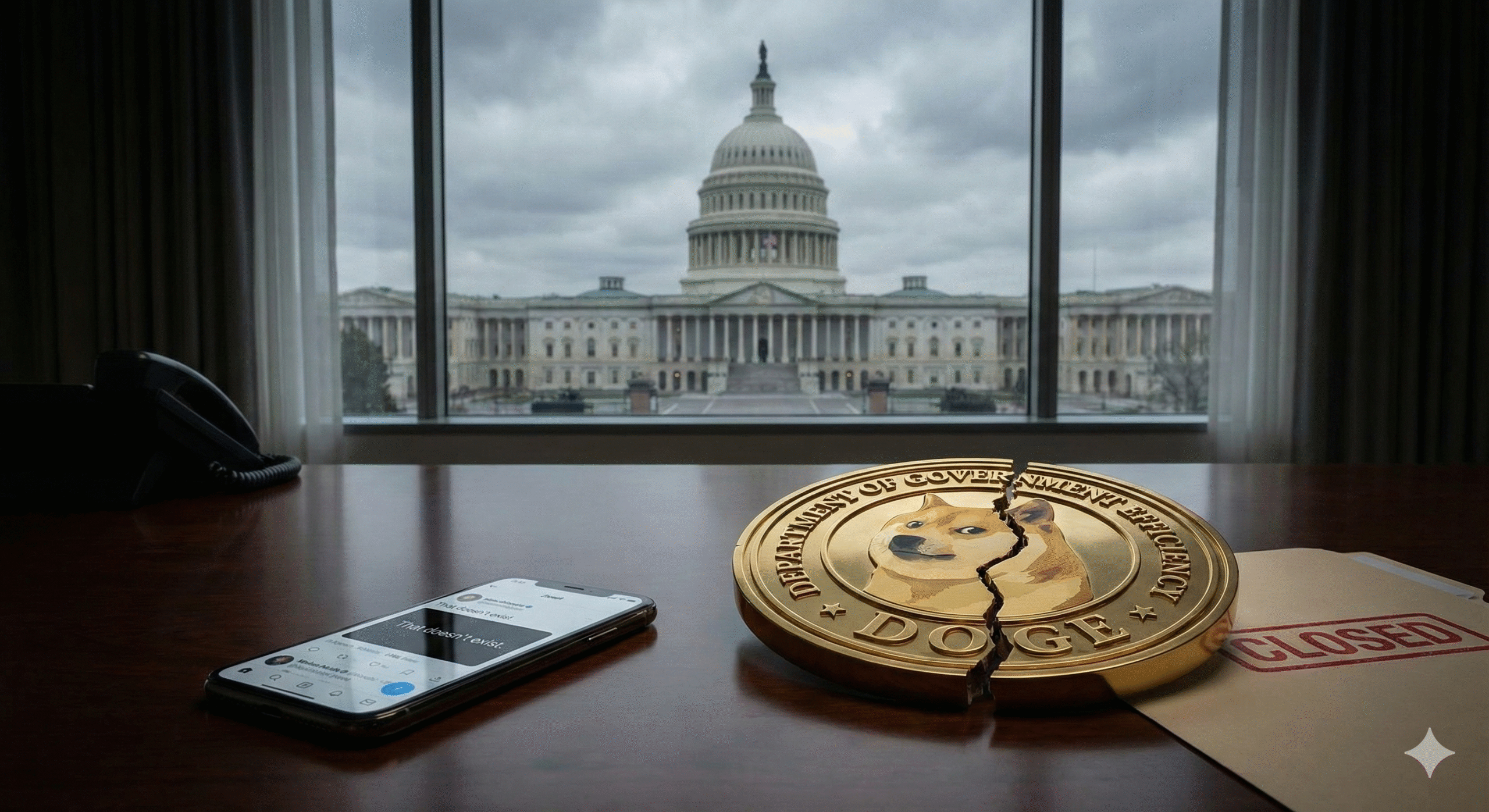
DOGE is dead. Following a statement from OPM Director Scott Kupor that the agency “doesn’t exist”, we analyse how Musk’s “chainsaw” approach failed to survive Washington.
If T.S. Eliot were covering the Trump administration, he might note that the Department of Government Efficiency (DOGE) ended not with a bang, but with a bureaucrat from the Office of Personnel Management (OPM) politely telling a reporter, “That doesn’t exist.”
Today, November 24, 2025, marks the official, unceremonious end of the most explosive experiment in modern governance. Eight months ahead of its July 2026 deadline, the agency that promised to “delete the mountain” of federal bureaucracy has been quietly dissolved. OPM Director Scott Kupor confirmed the news this morning, stating the department is no longer a “centralised entity.”
It is a fittingly chaotic funeral for a project that was never built to last. DOGE wasn’t an agency; it was a shock therapy stunt that mistook startup velocity for sovereign governance. And as of today, the “Deep State” didn’t just survive the disruption—it absorbed it.
The Chainsaw vs. The Scalpel
In January 2025, Elon Musk stood on a stage brandishing a literal chainsaw, promising to slice through the red tape of Washington. It was great television. It was terrible management.
The fundamental flaw of DOGE was the belief that the U.S. government operates like a bloatware-ridden tech company. Musk and his co-commissioner Vivek Ramaswamy applied the “move fast and break things” philosophy to federal statutes that require public comment periods and congressional oversight.
For a few months, it looked like it was working. The unverified claims of “billions saved” circulated on X (formerly Twitter) daily. But you cannot “bug fix” a federal budget. When the “chainsaw” met the rigid wall of administrative law, the blade didn’t cut—it shattered. The fact that the agency is being absorbed by the OPM—the very heart of the federal HR bureaucracy—is the ultimate irony. The disruptors have been filed away, likely in triplicate.
The Musk Exodus: A Zombie Agency Since May
Let’s be honest: DOGE didn’t die today. It died in May 2025.
The moment Elon Musk boarded his jet back to Texas following the public meltdown over President Trump’s budget bill, the soul of the project evaporated. The reported Trump-Musk feud over the “Big, Beautiful Bill”—which Musk criticized as a debt bomb—severed the agency’s political lifeline.
For the last six months, DOGE has been a “zombie agency,” staffed by true believers with no captain. While the headlines today focus on the official disbanding, the reality is that Washington’s immune system rejected the organ transplant half a year ago. The remaining staff, once heralded as revolutionaries, are now quietly updating their LinkedIns or engaging in the most bureaucratic act of all: transferring to other departments.
The Human Cost of “Efficiency”
While we analyze the political theatre, we cannot ignore the wreckage left in the wake of this experiment. Reports indicate over 200,000 federal workers have been displaced, either through the aggressive layoffs of early 2025 or the “voluntary” buyouts that followed.
These weren’t just “wasteful” line items; they were safety inspectors, grant administrators, and veteran civil servants. The federal workforce cuts impact will be felt for years, not in money saved, but in phones that go unanswered at the VA and permits that sit in limbo at the EPA.
Conclusion: The System Always Wins
The absorption of DOGE functions into the OPM and the transfer of high-profile staff like Joe Gebbia to the new “National Design Studio” proves a timeless Washington truth: The bureaucracy is fluid. You can punch it, scream at it, and even slash it with a chainsaw, but it eventually reforms around the fist.
Musk’s agency is gone. The Department of Government Efficiency news cycle is over. But the regulations, the statutes, and the OPM remain. In the battle between Silicon Valley accelerationism and D.C. incrementalism, the tortoise just beat the hare. Again.
Frequently Asked Questions (FAQ)
Why was DOGE disbanded ahead of schedule?
Officially, the administration claims the work is done and functions are being “institutionalized” into the OPM. However, analysts point to the departure of Elon Musk in May 2025 and rising political friction over the aggressive nature of the cuts as the primary drivers for the early closure.
Did DOGE actually save money?
It is disputed. While the agency claimed to identify hundreds of billions in savings, OPM Director Scott Kupor and other officials have admitted that “detailed public accounting” was never fully verified. The long-term costs of severance packages and rehiring contractors may offset initial savings.
What happens to DOGE employees now?
Many have been let go. However, select high-level staff have been reassigned. For example, Joe Gebbia has reportedly moved to the “National Design Studio,” and others have taken roles at the Department of Health and Human Services (HHS).
Discover more from Startups Pro,Inc
Subscribe to get the latest posts sent to your email.

PM Invites US-Based Pakistani Business Community to Invest in Pakistan as Investment Opportunities Expand

Trump Accounts Reshuffle Tens of Millions in Big Tech & AI Holdings

NIC Islamabad Launches Exclusive Acceleration Program with Up to PKR 5 Million Equity-Free Grant Support

World School Summit 2026 Malaysia: 41st Edition

Global Digital Trade Expo 2026: Dates, Schedule, Venue, Registration and Everything You Need to Know

How to Claim Your Sony PlayStation Store Credit Settlement (Up to $33.66)

CES 2027 Las Vegas: Registration Details, Dates and Venue [Ultimate Guide]

IPhone 18 Pro Specifications, Pricing, and Thermal Architecture Leaks Analyzed

Pre-IPO Investing Strategies: How Institutional Money is Approaching Anthropic

Smash Bros Ultimate 13.0.5 Patch Notes: What Actually Changed
NIC Islamabad Launches Exclusive Acceleration Program with Up to PKR 5 Million Equity-Free Grant Support
World School Summit 2026 Malaysia: 41st Edition
Trump Accounts Reshuffle Tens of Millions in Big Tech & AI Holdings
PM Invites US-Based Pakistani Business Community to Invest in Pakistan as Investment Opportunities Expand
-
Digital5 years ago
Social Media and polarization of society
-
Digital6 years ago
Pakistan Moves Closer to Train One Million Youth with Digital Skills
-
Digital5 years ago
Karachi-based digital bookkeeping startup, CreditBook raises $1.5 million in seed funding
-
Kashmir6 years ago
Pakistan Mission Islamabad Celebrates “KASHMIRI SOLIDARITY DAY “
-
Digital6 years ago
WHATSAPP Privacy Concerns Affecting Public Data -MOIT&T Pakistan
-
News6 years ago
Dr . Arif Alvi visits the National Museum of Pakistan, Karachi
-
China5 years ago
TIKTOK’s global growth and expansion : a bubble or reality ?
-
Business5 years ago
Are You Ready to Start Your Own Business? 7 Tips and Decision-Making Tools