
News
Hongqi Bridge Collapse: An Engineering Analysis of China’s Infrastructure Safety Failure

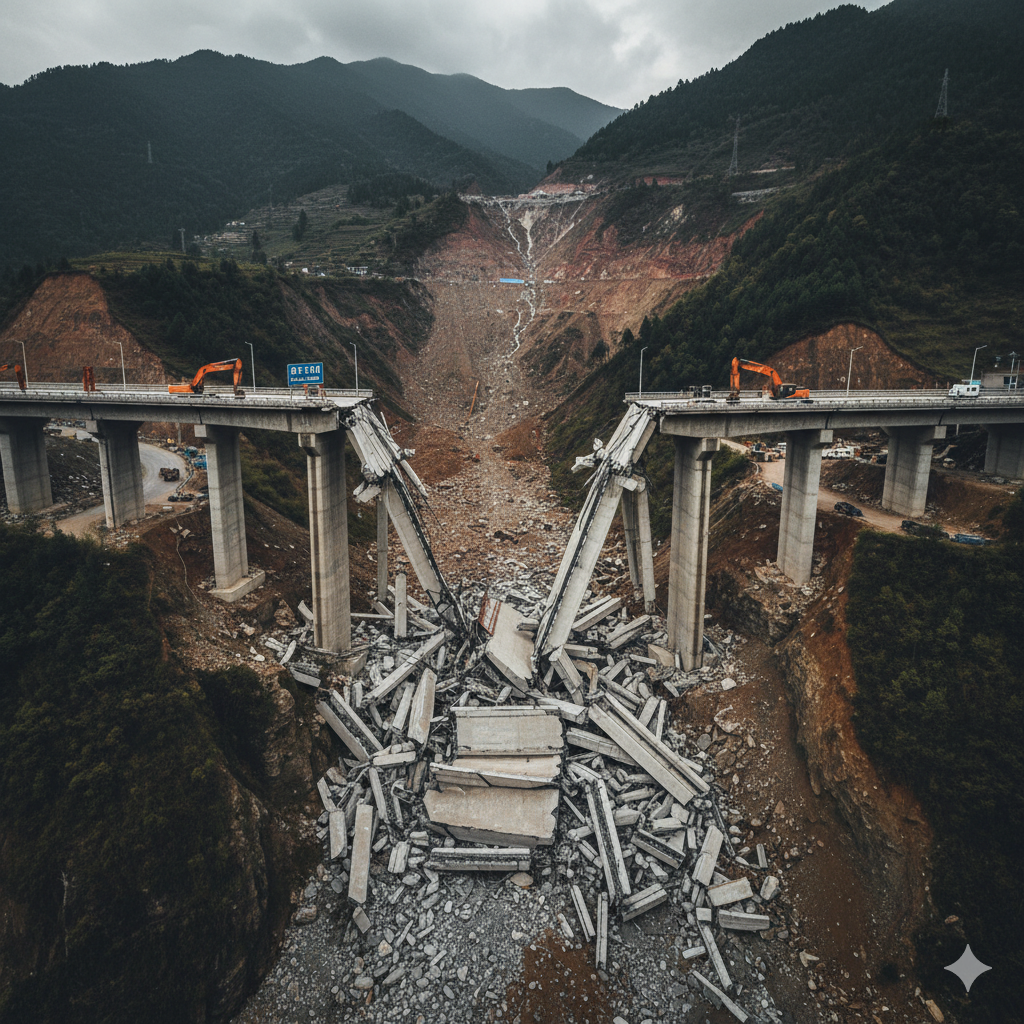
The recent news of the Hongqi Bridge collapse in China’s mountainous Sichuan province has sent a shockwave through the global engineering community. This was not a slow decay of an ancient overpass, but a sudden, dramatic failure of a recently completed, 758-meter cantilevered beam structure, designed as a key link on the G317 national highway. While thankfully traffic control measures ensured no casualties, the event has amplified the ongoing global debate about infrastructure longevity, the pressures of rapid development, and the critical role of geological stability. The incident involving the hongqi bridge serves as a stark, immediate case study: when the foundational principles of civil engineering are compromised, the consequences are swift and devastating. Early analysis suggests that the causes of the hongqi bridge collapse are intertwined between local geological volatility and potentially flawed foundational engineering protocols.
The Anatomy of the Hongqi Bridge Collapse: Technical Cracks
Initial reports confirmed that the primary trigger for the catastrophic failure of the Hongqi Bridge was a massive landslide caused by underlying geological instability in the steep mountain region. Authorities had wisely closed the bridge after detecting cracks and terrain shifts on adjacent slopes, a critical action that saved lives. However, to label this simply as a “natural disaster” is to overlook potential systemic weaknesses. The fact that a newly inaugurated, seemingly robust structure was so quickly rendered defunct raises deeper engineering and site assessment questions regarding the specific failure mechanism.
The Hongqi Bridge, with towering piers, was a complex structure built in a highly active geological environment. For any major infrastructure project in such a setting, geotechnical specialists confirm that the foundation and abutment design must account for significant, predictable geological movement. The approach section, which succumbed to the landslide, is where the engineered structure transitions to the natural earth.
The speed of the china bridge collapse indicates that if the initial soil analysis was inadequate, or if the construction methods failed to properly stabilize the mountainside surrounding the abutments, the bridge was built with a critical flaw. The historical pressure to complete large-scale projects quickly, a pervasive challenge in high-growth nations, can sometimes lead to shortcuts in critical, time-consuming steps like comprehensive geological surveys. This is a recurring vulnerability in the broader trend of chinese bridge collapses. The physical bridge collapse china, while triggered by an external force, highlights a crucial engineering lapse: the bridge’s structural integrity was not resilient enough to the environment it was explicitly designed to span.
Regulatory Oversight and Systemic Inspection Gaps
The tragedy spotlights a persistent challenge in infrastructure development: maintaining regulatory diligence during periods of rapid construction. While the timely closure of the hongqi bridge collapses site suggests an effective on-the-ground detection protocol, a deeper question persists for engineers and regulators: why were the underlying conditions not fully mitigated before construction completion?
Systemic issues in the regulatory environment can be traced to several points. There may be insufficient governmental oversight of the engineering design review process, allowing inadequate site assessment and foundation plans to bypass necessary checks. Furthermore, construction and inspection phases may be compromised by pressures to meet aggressive timelines and control costs, potentially overriding technical recommendations. The failure mechanism observed—landslide leading to foundation/approach failure—is a clear indicator of insufficient slope stabilization or poor anchoring of the abutments into the bedrock. This is a matter of compliance with global best practices, such as those detailed in Eurocode standards, rather than an unsolvable design problem. The history of chinese bridge collapses is unfortunately populated with examples where maintenance neglect (for older bridges) or geological instability (for newer mountain-region bridges) are the core culprits. The specific technical investigation into the hongqi bridge collapse is expected to scrutinize detailed structural integrity reports and regulatory sign-offs.
Global Implications and the Future of Proactive Prevention
The sudden failure of the hongqi bridge collapses is not merely a regional setback; it is a vital global warning. Nations worldwide, struggling with aging or rapidly expanded infrastructure built under varying standards, must heed the technical lessons from this china bridge collapse.
- Prioritize Geotechnical Rigor: Especially in steep or tectonically active regions, geotechnical risk assessment must be given equal weight to structural design. Investment in deep piling, soil anchors, and slope protection systems is non-negotiable for long-term safety.
- Embrace Advanced Monitoring: The future of infrastructure safety lies in continuous, remote monitoring. Modern bridges must be equipped with sensor networks (inclinometers, strain gauges, and piezometers) that use AI and machine learning to detect micro-movements and terrain shifts in real time. Had such advanced systems been operational, the warning of geological instability might have been predictive, allowing for preemptive mitigation rather than reactive evacuation.
- Ensure Independent Accountability: Inspection and certification protocols must be standardized, rigorous, and completely independent of the construction or local administrative bodies. The short service life of the hongqi bridge underscores that a final project sign-off is only the beginning of a lifetime commitment to public safety.
The dramatic images serve as a powerful reminder that our connection to the world—through critical infrastructure—relies on the meticulous and uncompromising execution of engineering science. Moving forward, the only sustainable path is to prioritize proactive management over reactive disaster response.
❓ Frequently Asked Questions (FAQ) on Bridge Collapses
Q: Was the Hongqi Bridge collapse caused by an earthquake? A: No. Preliminary reports indicate the collapse was triggered by a massive landslide and ground shifting due to geological instability, not seismic activity. However, the mountainous region is prone to such events, which should be factored into the bridge’s design.
Q: What is the most common cause of bridge collapses globally? A: Hydraulics (scour, or the erosion of bridge foundations by flowing water) is the single most common cause of bridge failure globally, followed by overload, impact, and material/structural flaws. The hongqi bridge collapse falls into the category of foundation failure driven by external geological forces.
Q: How can future bridge collapses in China be prevented? A: Prevention requires a dual approach: stricter adherence to international engineering standards (like those related to foundation stability and material quality) and the mandatory implementation of modern Structural Health Monitoring (SHM) systems for continuous, real-time assessment of structural integrity.
Discover more from Startups Pro,Inc
Subscribe to get the latest posts sent to your email.



As we stand on the cusp of 2026, the global media landscape is not merely evolving; it is undergoing a seismic restructuring. The tectonic plates of technology, geopolitical tensions, and shifting consumer trust are grinding against one another, forging a new, often precarious, reality for creators and conglomerates alike. We are witnessing a profound dislocation from the advertising-led, scale-at-all-costs model that defined the last decade. In its place, a more discerning, fragmented, and value-driven ecosystem is emerging—one where the very definitions of content, creator, and audience are being rewritten in real time.
The data paints a picture of staggering scale and simultaneous disruption. The global entertainment and media industry is on a trajectory to surpass $3 trillion, with advertising revenues alone projected to cross the monumental $1 trillion threshold in 2026. Yet, this growth is not evenly distributed. It’s a story of consolidation and crisis. While streaming giants battle for live sports rights and crack down on password sharing to sustain growth, traditional news publishers face an existential threat as AI-powered “answer engines” are predicted to erode up to 43% of their search traffic.
This challenging environment, however, is precisely where the most durable opportunities for media entrepreneurship in 2026 are being forged. The winners will not be those who simply produce more content, but those who solve the market’s most urgent new problems: the collapse of trust, the demand for verifiable authenticity, the need for intelligent curation in an age of algorithmic noise, and the monetization of deep, niche fandoms. What follows are not just ideas, but strategic responses to these fundamental market shifts—blueprints for the future of media startups.
1. The “Proof-of-Reality” Verification-as-a-Service (VaaS) Platform
The Problem: The proliferation of generative AI has triggered a full-blown synthetic content crisis. As deepfakes become indistinguishable from reality, a profound “trust deficit” is undermining journalism, corporate communications, and user-generated content. Audiences and organizations alike are desperate for a reliable authenticity layer.
Why 2026 is the Inflection Year: By 2026, the novelty of generative AI will have given way to widespread societal and regulatory alarm. Experts from the Reuters Institute predict an overwhelming need for verification tools to confirm the provenance of visual content. This creates a powerful market demand for a trusted, third-party arbiter of reality.
The Revenue Model: A B2B SaaS model targeting news organizations, legal firms, insurance companies, and corporate marketing departments. Tiers could be based on volume of verifications. A secondary B2C subscription could offer individuals a browser plug-in to flag synthetic content in their feeds.
Tech Enablers: Integration with the Coalition for Content Provenance and Authenticity (C2PA) open standard, which provides cryptographic proof of an asset’s origin. The platform would build a user-friendly interface on top of this, combining it with proprietary machine learning models trained to detect the subtle artifacts of AI generation. Blockchain technology can be used to create an immutable ledger of verified content.
Risk & Mitigation: The primary risk is the “arms race” against increasingly sophisticated AI generation models. Mitigation involves creating a research-focused arm of the company dedicated to constantly updating detection algorithms and collaborating with academic institutions and bodies like SAG-AFTRA, which are actively engaged in future-proofing against AI disruption.
2. AI-Powered Niche Streaming Bundles for the “Great Unbundling”
The Problem: Consumers are drowning in a sea of streaming services. Subscription fatigue is rampant, and the one-size-fits-all libraries of giants like Netflix and Disney+ often fail to satisfy the deep passions of niche audiences. The market is crying out for intelligent re-bundling.
Why 2026 is the Inflection Year: As major streamers consolidate and focus on broad-appeal content like live sports to justify rising costs, they leave valuable, high-engagement niches underserved. Deloitte’s 2026 outlook highlights that media success is now defined by “quality engagement” and “fandom,” not just production budgets, creating a gap for startups that can super-serve specific communities.
The Revenue Model: A subscription-based aggregator. Users subscribe to a “bundle” of niche streaming services (e.g., The Criterion Channel, Shudder, CuriosityStream, Mubi) for a single, discounted monthly fee. The startup takes a percentage of each subscription, providing a new acquisition channel for the niche streamers.
Tech Enablers: A sophisticated AI recommendation engine that learns a user’s specific tastes (e.g., “1970s Italian Giallo horror” or “documentaries on sustainable architecture”) and builds personalized viewing lists that pull from across the bundled services, creating a unified and curated discovery experience.
Risk & Mitigation: The primary risk is convincing niche streamers to join the bundle rather than competing independently. This is mitigated by offering a powerful value proposition: access to a broader audience, reduced churn through the bundle’s stickiness, and sophisticated cross-platform analytics that they could not afford on their own.
3. The Creator-Led B2B Education Platform
The Problem: Professional education is often sterile, outdated, and disconnected from the real-world pace of industries like marketing, finance, and software development. Meanwhile, top-tier industry practitioners are building massive audiences on social media but lack a premium, scalable platform to monetize their expertise beyond brand deals.
Why 2026 is the Inflection Year: The creator economy is maturing beyond a “vibe” and into a serious business. By 2026, many top creators will be looking for sustainable, high-margin revenue streams beyond advertising. As predicted in a Business of Fashion report, content creation is now a default career launchpad, and brands and followers are looking for deeper value.
The Revenue Model: A subscription platform where companies pay for team access to libraries of video courses taught by vetted, industry-leading creators. Revenue is shared with the creators, providing them with a recurring income stream that leverages their intellectual property.
Tech Enablers: An interactive learning platform with features like AI-driven quizzes, peer-to-peer feedback, and direct Q&A sessions with the creator-instructors. The platform would also handle all payment processing, content hosting, and enterprise-level administrative tools.
Risk & Mitigation: The main challenge is quality control and ensuring the educational content is rigorous and not just influencer fluff. This is mitigated by establishing a strict vetting process for creators, peer-review systems for courses, and partnerships with professional certification bodies to offer accredited qualifications.
4. Interactive Connected TV (CTV) Storytelling Studios
The Problem: Most television content, even on streaming platforms, remains a passive, one-way experience. While gaming offers deep interactivity, narrative film and television have yet to fully embrace audience agency.
Why 2026 is the Inflection Year: The technology for interactive, branching narratives on CTV is maturing. Simultaneously, as noted in a Deloitte report, audiences are seeking richer, more immersive experiences, leading to the rise of formats like “microdramas” on mobile. Bringing this interactivity to the high-production-value environment of the living room TV is the next logical step.
The Revenue Model: A studio model that develops and licenses interactive shows to major streaming platforms. Additional revenue streams include brand partnerships for in-narrative product placement (e.g., a character chooses a car, and a link to the automaker appears) and direct-to-consumer sales of “story packs” that unlock new narrative branches.
Tech Enablers: Real-time 3D rendering engines like Unreal Engine 5, combined with proprietary software for managing complex narrative trees and audience choices. AI can be used to dynamically adjust storylines based on collective audience data, creating a truly responsive entertainment experience.
Risk & Mitigation: High production costs are a significant barrier. This can be mitigated by starting with lower-stakes genres like romantic comedies or thrillers before scaling to large-scale sci-fi or fantasy. Partnering with a major streamer early on for a proof-of-concept series would also de-risk the initial investment.
5. “Dark Social” Community Management for Brands
The Problem: As public social feeds become saturated with AI-generated “slop” and algorithm-driven noise, the most valuable brand-consumer interactions are moving to private channels like Discord, WhatsApp, and Telegram—so-called “dark social.” Most brands lack the tools and expertise to effectively manage and monetize these high-trust communities.
Why 2026 is the Inflection Year: An Ogilvy trends report for 2026 identifies a massive migration to “dark social” as a response to AI flooding public feeds, noting that trust is moving to private channels. Brands that fail to follow their audience into these spaces will lose relevance.
The Revenue Model: A hybrid agency/SaaS model. The startup offers strategic consulting and community management services to help brands build and nurture their presence on private channels. It also provides a proprietary software dashboard that consolidates analytics, automates moderation, and facilitates exclusive e-commerce drops within these communities.
Tech Enablers: An analytics platform that can (with user consent) track engagement, sentiment, and conversion metrics within private group chats. AI-powered chatbots can handle routine customer service inquiries, freeing up human community managers to focus on high-value interactions.
Risk & Mitigation: The key risk is navigating the privacy-centric nature of these platforms without appearing intrusive. Mitigation requires a “community-first” approach, where the startup helps brands provide genuine value (exclusive content, early access, direct support) rather than just pushing marketing messages. Radical transparency about data usage is non-negotiable.
6. Hyper-Localized News & Events Platforms
The Problem: Traditional local news has been decimated, leaving a vacuum for community-specific information. At the same time, large social platforms are poor at surfacing relevant local events, discussions, and news, often burying them under a deluge of national content.
Why 2026 is the Inflection Year: Forrester predicts a significant portion of consumers will actively choose offline and local experiences over purely digital ones in 2026, seeking richer, more sensory interactions. This creates a demand for a media service that bridges the digital and physical worlds at a neighborhood level.
The Revenue Model: A “freemium” subscription model. A free version offers a basic digest of local news and events. A premium subscription unlocks features like a detailed community calendar, exclusive deals from local businesses, and participation in neighborhood forums. Additional revenue comes from local businesses paying to be featured.
Tech Enablers: A platform that aggregates data from local government sites, community groups, and local creators, using AI to curate a personalized feed for each user based on their specific neighborhood and interests. Geofencing technology can push alerts for nearby events or news.
Risk & Mitigation: Scaling is the major challenge, as the model requires deep penetration in one market before expanding to the next. This is mitigated by focusing intensely on a single city or even a single large neighborhood to perfect the playbook, building a loyal user base and strong network effects before attempting to replicate the model elsewhere.
7. AI-Augmented Audio & “Vodcast” Production Suite
The Problem: Producing a high-quality podcast or video podcast (“vodcast”) is still technically demanding and time-consuming. Editing, mixing, transcription, and creating social media clips require multiple tools and significant manual effort, creating a barrier for many would-be creators.
Why 2026 is the Inflection Year: Podcasting is rapidly shifting to video. By 2026, Deloitte predicts that video-enabled podcasts will be prevalent, with global ad revenues for the format reaching approximately $5 billion. This shift increases production complexity, creating a need for more efficient tools.
The Revenue Model: A tiered SaaS subscription. A basic tier offers AI-powered audio enhancement and transcription. Higher tiers add features like multi-camera video editing, automated generation of social media clips (e.g., “Find the 5 most powerful quotes and turn them into TikToks”), and AI-driven content repurposing (e.g., turning an episode into a blog post and newsletter).
Tech Enablers: An all-in-one, browser-based platform powered by generative AI. The tool would use AI to automatically remove filler words, balance audio levels, switch between camera angles based on who is speaking, and identify the most shareable moments to be clipped for promotion.
Risk & Mitigation: Competition from established software players (Adobe, Descript) is the main risk. The startup can mitigate this by focusing on an extremely intuitive, user-friendly interface designed for creators, not professional video editors, and by offering more generous free tiers to build a large user base quickly.
8. The Ethical Creator-Brand Partnership Marketplace
The Problem: The influencer marketing space is inefficient and opaque. Brands struggle to find authentic creators who align with their values, while creators are often underpaid or pushed into inauthentic partnerships. The process is manual, relationship-based, and lacks transparent ROI metrics.
Why 2026 is the Inflection Year: The creator economy is professionalizing. As noted in a report by Ogilvy, vanity metrics are dead, and ROI is the new KPI, with top campaigns delivering an average of $5.78 in revenue for every dollar spent. This demands a more data-driven approach to partnerships. The shift is from brand deals to true co-creation and equity partnerships.
The Revenue Model: A marketplace model that takes a commission on deals facilitated through the platform. The platform would differentiate itself by using an “ethics-first” algorithm that matches brands and creators based on shared values, audience trust scores, and historical performance data, not just follower counts.
Tech Enablers: A data-rich platform that provides deep analytics on a creator’s audience demographics, engagement quality, and past campaign performance. AI could analyze a creator’s content library to generate a “brand safety and values alignment” score. Blockchain-based smart contracts could automate payments and ensure transparency.
Risk & Mitigation: Gaining the trust of both brands and creators to build initial marketplace liquidity is the key challenge. This can be mitigated by partnering with a respected creator-focused organization or talent agency (UTA’s Creators division, for example ) to onboard a critical mass of high-quality talent from the outset.
9. IP Incubation for the Creator Economy
The Problem: The most successful creators are evolving from being individuals into being media brands. However, very few have the expertise or capital to translate their digital fame into durable intellectual property (IP) like games, animated series, product lines, or live experiences.
Why 2026 is the Inflection Year: Having spent a decade building audiences, veteran creators are now asking, “What is my legacy?” They are shifting from content-for-content’s-sake to building businesses and lasting impact. This creates a demand for partners who can help them build enterprise value around their personal brands.
The Revenue Model: A hybrid venture studio and strategic advisory firm. The startup would identify top creators with strong IP potential and co-invest with them to develop new ventures. Revenue comes from a combination of advisory fees and, more significantly, equity stakes in the new businesses created.
Tech Enablers: While primarily a human-capital business, technology plays a role in identifying potential creator partners through analytics platforms that track audience loyalty, merchandise sales, and other indicators of strong brand affinity.
Risk & Mitigation: The risk is that of any venture capital investment—some bets will fail. This is mitigated by developing a rigorous selection process and a diversified portfolio of creator partnerships across different verticals (e.g., gaming, beauty, education, food) to spread the risk.
10. The On-Demand Geopolitical & Economic Intelligence Briefing Service
The Problem: In an era of increasing global volatility, executives, investors, and strategists need concise, forward-looking intelligence on how geopolitical shifts and economic trends will impact their industries. Traditional analysis from sources like The Economist or the Financial Times is exceptional but not always tailored to a specific company’s or sector’s needs.
Why 2026 is the Inflection Year: The convergence of deglobalization, trade wars, climate-related disruptions, and technological competition between nations (especially the US and China) has made high-quality geopolitical risk analysis an essential, not an optional, business tool. This demand for bespoke intelligence will only intensify.
The Revenue Model: A high-ticket subscription service. Corporate clients pay a significant annual fee for access to a team of analysts, a library of on-demand video briefings, and the ability to commission custom reports on topics relevant to their business (e.g., “How will the 2026 semiconductor export controls affect the automotive supply chain in Europe?”).
Tech Enablers: An AI-powered platform that constantly scans thousands of global news sources, government reports, and financial filings to identify emerging risks and opportunities. This “first-pass” analysis is then elevated by a team of human experts (former diplomats, economists, and journalists) who provide the crucial layer of nuance and forward-looking insight that AI alone cannot.
Risk & Mitigation: Establishing credibility is the paramount challenge. This is mitigated by hiring a small, elite team of highly respected analysts with impeccable credentials from the outset. Producing a series of high-impact, publicly available reports in the first year can serve as a powerful marketing tool to demonstrate the quality of the analysis and attract the first cohort of paying clients.
Discover more from Startups Pro,Inc
Subscribe to get the latest posts sent to your email.
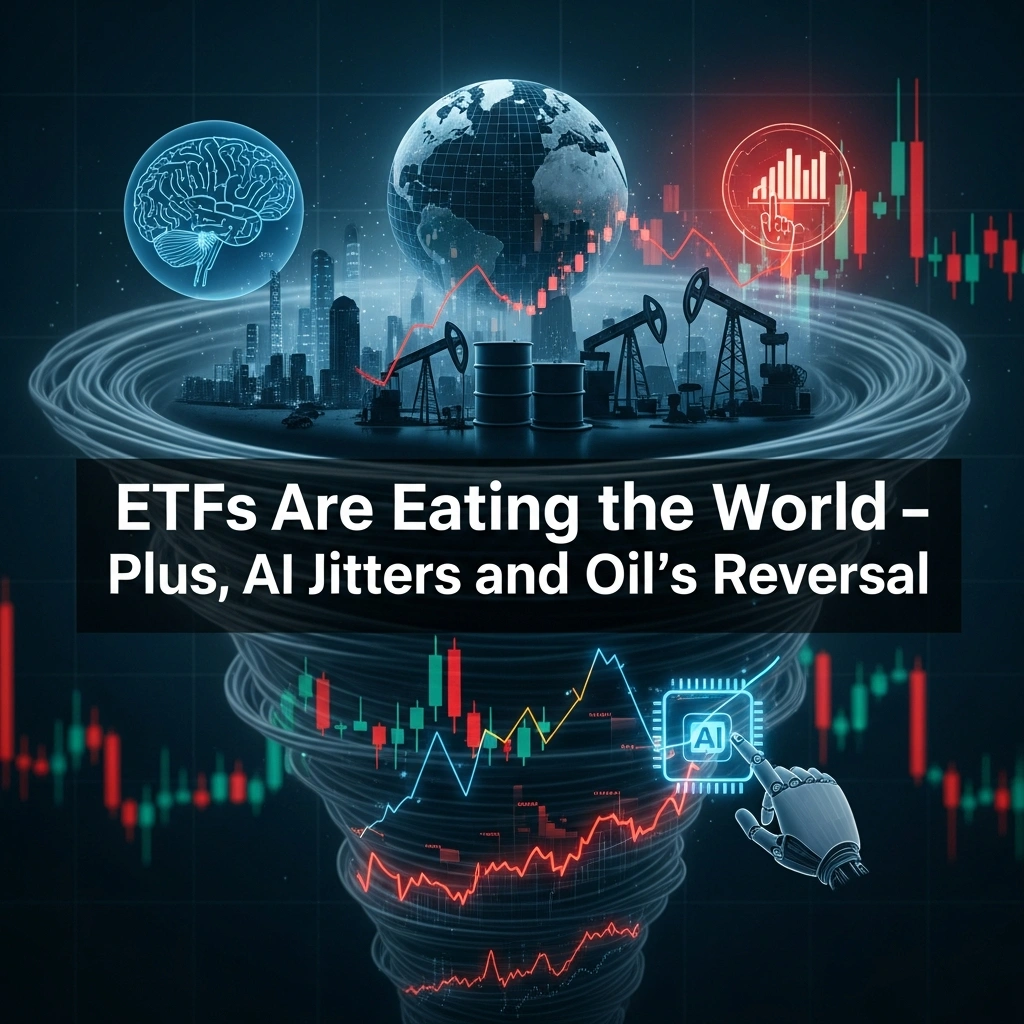
ETFs are reshaping markets as AI hype drives volatility and oil reversals hit energy. A political‑economy view of risk, power, and flows.
ETFs are “eating the world” because low‑cost indexing has pulled vast amounts of capital into a small set of benchmarks, concentrating ownership and flows. AI‑fueled swings intensify crowding in tech, while oil’s reversal exposes how passive portfolios can lag real‑economy shifts and geopolitics.
Key Takeaways
- ETFs made investing cheaper and easier—but they also concentrate flows, power, and price discovery in a handful of indexes and providers.
- AI‑driven enthusiasm creates crowding risk inside passive vehicles, amplifying both rallies and selloffs.
- Oil’s reversal shows the blind spot of broad indexing: real‑economy shocks can move faster than passive portfolios.
- Regulators see the plumbing risks, but policy still lags the market reality.
- Investors need to understand the political economy of indexing, not just its fees.
The Hook: A Market Built for Speed, Not Reflection
Picture a day when the market opens with a jolt: an AI‑themed mega‑cap sells off on a single earnings comment, energy stocks surge on an OPEC headline, and most retail portfolios barely blink—because the flows are pre‑programmed. That’s the new normal. ETFs have turned markets into a high‑speed logistics network where money moves with incredible efficiency, but not always with great wisdom.
This is the core paradox: ETFs are eating the world, yet the world they’re eating is becoming more concentrated, more narrative‑driven, and more sensitive to macro shocks. The political economy angle matters here—because when capital becomes more passive, power becomes more centralized.
1) ETFs Are Eating the World—And It’s Not Just About Fees
ETFs won because they made investing easy: low costs, intraday liquidity, diversification in one click. The U.S. SEC’s ETF rulemaking in 2019 standardized and accelerated ETF growth by making it easier to launch and operate funds, effectively industrializing the format’s expansion (SEC Rule 6c‑11). Add zero‑commission trading and mobile brokerages, and the ETF wrapper became the market’s default delivery system.
But the bigger story is market structure. When indexing dominates, the market stops being a collection of independent price judgments and starts behaving like an ecosystem of shared pipes. The evidence is in decades of data on active manager underperformance: the persistence of indexing’s edge has been documented by S&P Dow Jones Indices’ SPIVA reports, which track active‑vs‑index outcomes across asset classes and regions (SPIVA Scorecards). As more capital goes passive, the marginal price setter becomes thinner.

The Power Shift You Don’t See in Your Brokerage App
Every ETF is a wrapper around an index. That means index providers and mega‑asset managers now sit at the center of capital allocation. Methodology choices—what gets included, what gets excluded, how often rebalanced—are no longer small technical details; they are de facto policy decisions. Index providers publish their methodologies and governance processes, but their influence has outgrown their public visibility (S&P Dow Jones Indices Methodology, MSCI Index Methodology Hub).
The political economy question is straightforward: who governs the gatekeepers? When a handful of index decisions can redirect billions overnight, “neutral” becomes a powerful political claim—one that deserves scrutiny.
2) Market Plumbing: When the Wrapper Becomes the Market
ETF liquidity is often secondary‑market liquidity—trading of ETF shares between investors. But the primary market (where new shares are created or redeemed via authorized participants) is what keeps the ETF aligned with its underlying holdings. This is sophisticated plumbing that works beautifully—until it doesn’t.
Regulators have flagged the risks of liquidity mismatch and stress dynamics in market‑based finance. The IMF’s Global Financial Stability Reports have repeatedly examined how investment funds can amplify shocks through redemptions and market depth constraints (IMF Global Financial Stability Report). The BIS Quarterly Review has also analyzed how ETFs can transmit stress across markets when liquidity in underlying assets dries up (BIS Quarterly Review).
This doesn’t mean ETFs are fragile by default. It means ETF stability is conditional—on underlying liquidity, dealer balance sheets, and the health of market‑making infrastructure. That’s a systemic issue, not an investor‑education footnote.
3) AI Jitters: Narrative Crowding Meets Passive Plumbing
AI is a genuine technological shift—but the market’s response has a familiar shape: concentration, hype cycles, and correlation spikes.
As AI narratives accelerate, money tends to flow into the same handful of mega‑cap names and thematic ETFs. That can create a feedback loop: flows drive prices, prices validate the narrative, and the narrative attracts more flows. Research institutions and regulators have emphasized how valuation sensitivity and concentrated exposures can heighten market vulnerability, especially when expectations outrun fundamentals (Federal Reserve Financial Stability Report).
The irony? Passive investing is supposed to diversify risk. But when the market’s capitalization itself is concentrated, indexing becomes a lever that amplifies concentration. Index providers track and publish concentration metrics, but the shift is structural: if the index is top‑heavy, the index fund is top‑heavy.
Morningstar’s fund flow research highlights how investor demand often clusters in the same categories at the same time—precisely the behavior that can exacerbate crowding in narrative‑driven sectors (Morningstar Fund Flows Research). In an AI‑fueled cycle, this means the same ETF wrapper that democratized access can also democratize risk.
4) Oil’s Reversal: The Old Economy Bites Back
While AI dominates headlines, oil reminds us that real‑world supply and geopolitics still run the table. When oil reverses—whether due to OPEC decisions, demand surprises, or geopolitical shocks—sector weights and macro assumptions change faster than broad passive portfolios can adapt.
The most credible real‑time oil data comes from institutions that track physical balances and policy developments. The International Energy Agency’s Oil Market Report, the U.S. EIA’s Short‑Term Energy Outlook, and OPEC’s Monthly Oil Market Report provide the market’s core macro narrative (IEA Oil Market Report, EIA Short‑Term Energy Outlook, OPEC MOMR).
Now connect that to ETFs: broad‑market indexes rebalance slowly, while sector ETFs can swing on a dime. If oil’s reversal signals a structural shift—say, prolonged supply constraints or a geopolitical premium—passive portfolios are late to the party by design. In the meantime, ESG‑tilted portfolios may under‑ or over‑expose investors to energy at precisely the wrong time, a tension widely discussed in responsible‑investment circles (UN‑supported PRI).
Oil’s reversal isn’t just a commodity story. It’s a governance and allocation story—about how passive capital interacts with geopolitics, energy policy, and the physical economy.
5) The Political Economy of Passive Power
ETFs feel apolitical because they’re built on formulas. But formulas are choices, and choices accumulate power. When a few providers and index committees control the rules, the market’s “neutrality” becomes a governance issue.
Concentration of Ownership and Voting
Large asset managers now represent substantial voting power across public companies—a fact regulators and policy analysts have debated extensively. The SEC’s resources on proxy voting and fund stewardship underscore the governance significance of fund voting policies (SEC Proxy Voting Spotlight). The OECD’s corporate governance work also highlights how ownership structures influence accountability and long‑term capital allocation (OECD Corporate Governance).
The result is a paradox: indexing reduces fees, but concentrates influence. That influence is often exercised behind closed doors via stewardship teams, policy statements, and index inclusion decisions.
Regulatory Lag
Central banks and financial authorities increasingly focus on market‑based finance and nonbank intermediation. Yet ETF‑specific regulation still looks incremental compared with the speed of market evolution. The IMF and BIS acknowledge these dynamics, but the policy response remains cautious—partly because ETFs have also delivered undeniable investor benefits (IMF GFSR, BIS Annual Economic Report).
In short: we have system‑level dependence on a structure whose governance remains diffuse.
6) What This Means for Investors, Policymakers, and Markets
For long‑term investors
- Know what you own: broad ETFs are only as diversified as the underlying index. If the index is top‑heavy, your portfolio is too.
- Understand liquidity layers: ETF trading liquidity can mask underlying asset illiquidity during stress.
- Treat thematic ETFs as tactical: AI‑focused ETFs can be useful, but they behave like crowded trades, not balanced portfolios.
For policymakers
- Index governance deserves visibility: transparency in methodology changes, inclusion criteria, and stewardship votes matters.
- Stress‑test the plumbing: market‑making capacity and authorized participant resilience should be policy priorities.
- Don’t confuse access with resilience: ETFs democratize investing, but democratization can also democratize systemic risk.
For institutions
- Scenario‑test the narrative: what if AI expectations compress sharply? What if oil flips the inflation story?
- Use active risk where it matters: passive core can coexist with active hedges or sector rotations.
- Engage stewardship intentionally: if you own the market, you own its outcomes.
7) Three Scenarios to Watch
- Crowding unwind: AI‑exposed indexes and ETFs face synchronized selling, revealing liquidity gaps.
- Oil regime shift: a sustained energy price reversal reshapes inflation expectations and sector leadership, forcing passive reweighting.
- Regulatory recalibration: a policy move on ETF transparency or index governance changes the economics of passive flows.
None of these scenarios are destiny—but all are plausible.
Conclusion: Convenience Won. Power Concentrated.
ETFs didn’t just win on price—they won on architecture. They are the pipes through which modern capital flows. But when the pipes grow large enough, they shape the city.
AI jitters and oil’s reversal are not separate stories. They are stress tests for a market that now relies on passive plumbing to allocate active realities. The promise of ETFs was democratization; the risk is centralization without accountability.
The real question isn’t whether ETFs are “good” or “bad.” It’s whether we’re willing to govern the system they’ve become. Because in a world where ETFs are eating the world, the rules of the dinner table matter more than the menu.
Discover more from Startups Pro,Inc
Subscribe to get the latest posts sent to your email.

Discover why FITUR 2026 in Madrid is essential for travel professionals. US, Mexico, India, China, and Spain showcase groundbreaking tourism innovations, sustainability initiatives, and networking opportunities. Expert insights and trends inside.
Picture this: Over 250,000 travel professionals flooding Madrid’s state-of-the-art IFEMA fairgrounds, deals being struck in bustling aisles, and the air buzzing with ideas that will shape billions in tourism revenue. This is FITUR 2026—the International Tourism Trade Fair—set to unfold from January 21 to 25, 2026. As the United States makes a strategic push alongside powerhouses Mexico (the official Partner Country), India, China, and host Spain, this edition promises to be the most dynamic since the pre-pandemic era.
You’ll discover emerging destinations, forge partnerships across continents, and gain firsthand insights into AI-driven travel experiences and regenerative tourism. According to the UN Tourism, international arrivals grew 5% in the first nine months of 2025, with projections pointing to full recovery and beyond in 2026. Missing FITUR means risking your edge in an industry expected to contribute record economic impact, as forecasted by the World Travel & Tourism Council (WTTC).
In the sections ahead, you’ll explore why these five nations are dominating the spotlight and how FITUR 2026 positions you at the forefront of global tourism evolution.
What Is FITUR? The World’s Leading Tourism Trade Fair
Featured Snippet Optimization – Definition Box:
FITUR (Feria Internacional de Turismo) is the world’s second-largest tourism trade fair, held annually in Madrid, Spain. The 2026 edition, from January 21-25 at IFEMA Madrid, expects over 255,000 professional visitors from more than 156 countries, making it essential for travel industry professionals seeking partnerships, market insights, and destination discoveries.
Since its inception in 1980, FITUR has grown into a global benchmark, blending B2B matchmaking with innovation showcases. Organized by IFEMA Madrid, it consistently drives billions in business deals. The 2025 edition welcomed representatives from 165 countries and generated significant media impact worldwide.
For 2026, a new Knowledge Pavilion in Hall 12 debuts, focusing on tourism intelligence, AI, and sustainability. Mexico’s role as Partner Country amplifies Latin America’s presence, while expanded tech zones grow 50% to accommodate cutting-edge exhibitors.
Economically, FITUR injects vitality into Spain’s tourism sector, which contributes over 12% to GDP according to Spain Tourism Board. The WTTC projects global Travel & Tourism to reach new heights in 2026, with international spending surpassing pre-pandemic peaks.
Did You Know?
FITUR’s B2B platform facilitates thousands of scheduled meetings annually, with success rates exceeding 70% for many participants.
The Powerhouse Lineup: 5 Countries Dominating FITUR 2026
Spain: The Host Nation’s Home Advantage
As host, Spain commands prime real estate across Halls 5, 7, and 9, showcasing regional diversity from Andalusia’s flamenco heritage to Catalonia’s modernist architecture and the Balearics’ pristine beaches.
Post-pandemic recovery has been robust: Spain welcomed record visitors in 2025, driven by sustainability initiatives like carbon-neutral destinations. Regions emphasize regenerative tourism—giving back to local communities while preserving natural assets.
Expect immersive pavilions with VR tours of UNESCO sites and forums on overtourism solutions. “Spain continues to lead in sustainable practices,” notes an executive from the Spain Tourism Board.

United States: America’s Strategic Comeback
The US returns with renewed vigor, highlighting growing ties with Spain. Representations include Visit USA Spain, Visit Florida, Explore Louisiana, and Visit Orlando, alongside major brands like Hilton and Marriott.
Brand USA campaigns target European markets, promoting adventure in national parks and urban experiences in New York and California. Visa policy easing and direct flights boost accessibility.
According to IFEMA announcements, the US pavilion underscores business opportunities, with Spain viewing America as a key inbound source. “The growing importance of the US market for Spain cannot be overstated,” states a recent IFEMA release.
Expert Tip: Prioritize meetings with US state delegations—they’re eager for European partnerships in bleisure and eco-adventures.
Mexico: Cultural Tourism at Its Finest
As Partner Country, Mexico steals the show with the largest pavilion from the Americas, featuring all 32 states and over 190 companies.
Josefina Rodríguez Zamora, Secretary of Tourism, declares: “Mexico will participate with all 32 states and more than 190 companies, showcasing our culture, traditions, and gastronomy in an immersive space.”
Highlights include UNESCO sites like Chichen Itza, Pueblos Mágicos, and emerging eco-destinations in Oaxaca and Tulum. Growth in the US-Mexico tourism corridor surges, fueled by adventure and cultural immersion.
Sustainability forums feature Mexico’s mangrove restoration projects.
India: The Rising Giant in Global Tourism
India receives special spotlight, strengthening cultural and economic links with Europe. The Incredible India pavilion promotes spiritual journeys to Varanasi, wellness retreats in Kerala, and new infrastructure like expanded airports.
Digital nomad programs and the Incredible India 2.0 campaign draw attention. An exclusive gala dinner honors India’s tourism pioneers.
“FITUR 2026 will showcase India’s great tourism potential and business opportunities with Europe,” emphasizes a joint statement from organizers.
Wellness tourism—yoga, Ayurveda—aligns perfectly with 2026 trends.
China: Innovation Meets Tradition
China occupies a prominent position, capitalizing on post-reopening momentum and aviation connectivity with Spain.
Pavilions blend ancient heritage (Great Wall VR experiences) with tech-forward offerings, including AI-personalized itineraries and Belt and Road initiatives.
Outbound trends shift toward quality experiences, while inbound promotion targets European visitors. “FITUR 2026 will consolidate deepening cooperation between China and Spain’s tourism industries,” notes industry coverage.
Tech integrations like AR cultural tours stand out.
Country Participation Comparison Table (Snippet Optimization):
| Country | Pavilion Size | Key Focus | Expected Highlights |
|---|---|---|---|
| Spain | Multiple halls (5,7,9) | Sustainability & Regions | 50,000+ regional reps |
| USA | Dedicated zone | Adventure & Urban | Major state & brand partnerships |
| Mexico | Largest in Americas | Culture & Eco-Tourism | 190+ companies, immersive experiences |
| India | Special spotlight | Wellness & Spiritual | Gala events, digital nomad promotion |
| China | Prominent halls | Tech Innovation & Heritage | AI/VR demos, B&R initiatives |
Why FITUR 2026 Is Unmissable: Key Highlights
Here are the top reasons to attend FITUR 2026:
- Network with exhibitors from 156+ countries in expanded halls
- Access B2B matchmaking with proven high success rates
- Explore the new Knowledge Pavilion for AI and innovation insights
- Join sustainability forums shaping regenerative tourism
- Discover travel tech in a 50% larger zone with 150+ exhibitors
- Attend specialized sections like FITUR Cruises and FITUR4all
- Gain investment intelligence from emerging markets
Over 200 educational sessions feature global experts.
Industry Trends Unveiled at FITUR 2026
Sustainability evolves into regenerative models. AI powers hyper-personalization, from itineraries to chatbots.
Wellness tourism surges, with retreats emphasizing holistic health. Bleisure blends work and leisure for digital nomads.
Post-pandemic shifts favor authentic, transformative experiences. “Wellness tourism will redefine self-care in 2026,” predict experts at recent summits.
How to Maximize Your FITUR 2026 Experience
To register and thrive:
- Visit ifema.es/fitur 60+ days early for professional accreditation
- Upload business credentials for approval
- Download the FITUR app for agendas and matchmaking
- Book meetings via the B2B platform
- Target must-attend sessions in the Knowledge Pavilion
- Network strategically—focus on country pavilions first
Use the app’s QR features for seamless entry.
Conclusion
FITUR 2026 isn’t merely an event—it’s where global tourism’s next chapter begins. With the US, Mexico, India, China, and Spain leading, you’ll leave equipped with partnerships, insights, and inspiration to navigate 2026’s record-breaking growth.
As the WTTC forecasts unprecedented spending, now is the time to act. Register today and position yourself at the heart of the industry.
FAQ Section
What are the dates for FITUR 2026?
January 21-25, 2026, at IFEMA Madrid.
Who is the Partner Country for FITUR 2026?
Mexico, with the largest pavilion from the Americas.
Why is US participation significant at FITUR 2026?
It boosts transatlantic business, featuring major states and brands targeting Europe.
What new features does FITUR 2026 introduce?
The Knowledge Pavilion for innovation and a 50% expanded travel tech zone.
How can I register for FITUR 2026?
Via ifema.es/fitur; professional accreditation required for full access.
What trends will dominate discussions?
AI integration, regenerative sustainability, and wellness tourism.
Is FITUR open to the public?
Professional days January 21-23; public access January 24-25.
Discover more from Startups Pro,Inc
Subscribe to get the latest posts sent to your email.

PM Invites US-Based Pakistani Business Community to Invest in Pakistan as Investment Opportunities Expand

Trump Accounts Reshuffle Tens of Millions in Big Tech & AI Holdings

NIC Islamabad Launches Exclusive Acceleration Program with Up to PKR 5 Million Equity-Free Grant Support

World School Summit 2026 Malaysia: 41st Edition

Global Digital Trade Expo 2026: Dates, Schedule, Venue, Registration and Everything You Need to Know

How to Claim Your Sony PlayStation Store Credit Settlement (Up to $33.66)

CES 2027 Las Vegas: Registration Details, Dates and Venue [Ultimate Guide]

IPhone 18 Pro Specifications, Pricing, and Thermal Architecture Leaks Analyzed

Pre-IPO Investing Strategies: How Institutional Money is Approaching Anthropic

Smash Bros Ultimate 13.0.5 Patch Notes: What Actually Changed
NIC Islamabad Launches Exclusive Acceleration Program with Up to PKR 5 Million Equity-Free Grant Support
World School Summit 2026 Malaysia: 41st Edition
Trump Accounts Reshuffle Tens of Millions in Big Tech & AI Holdings
PM Invites US-Based Pakistani Business Community to Invest in Pakistan as Investment Opportunities Expand
-
Digital5 years ago
Social Media and polarization of society
-
Digital6 years ago
Pakistan Moves Closer to Train One Million Youth with Digital Skills
-
Digital5 years ago
Karachi-based digital bookkeeping startup, CreditBook raises $1.5 million in seed funding
-
Kashmir6 years ago
Pakistan Mission Islamabad Celebrates “KASHMIRI SOLIDARITY DAY “
-
Digital6 years ago
WHATSAPP Privacy Concerns Affecting Public Data -MOIT&T Pakistan
-
News6 years ago
Dr . Arif Alvi visits the National Museum of Pakistan, Karachi
-
China5 years ago
TIKTOK’s global growth and expansion : a bubble or reality ?
-
Business5 years ago
Are You Ready to Start Your Own Business? 7 Tips and Decision-Making Tools